
Marvel Super Heroes is not a licensed set coasting on IP. The design team hid real engines inside the costumes: a one-mana five-color commander, a two-mana indestructible mana rock with an ETB trigger, an infinite-combat commander that costs one blue mana, and a colorless 3-drop that staples a tournament-proven artifact ability onto a legendary body. The IP is Marvel. The card design is serious.
Character popularity doesn't enter the evaluation here. Format impact does. The filter is simple: does a card enable a win, protect a win, or gather information toward a win? A card that goes in 600,000 decks outranks one that only fits a 40-card Merfolk tribe, regardless of whose face is on the art.
How We Ranked These Cards
The ranking covers all Commander formats, from bracket 1 kitchen tables to cEDH pods. Cards are sorted worst to best: #20 is the most speculative, #1 is the format staple you'll still be sleeving five years from now.
Three mechanics from this set require a quick frame before the analysis. Power-up is a per-creature activated ability that fires at a discount if you activate it the same turn that creature entered, reducing the activation cost by the creature's own mana value. Cast Bruce Banner // The Incredible Hulk on turn one, Power-up on turn one, costs less than waiting until turn two. The "once per creature instance" clause is the critical rule: blink or flicker a creature and that specific instance resets, giving you another activation. Teamwork is an optional additional cost on some instants and sorceries, tap creatures with total power X or more to upgrade the spell's effect, similar to how Crew works on Vehicles. Plan is a new enchantment subtype with a counter-accumulation engine: each trigger adds a plan counter and a small reward, and when you hit the threshold, the Plan sacrifices itself for a major effect. Doom Reigns Supreme and Construct a Cosmic Cube are the headliners.
Ranking criteria, in order: format-wide adoption ceiling (colorless cards and cards available to the most color identities rank above narrow tribal pieces), interaction quality, how much the card does that no cheaper alternative already handles, and whether the card changes what's possible in the format rather than just doing an existing effect slightly differently. Several ranked cards are legendary creatures doubling as potential commanders, and that duality matters: a card that works in the 99 and can lead a deck has a higher ceiling than one locked into a single role.
Heart-Shaped Herb
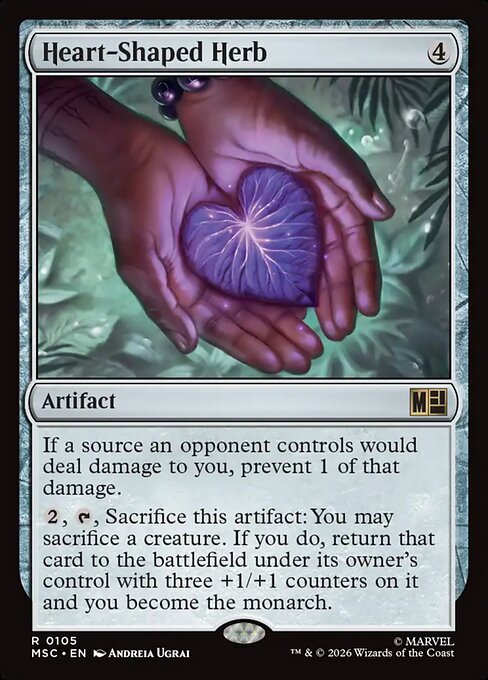
Zero registered Commander decks at time of writing. That's the lede, and it's worth sitting with for a second: this is the only card on this list with no adoption curve yet, which means either the community hasn't found it or it genuinely doesn't work. The text packs three distinct synergies onto one line, sacrifice a creature, return it with three +1/+1 counters, become the monarch. That's a reanimation effect, a counter injection, and a draw-engine trigger all in one, on a 4-mana colorless artifact. The passive damage prevention is almost irrelevant at most tables.
The shells where this fits: aristocrats that want ETB creatures cycling back with counters, monarch-matters decks that need a reliable way to grab the crown, and counters-synergy builds where three counters on entry triggers other payoffs. It competes with cheaper reanimation options, and the 4-mana body before you've even used the ability is the real ask. Watch it if Esika's God of the Tree or similar legendary-matters decks start picking it up. Speculative keep. Not a mull yet.
Jennifer Walters // The Sensational She-Hulk
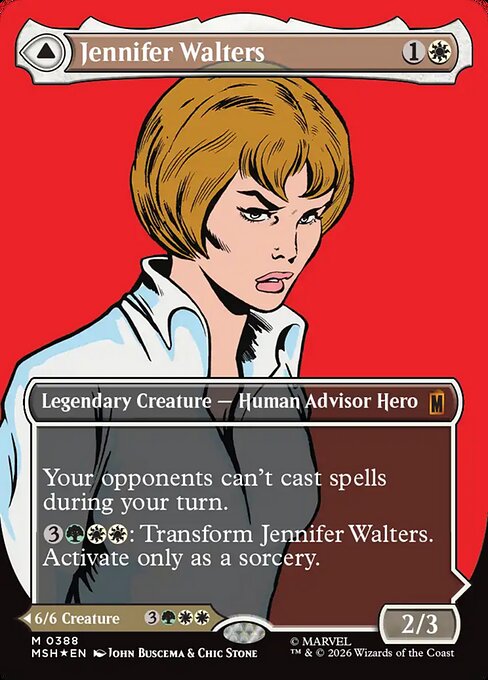
Think of Jennifer Walters as Grand Abolisher who went to law school and got a legendary supertype as part of the settlement. The text is functionally identical on the creature side: your opponents can't cast spells during your turn. The difference is the legendary clause, and that distinction matters more than the community is giving it credit for.
Sisay, Weatherlight Captain can tutor Walters directly onto the battlefield. Grand Abolisher can't say that. In a five-color legendary build, Sisay finding a turn-two spell lock is a line. That's not the floor of what she does, that's the ceiling you're building toward. The information cost is real, casting her on turn two tells every opponent their counterspell window closed on your turns, and they will prioritize her removal accordingly. But in a Sisay shell where the whole plan survives because opponents can't respond during your turn, that information trade is worth it.
The She-Hulk transform side is steep. A 6/6 reach trample with the same spell-lock plus a once-per-turn damage redirect is a serious threat, but in most games the creature side is doing enough work that you don't need it. Her adoption at 604 decks is undervalued, not overvalued. A legendary Grand Abolisher in a format with Sisay is not a bracket 3 curiosity. The line goes through her in more builds than the numbers suggest.
Baron Strucker, HYDRA Overlord
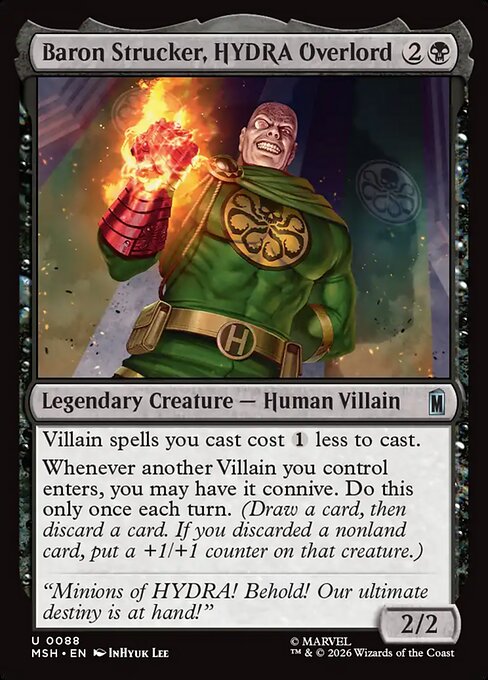
Villain spells cost one less. Each Villain that enters may connive, once each turn. Clean text, narrow context. In a dedicated Villain tribal shell with M.O.D.O.K. and Doctor Doom, King of Latveria cycling through the board, Strucker shaves a mana off everything you cast and turns every entry into a loot trigger. Outside that shell, he does nothing. This is correct in exactly one archetype and irrelevant in every other. Run him if you're building Villains. Don't if you're not.
Nick Fury, Agent of S.H.I.E.L.D.
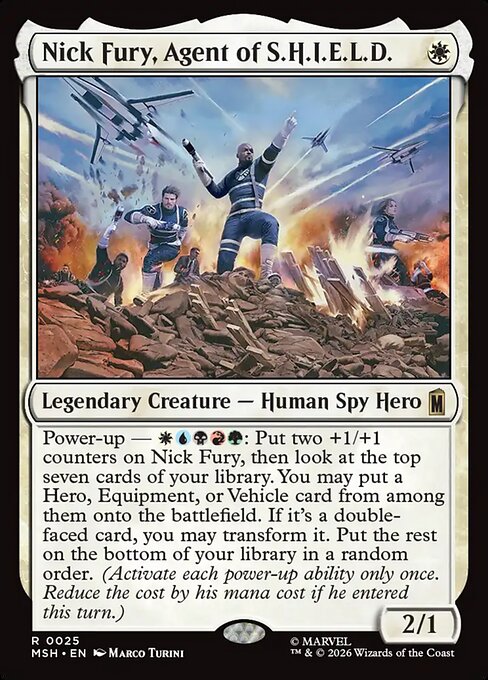
Turn one. You're on the play. You drop Nick Fury for W. The table looks over and does the math on whether a 2/1 for one white mana is a threat. It isn't. Then you activate the Power-up.
Nick Fury entered this turn, so the discount fires: the activation costs WUBRG minus his own mana cost. That means the net activation is UBRG in additional mana. On turn one in a five-color build with fast mana, you look at the top seven cards of your library and put a Hero, Equipment, or Vehicle directly onto the battlefield. No mana cost. If it's a double-faced card, you can transform it on entry. That's a one-mana commander that can deploy Silver Surfer, Cosmic Voyager, Tony Stark // The Invincible Iron Man, or King T'Challa // Black Panther, Hope Enduring on the same turn he enters.
The real line with Fury is Silver Surfer as the blink reset engine. Silver Surfer exiles your entire board and returns it at end of turn, which means every Power-up on every creature you control resets for another activation next turn. Fury gets another look at seven. Any other commanders with Power-ups on board activate again. That's a repeatable toolbox engine, not a one-shot effect.
Landing T'Challa on Fury's entry turn is strong, but the trigger on the Black Panther side watches for a player's second card drawn in a turn. The draw step only produces one card, so to get immediate value you need an opponent to draw a second card through something already on the battlefield.Rhystic Study, a cantrip, anything that forces additional draws, after T'Challa is already in play.
The constraint is real: five-color mana on turn one is infrastructure-dependent, and the activation window closes after Fury's entry trigger resolves. The table will read a five-color one-drop as a turbo signal and respond accordingly. Fury is the first legendary five-color one-drop in the format, and no commander before him has offered this kind of accelerated deployment at this cost. Whether the deck around him scales to your table depends entirely on how committed you are to assembling the mana.
Shuri, Wakandan Inventor
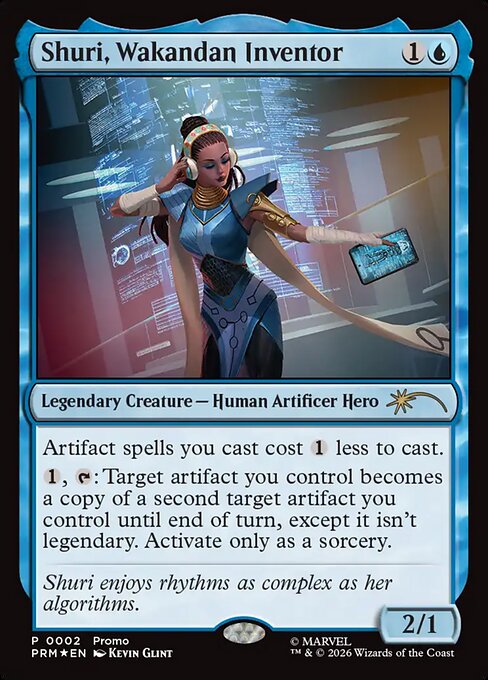
Artifact spells cost one less. That passive reduction applies the moment she enters and asks nothing further from you; in a blue artifact deck, she pays for herself in the first two spells you cast after she resolves. Her activated ability lets you copy one artifact into another for the turn, non-legendary, at sorcery speed. That's a second trigger from your best artifact, or a Blightsteel that can be blocked by something reasonable for once.
She's not a build-around. She's a 2-mana support piece for artifact decks that happen to be blue, competing with Urza and other established blue artifact commanders for that role. The ceiling in artifact-storm is real, but the sorcery-speed restriction caps it. Bring her in as a supporting piece, not a headliner.
King T'Challa // Black Panther, Hope Enduring
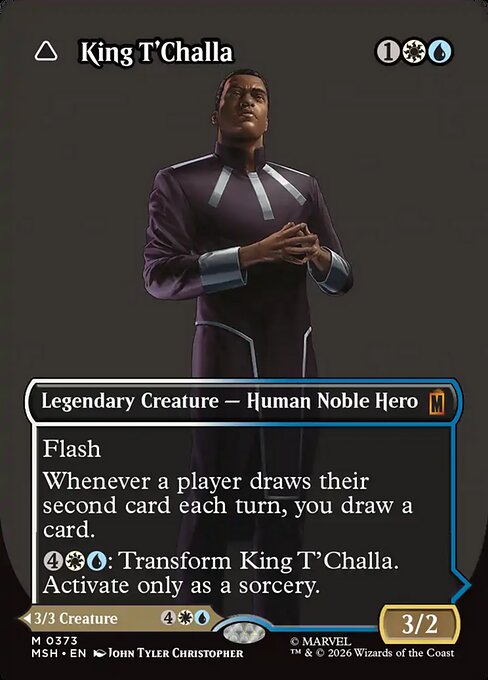
Turn three. You cast King T'Challa at instant speed during an opponent's turn. An opponent casts a cantrip after he's already on the battlefield, drawing their second card of the turn. You draw a card. Another opponent triggers a Rhystic Study, drawing their second card. You draw again. Before it's even your turn, you've drawn two cards off a 3-mana creature that nobody had to interact with because it came down at flash speed.
The trigger fires off every player's draws, not just yours. In a four-player game with even moderate cantrip usage, the card advantage compounds across each rotation. That's the information engine: you're seeing more cards than anyone, which means you're making better decisions than anyone. The flash on his front face lets you deploy him into draw triggers opponents are already committing to. The correct sequence: wait until someone's casting Rhystic Study, drop T'Challa in response, profit from every card they draw off it.
The Black Panther transform side costs 4WU as a sorcery and delivers double strike, damage prevention, and a draw trigger on hits. A Black Panther that can't be damaged swinging twice and drawing a card each time is a closing threat. The creature face is what gets you there; the front face is what justifies the inclusion in UW control or multicolor draw-heavy builds. The more your opponents draw, the better he scales, so slot him into the greediest tables you can find and let the triggers do the math.
Namor the Sub-Mariner
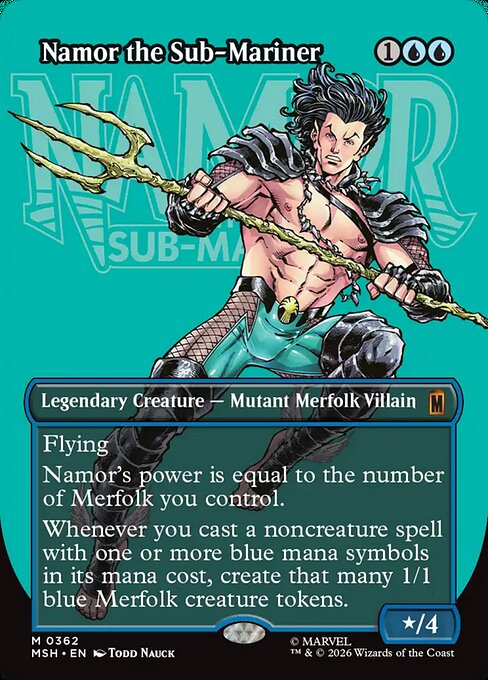
About Namor: the flavor description obscures what actually matters. He's not a Merfolk commander because he likes fish. He's a Merfolk commander because the most efficient blue spells in the format are loaded with blue mana symbols, and every pip creates a 1/1 Merfolk token.
Archmage's Charm costs UUU. That's three tokens on a single counterspell. Three. You countered a spell and created a 3/1 worth of board presence simultaneously. A Force of Will analog with two blue pips is two tokens. A Cyclonic Rift equivalent with one pip is one token. The entire blue interaction suite in the format becomes a token engine, and Namor's power equals the number of Merfolk you control, so the more you counter and cantrip, the bigger he gets and the harder he hits with flying.
The community is still mapping this ceiling, and the correct answer is "higher than anyone initially thought." Attuma, Atlantean Warlord pairs naturally in the 99: other Merfolk get +1/+1 and each attack from your Merfolk draws you a card. In a mono-blue shell running 25 or more spells with blue pips, you're generating a wide board and a scaling flying commander simultaneously. For players who want a token-combo angle, this is likely the best new mono-blue build from the set. The line here is resolve Namor, cast interaction, attack with growing Merfolk, win before the table understands what happened.
M.O.D.O.K.
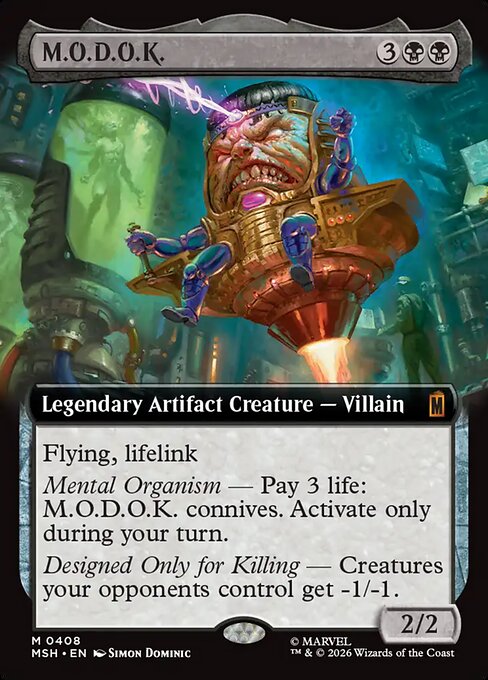
Pay 3 life per connive. That's the ask, and the payments add up fast. In a 40-life format, you can afford to activate this six or seven times before the life payments become fatal on their own, which sounds like enough until you're also taking hits across the board and losing life to your own payoffs.
But the rest of the text does real work. Flying lifelink means he's recouping some of that life loss in combat, not fully, but meaningfully. Designed Only for Killing shaves a permanent -1/-1 off every opposing creature, which shuts down 1/1 token strategies cold and weakens utility creatures below the threshold where they can attack effectively. The connive activation is sorcery-speed and free of mana cost, and in a Villain shell where you're already looting through your deck to find combo pieces, a repeatable loot engine that costs nothing but life creates card advantage at a pace most draw spells can't match.
The math looks better inside the shell. Baron Strucker, HYDRA Overlord reduces Villain spell costs, Doom Reigns Supreme drains opponents for life when Villains enter, and every activation feeds the connive-matters payoffs. As a commander, build around the -1/-1 anthem and the connive synergies. In the 99, he's supplemental looting in a Villain deck. One archetype, one role, no pretense of scaling beyond it.
Thor, God of Thunder
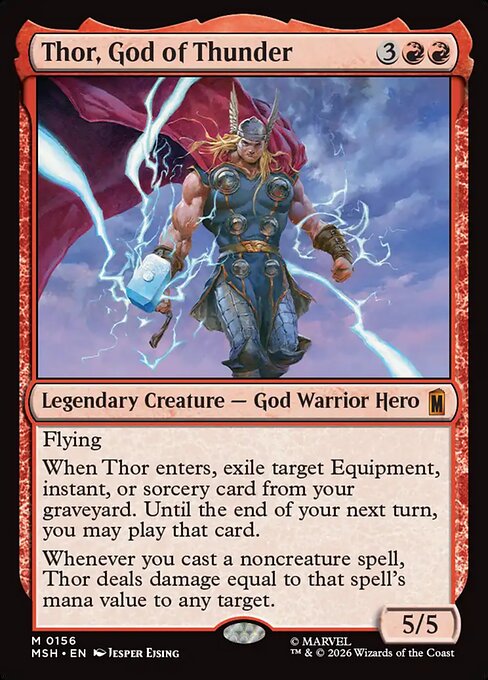
Someone at your table slams a 5/5 flyer on turn four and immediately exiles a Demonic Tutor from their graveyard to replay it. The table recalculates. Then on their next turn they cast a board wipe. Thor pings something for five. Then they cast a Demonic Tutor they just recovered. Two more. The game state shifts in a way that a beatstick alone would never produce.
That's what Thor does differently from other 4-drop commanders. Every noncreature spell becomes targeted damage equal to its mana value, routed wherever you want it. A six-mana sorcery hits for six. A two-mana removal spell hits for two. In a red-heavy spellslinger build, he's dealing meaningful damage to creatures and players every round while swinging as a 5/5 with flying. The graveyard recursion on entry is the part people undervalue: exile an Equipment, instant, or sorcery from your graveyard and you can play it through the end of your next turn. His ceiling in a heavy noncreature-spell deck is real. His downside is that he competes with established spellslinger commanders and requires a critical mass of high-mana-value spells to maximize the damage triggers. The floor is a 5/5 flyer with free recursion. That's fine on its own. Fine doesn't earn a top-ten slot, but it earns this one.
Captain America's Shield
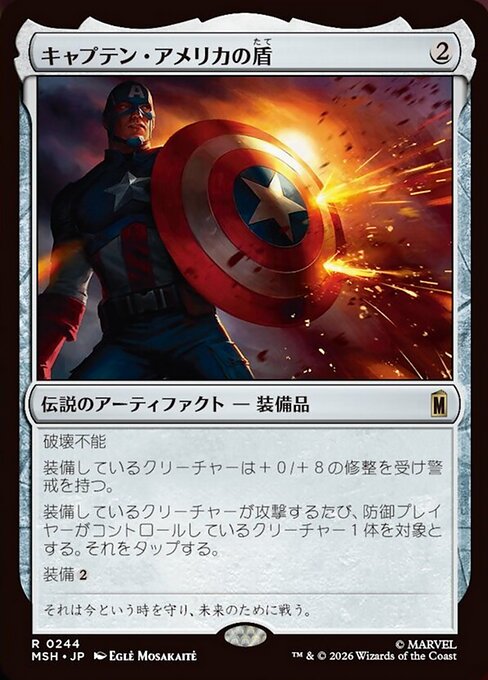
Indestructible Equipment, +0/+8 and vigilance, tap a blocker on attack. Equip for two mana. Any deck that runs creatures can run this. The indestructibility on the artifact itself means you never lose the piece, destroy effects don't work. The +8 toughness on a creature already at 4 toughness puts you at 12. Good luck blocking that in combat. Tap a blocker on attack, attack freely, block freely on the way back, the vigilance clause means the equipped creature works both directions in the same turn.
No color requirement. No restriction on which creature qualifies as worthy. It's the defensive Equipment that every creature-combat deck has been missing, and the toughness bonus breaks commander-damage math in ways that matter. Run it.
Mjölnir, Hammer of Thor
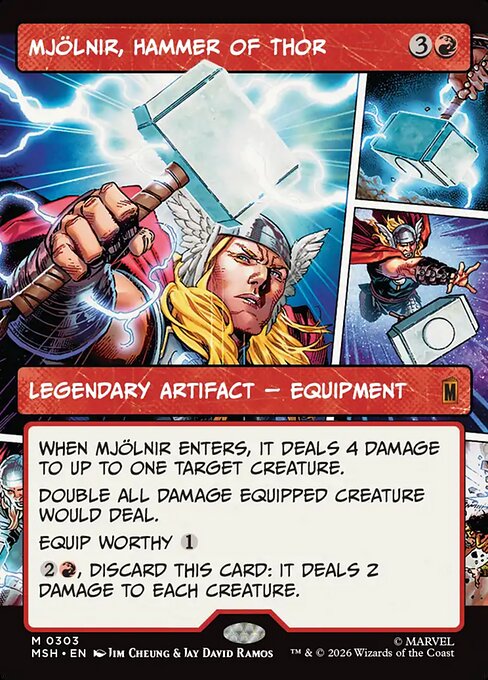
Mjölnir is one of the strongest Equipment cards printed in years for the specific deck that can use it, and the Equip Worthy restriction is precisely what keeps it honest. All damage the equipped creature would deal is doubled. Not double strike, not a power bonus, the damage total itself. A 5-power attacker equipped with Mjölnir deals ten on contact. A 10-power attacker deals twenty. Trample damage is doubled before assignment, and that interacts with prevention effects and damage replacement differently than double strike does, which matters in Commander where Panther Habit and prevention effects are relevant.
The Worthy clause limits hosts to legendary non-Villain creatures that are red and/or white. That's a real constraint that cuts out most of your green and black legends, but it still covers most Boros legends, mono-red legends, and any red-white Hero from this set. Thor, God of Thunder himself qualifies: a 5/5 flyer swinging for ten while also pinging for his spell's mana value is a clock and a burn engine simultaneously.
Three modes of value on a single card. The ETB trigger deals four damage to up to one target creature, which is premium removal attached to an Equipment cast. Then there's the discard mode: pitch Mjölnir from hand to deal two damage to each creature, functioning as a pocket mass pinger in emergency. In Boros or mono-red Voltron builds with a legitimate legendary attacker to equip, this is correct. It's not cute. It's cracked for the decks that want it.
Arc Reactor
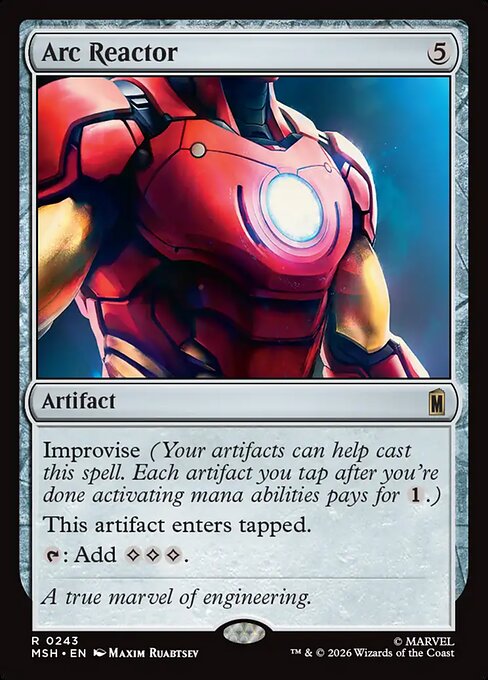
Compare this directly to Thran Dynamo: both produce three colorless mana, and Arc Reactor has Improvise. On the surface that looks like a strictly worse version, it costs one more at base and enters tapped. The case for it over Thran Dynamo is the Improvise clause, and it's not a small case.
Improvise lets you tap artifacts after activating mana abilities to pay for one generic mana each. In an artifact-heavy deck with four artifacts already on the table when you cast this, the card costs one mana. One. In the shell where Ultron, Artificial Malevolence is firing and creating token copies of every artifact entering, your board fills fast enough that Arc Reactor is routinely a turn-two or turn-three play. Producing that output before turn five is significant ramp, and this card does it in the right shell.
The downside is real outside that context. Enters tapped means you can't immediately tap it for value on the turn you play it. Without an artifact board, Improvise disappears and you're paying five mana for acceleration that doesn't come online until your next turn. This is a card for the deck that wants it, not a generic ramp piece. In Ultron, Artificial Malevolence or any artifact-storm build where Improvise is nearly always active, this is better than Thran Dynamo. Everywhere else, it isn't. Name your deck before you sleeve this.
World War Hulk
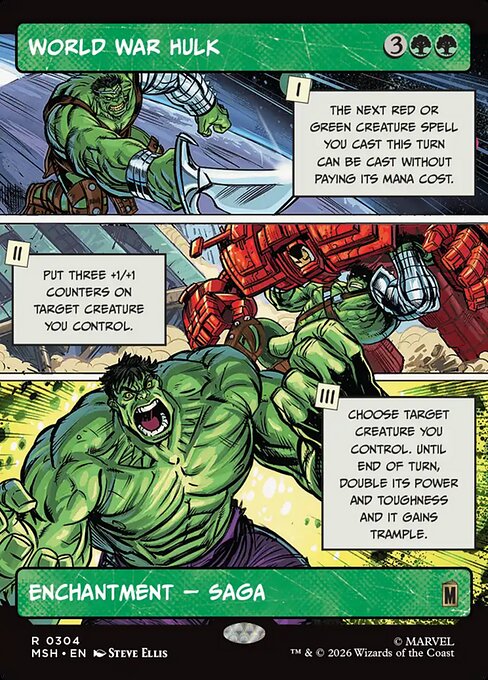
You cast World War Hulk on turn five. Chapter I fires immediately on entry: the next red or green creature spell you cast this turn can be cast without paying its mana cost. You have a 10-drop green creature in hand. You cast it for free. The table looks at you with the specific expression that says they're recalculating whether this is the turn they should have interacted.
Chapter II arrives on your next draw step: three +1/+1 counters on target creature you control. Your free 10-drop now has three extra counters on it. Chapter III closes the game: choose a creature you control, double its power and toughness through the end of the turn and give it trample. The creature that entered for free, buffed with three counters, is now doubled in both dimensions and trampling through blockers. If all three chapters resolve on the same target, you've turned one five-mana enchantment into a game-ending swing within three turns.
The information read on this Saga is loud. Every opponent knows what's coming when it resolves. A smart pod will prioritize destroying it before Chapter III or killing the creature you're targeting after Chapter I. The window to disrupt it exists, which is why this ranks at eight rather than higher: a patient opponent with removal can break the sequence. But in a Gruul or big-creature build where you have multiple threats and the table can't answer everything, World War Hulk does what three separate cards would normally accomplish. Bruce Banner // The Incredible Hulk specifically benefits here: Banner enters cheaply, contributes to the board, and transforms into an 8/8 that Chapter III can double, with trample, into a lethal swing from a single enchantment.
Shang-Chi, Master of Kung Fu
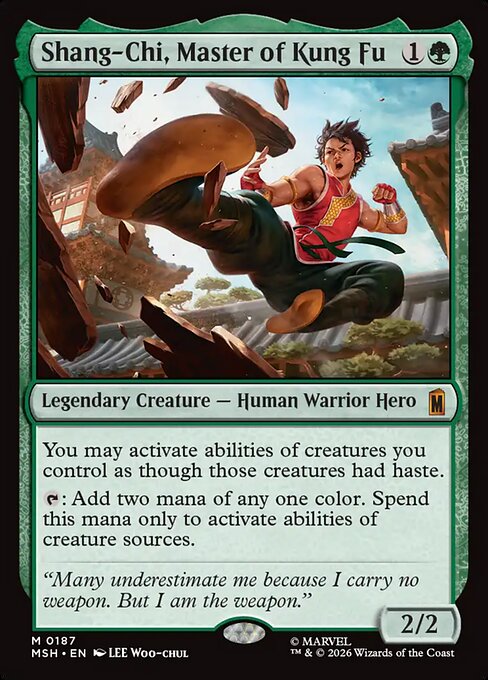
The rules interaction here is worth unpacking before the evaluation, because most players read "activate abilities as though those creatures had haste" and assume it means haste. It does not mean haste. Haste lets a creature attack and use tap abilities the turn it enters. What Shang-Chi does is remove the summoning sickness restriction specifically for activated abilities, including those that require tapping. A creature that enters without haste and therefore can't attack can still immediately tap to use its activated ability the turn it enters. These are different rules and they produce different play patterns.
What this means at the table: every creature you deploy can immediately fire its tap ability. You tutor a Deathrite Shaman into play, it taps. You find a Selvala with a creature tutor, she taps on entry. Any creature whose value is locked behind a tap activation is now instantly active. In a deck that chains creature tutors mid-turn to assemble a line, this enables sequences that normally require waiting a full rotation.
The mana ability is the second layer: tap Shang-Chi for two mana of any one color, but only to activate creature abilities. That's a Selvala, Heart of the Wilds-adjacent rate specifically for creature-ability decks. In a build using Sisay, Weatherlight Captain or Agatha's Soul Cauldron, Shang-Chi enables same-turn ability chains that would otherwise take multiple turns to set up. The cEDH relevance is real. In a creature-based combo deck that needs to fire off key pieces the turn they enter, this is correct and not a little too cute. The line goes through those creature activations, and Shang-Chi is what makes that line fast enough to matter.
Cosmic Cube
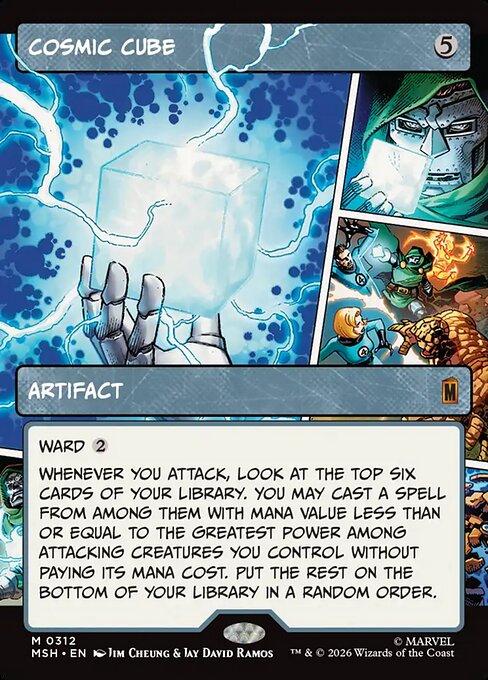
Turn six. You have four creatures attacking, biggest is a 6-power threat. The Cosmic Cube's attack trigger fires: look at the top six cards of your library. You may cast any spell with mana value six or less from among them for free. Not cascade, you look at six, pick one, cast it for free, put the rest on the bottom. A free 6-mana spell off an attack trigger on a colorless artifact with Ward 2.
The Ward 2 on a five-mana artifact is meaningful protection. Opponents need to pay two additional mana to target it, which slows down instant-speed removal and makes the first activation after you cast it reasonably likely to resolve. The free cast scales directly with your creature's power, a 10-power attacker lets you free-cast a 10-drop. In an aggressive or midrange deck where your creatures are already large and you're attacking regularly, Cosmic Cube converts combat into a draw-and-cast engine that generates free spells every time you swing.
The political cost is real. Attacking at some tables is a declaration of aggression that draws removal. Cosmic Cube requires you to attack to benefit, which means it's better in decks that were already planning to attack than in decks that want to sit back. But in any midrange Commander build that regularly threatens combat, and most do, this is five mana for an artifact that generates free high-value casts each round. The Vision pairs well here: as a commander he opens a colorless spellslinger shell, and as a 99-piece he fits any deck running instants and sorceries. Cast something off Cosmic Cube, and he picks up a keyword or draws a card. The overlap between "attack with powerful creatures" and "cast spells for value" describes a wide range of Commander decks, and any of them can run this.
Ultron, Artificial Malevolence
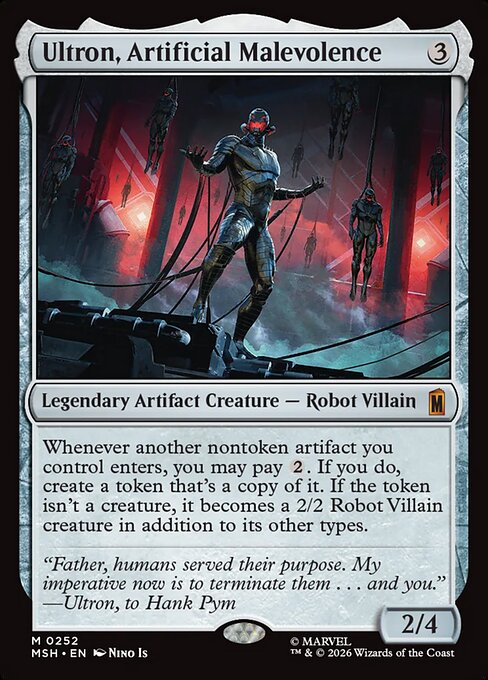
Compare to Mirrorworks: a colorless 5-mana artifact that does the same triggered copy effect. Same cost to copy (pay two, get a token copy of the entering artifact). Ultron, Artificial Malevolence costs three mana, is a 2/4 body, is legendary, and makes non-creature artifact tokens into 2/2 Robot Villain creatures. Mirrorworks costs two more mana for no body and no creature-creation upside. Ultron is Mirrorworks at a two-mana discount stapled to a commander. That's the entire case for why he's top five.
What the copy trigger actually produces in play: every artifact you cast triggers it. Pay two, get a token copy. A Treasure token that enters becomes a Treasure token AND a 2/2 Robot Villain that also happens to be a Treasure. Your mana rocks enter and immediately generate token versions. Your utility artifacts duplicate. In an artifact-storm build, Ultron can turn a sequence of cheap artifacts entering into a board of Robot Villains plus duplicated mana production simultaneously.
One rule trap that trips up new Ultron pilots: Equipment token copies are creatures per the full rules, and creatures cannot be attached to other creatures as equipment unless the creature-equipment has the reconfigure ability. Your copied Equipment tokens are 2/2 Robot Villains that cannot equip anyone. Don't build assuming your Equipment copies will equip your creatures. They won't.
The combo ceiling: Krark-Clan Ironworks sacrifices artifacts for mana, and Nim Deathmantle returns creatures to the battlefield when they die. With Ultron on board, artifacts enter, trigger copies, you sacrifice for mana with KCI, Deathmantle returns the creature, and the loop closes. Ultron the Annihilator from this set provides the same shell in mono-black for players who want the black combo support, consistent Krark-Clan Ironworks and Deathmantle lines with drain payoffs. Colorless Ultron is the commander. Black Ultron the Annihilator belongs in the 99 of a black build that wants the combo but already has a different commander.
The Ten Rings
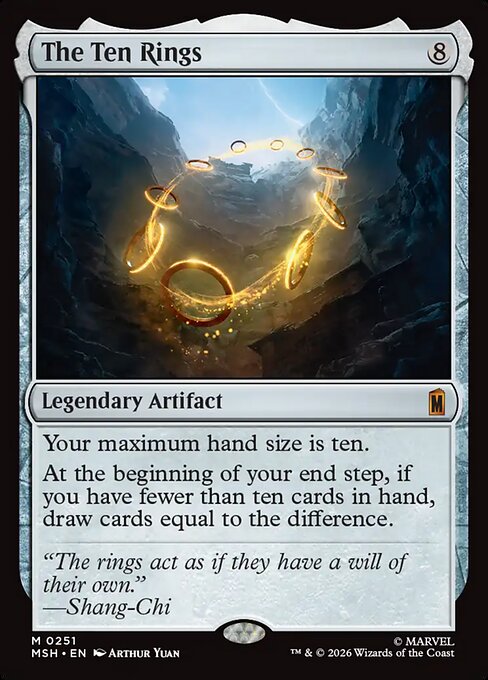
There's a specific moment when someone resolves an 8-mana artifact that refills their hand to ten cards every turn. The table goes quiet in the particular way that means every player is recalculating whether the game is now over. Not because the effect is explosive, it isn't. Because it means that player will never run out of answers again.
The text is straightforward: your maximum hand size is ten, and at the beginning of your end step, if you have fewer than ten cards in hand, draw up to ten. As long as The Ten Rings is on the battlefield. If you spent your turn developing the board and your hand is down to two cards, you refill to ten before you pass. The next turn starts with ten cards in hand. The turn after that starts with ten cards in hand. This continues until someone answers it or the game ends.
Eight mana is steep. Commander games regularly reach turns seven or eight with enough mana to cast this, especially in any deck running normal ramp. Colorless means any deck can run it, no color requirement, no color identity restriction. The refill is most powerful after you've emptied your hand developing a board state, which describes the exact moment in games where most Commander players feel resource-starved. The Ten Rings solves that problem permanently once it resolves.
People are massively overbuilding around this as if it's a turn-two play. It almost never is. Decks contorting their mana curve to deploy The Ten Rings on turn four or five are doing something worse than just playing normal card draw at a normal cost. The correct deployment is late game, when you've spent your mana doing other things and the refill converts your spent resources into a fresh hand of ten. Treat it as a war-of-attrition engine, not an explosive early play. That framing changes how you build the deck around it and how you evaluate when to cast it.
Bruce Banner // The Incredible Hulk
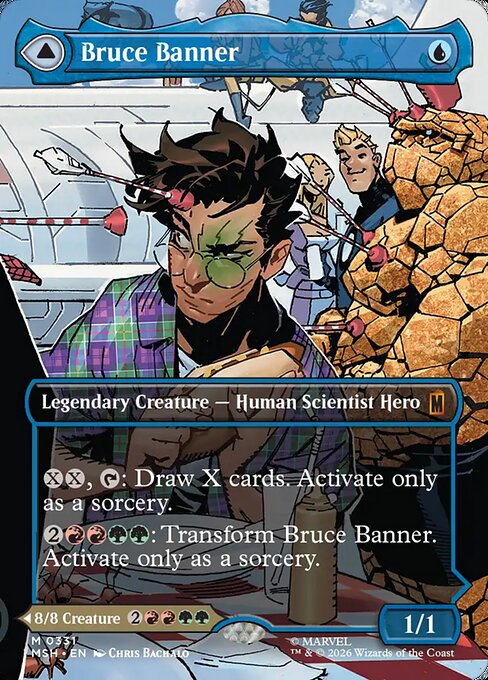
Turn three in a cEDH pod. Banner has been sitting at 1U since turn one, drawing cards off his activated ability, looking like a value engine. Nobody has prioritized removing a 1/1 that draws cards. You activate the transform ability for 2RRGG. The Hulk enters as an 8/8 with reach and trample. You attack.
Caltrops was already on the board. It deals one damage to each attacking creature. The Hulk takes one damage. Enrage triggers: put a +1/+1 counter on him, and because he's attacking, untap him and there is an additional combat phase after this phase. He's now a 9/9 untapped with reach and trample going into an additional combat step. Caltrops fires again. Another counter, another untap, another combat phase. This loop doesn't stop until you choose to stop it or something disrupts it. Infinite combat steps. Every opponent takes trample damage from a growing Hulk in each one. Pyrohemia accomplishes the same loop: activate for one damage while he's attacking, trigger Enrage, repeat.
What makes this a turn-four kill in optimal draws is also what makes it hard to see coming. Banner presents as a draw engine. The Caltrops loop doesn't reveal itself until Caltrops resolves and the Hulk swings. The table's interaction window is narrow: kill Banner before transform, answer Caltrops before the attack, or have a stack interaction the turn the Hulk attacks into Caltrops. If those windows close, the game ends.
Mox Amber generates mana off Banner as a legendary creature, enabling faster deployment of the transform cost. Fierce Guardianship and Deflecting Swat are the free interaction package that makes a 1U commander viable at a competitive table. Guardianship protects the combo turn when you tap out to transform; Swat redirects the counterspell someone is pointing at your Caltrops. The cEDH community has correctly identified this as a genuine tier threat, the fast hand looks like: land, Amber, Bruce Banner, Caltrops in opening hand. That's a turn-four kill in the right draw, and it's probably the best new cEDH commander from the set.
The Vision
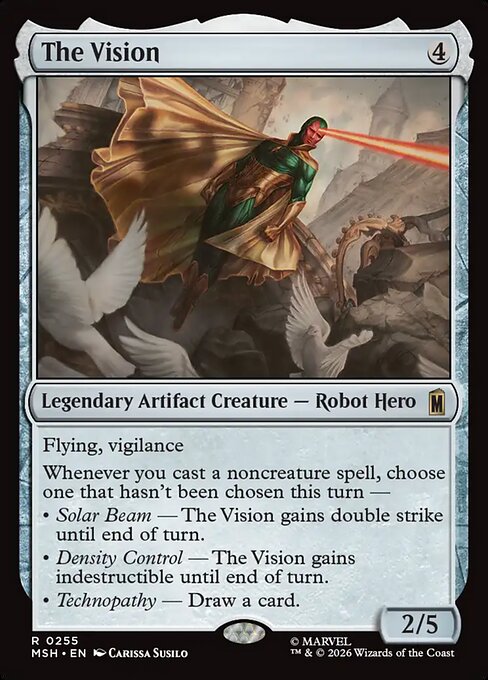
Run this in any Commander deck with instants, sorceries, and artifacts. Which is every Commander deck. That's the verdict.
The Vision is a colorless 4-drop with flying, vigilance, and a 2/5 base. He attacks and blocks freely without tapping. Whenever you cast a noncreature spell, choose one mode that hasn't been chosen this turn: Solar Beam gives him double strike, Density Control gives him indestructible, Technopathy draws a card. Three spells in a turn unlocks all three. Cast three spells and Vision is attacking for double-strike damage while being indestructible and you've drawn a card. A 2/5 indestructible flyer with that combat bonus is a 10-point clock against an unprotected opponent.
His colorless legendary status is what pushes the ceiling. He goes in five-color decks, colorless builds, mono-red, Dimir, anything. As a 99-piece he's a threat that scales with spell density in any existing build. As a commander, he leads a colorless spellslinger shell where every noncreature spell you cast is doing double work: advancing your plan and charging Vision's modes.
Cosmic Cube overlaps naturally: you're attacking with Vision (who rewards casting spells), Cosmic Cube fires off the attack trigger and lets you cast a spell without paying its cost, that spell triggers Vision's mode choices. Both reward the same axis. Thanos, the Mad Titan is the headlining build option in five-color, and Vision belongs in the 99 alongside him. There's a lot to say about Vision because he does something no other colorless commander does at this cost, and the depth of what "three spells unlock all three modes" means in practice is still being mapped. This is a card that will show up in Commander collections for a long time.
The Mind Stone
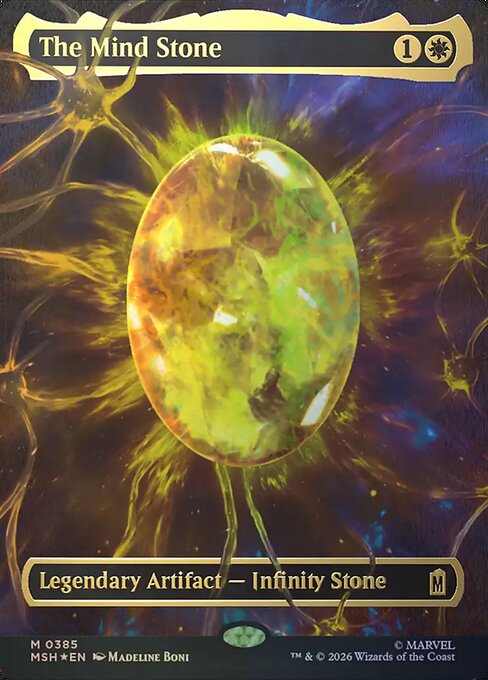
Start with the classic Mind Stone you already know: 2 mana, taps for colorless, sacrifice to draw a card. A beloved staple. Now compare The Mind Stone, capital T, capital M, because it is a different card in almost every dimension that matters.
Two mana, white, indestructible. It taps for W, meaning it produces colored mana. For 5W and a tap, you Harness it, activating the infinity trigger: at the beginning of your end step, exile up to one other target nonland permanent you control, then return that card to the battlefield under its owner's control. That is a free blink. Every round. On a 2-mana artifact that produces colored mana and laughs at removal.
The Harness cost (5W plus tap) is not cheap as an activation, but it's a one-time cost. Once harnessed, the infinity trigger is free each end step without further investment. The applications are broader than the card text implies. Blink an ETB creature at end of step and it re-enters immediately, firing its triggers before the turn ends, ready to use again on your next turn. Reset a Saga back to chapter one every rotation. Trigger a Power-up on Nick Fury, Agent of S.H.I.E.L.D. or T'Challa, the Black Panther by blinking them, which treats them as a fresh permanent for Power-up purposes. Permanents with "once per turn" clauses come back with those restrictions cleared. Any permanent that does something when it enters, which describes roughly half of Commander, becomes repeatable.
White gets 2-mana artifact mana rocks constantly, but this one converts into a blink engine after a single Harness activation, and every subsequent trigger is free. This is the best mana rock white has gotten in years, and the secondary ability is why it's #1. Every white deck in Commander can run this. 6,449 registered decks is the highest adoption of any card in this set, driven by broad format applicability across all brackets rather than narrow synergy exploitation. Indestructible plus legendary means it survives removal and is tutorable via legendary-matters engines like Sisay, Weatherlight Captain.
The Mind Stone will show up in Commander collections ten years from now regardless of whether the Marvel license survives. That's the test for a format staple. This passes it.
Cards That Just Missed the Cut
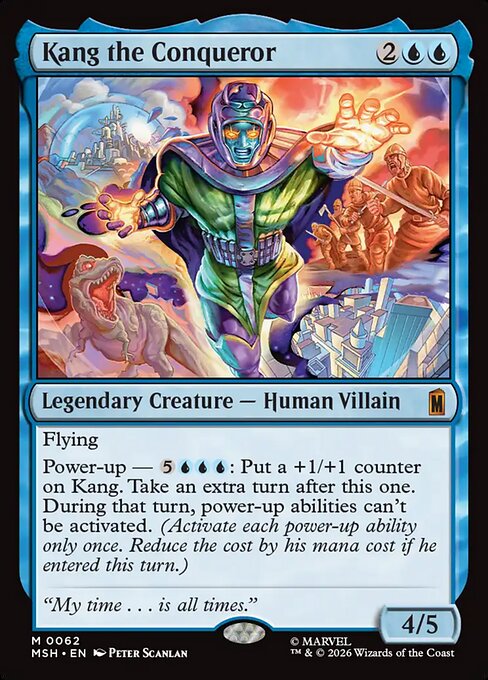
A few cards have real Commander merit that didn't land in the ranked twenty.
Kang the Conqueror: A 4/5 flying 4-drop whose Power-up takes an extra turn for 5UUU at base. If cast the same turn, the discount reduces that to roughly UUU on the activation, a potential turn-four extra turn from a legendary body. The ceiling is degenerate. The narrowness as a commander and the extra turn being locked behind a Power-up that resets with each new Kang instance keeps him off the ranked list. Watch him in decks with blink effects that reset the Power-up each activation cycle.
The Sentry, Golden Guardian: A 5/5 flying indestructible vigilance creature for 3W that gives an opponent a 5/5 flying indestructible token that must attack each combat. There is no clean analog for this politics piece in the format. The opponent's token is a forced-attacker that can't die to damage taken in combat, which creates threat patterns that force unusual decision trees. The community hasn't mapped the ceiling yet.
Doctor Doom: Six mana, creates two 3/3 Robot Villain tokens on entry, is indestructible while you control an artifact creature or a Plan, and draws a card and loses a life at each turn's end. The Doombot factory plus indestructibility plus card draw is a legitimate black artifact commander engine. Already finding a home in existing black artifact builds. The community chunk density is high, he's being actively built. The cost is steep and the color restriction to black keeps him off the colorless accessibility axis that drives the ranked list.
Avengers Tower: Taps for colorless or for any color toward Hero spells and Hero ability activations. A utility land for any Hero-tribal build that costs nothing to include. Not a build-around, just a free slot in the right deck.
Captain America, Team Leader: The best Captain America for Hero-tribal builds. Heroes that enter gain vigilance and haste through the end of that turn, and both that Hero and Team Leader gain a +1/+1 counter. Every Hero that enters turns into a counter-stacking haste-enabled threat. In a dedicated Hero ETB deck, he's the correct commander. Outside Hero tribal, he doesn't exist.