
Here is how Marvel Super Heroes gets you: the packaging is so good you forget to ask whether the cards are worth building around. This is a test edit.
Every legendary creature in this set has a household name attached to it. Thor. Doctor Doom. Thanos. The full cultural weight of seventy years of comics, two decades of blockbusters, and approximately one thousand arguments about who would win in a fight. That is a lot of noise to cut through when you are trying to answer a much quieter question: which of these are actually good commanders?
The ranking criteria here is build-around identity, mechanical uniqueness, and honest ceiling. Not IP recognition. Not how much your nephew would enjoy seeing the card. Not alone, though community volume is a useful quality signal, 227 written pieces about a card means brewers have found something worth digging into. The question is whether the card generates a real deck identity, whether it has a combo ceiling worth chasing, and whether the command zone is the right place for it at all.
That last point matters more in this set than most. Several MSH legends, Ultron, Artificial Malevolence being the flagship case, are dramatically better in the 99 than in the command zone. Seven mana, colorless, no removal package. Ultron in the 99 of any artifact deck is a house. Ultron in the command zone is a philosophy experiment. The two evaluations are different and this ranking treats them as different.
A quick glossary for mechanics you will see repeatedly: power-up is a once-per-activation ability that reduces in cost if you activate it the turn the creature entered. Connive means draw a card, discard a card, and if you discarded a nonland card, put a +1/+1 counter on the creature. Enrage triggers whenever a creature takes damage. Miracle here means zero, as in free, which is the whole point of Molecule Man's existence.
The Serpent Society appears twice in the ranked data due to a database duplication. One card. One entry. Ranked once at its correct position. And that position is higher than you expect.
There are 19 unique legendary creatures in this set worth ranking as commanders. The most powerful of them is a green 4/4 that most players stacked at the bottom of their pull pile. We will get there.
Scarlet Witch, Chaotic Avenger
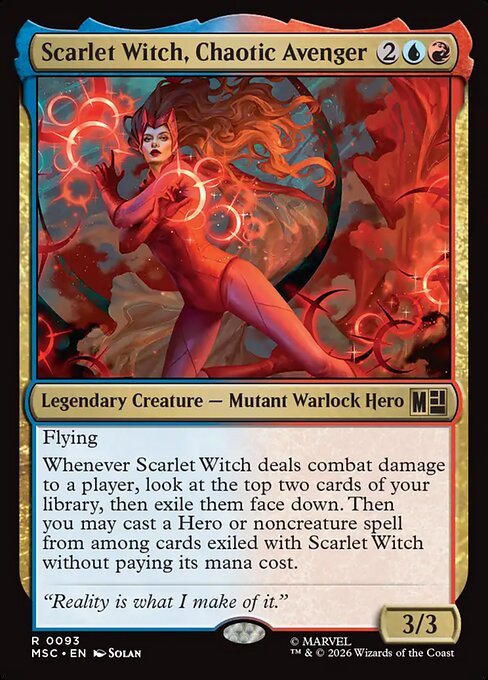
The trigger is real: connect with Scarlet Witch, exile the top two cards, cast one for free. The problem is that in Izzet, connecting requires your opponents to cooperate, and Izzet opponents do not cooperate. One free spell per attack makes this a slow value engine in a color pair that already has Loki, God of Mischief and other, faster spellslinger options at similar costs. She is a fine support piece in any Hero-heavy list. As a commander, the ceiling is a storm deck that never actually storms.
The Astonishing Ant-Man
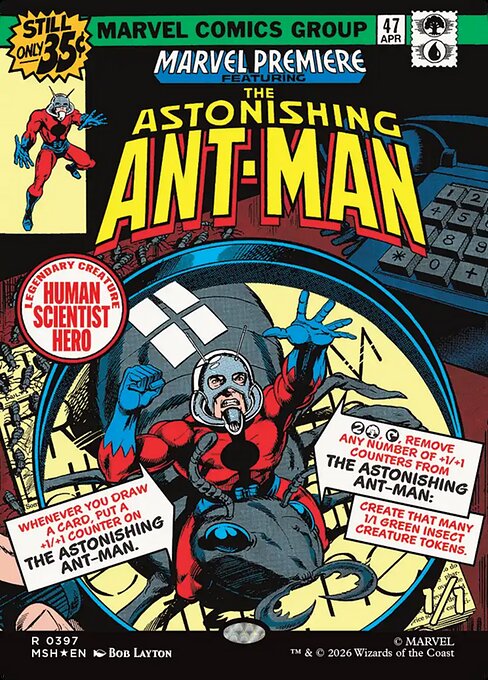
Ant-Man is a Simic commander who gets a +1/+1 counter when he attacks (and creates a 1/1 Insect token alongside it) and another counter whenever you draw a card. Both halves need setup, neither half is explosive, and he has no evasion to make the counters relevant in combat. He is pleasant in a Simic goodstuff pile. He is not, by any definition the word implies, astonishing.
Ultron, Artificial Malevolence
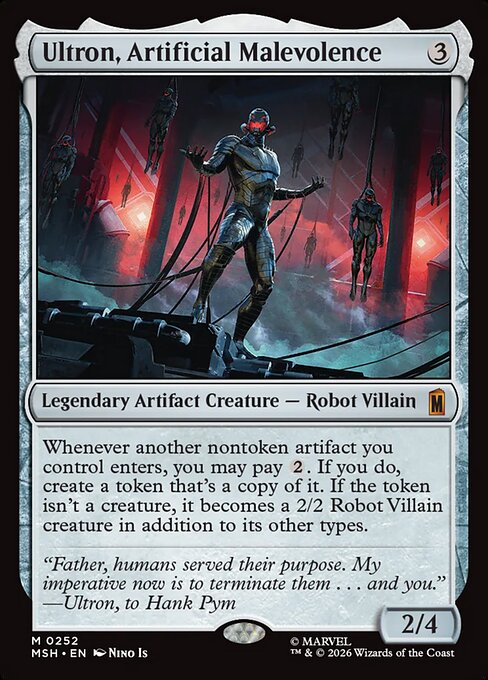
Think of Ultron as Mirrorworks wearing a body, which is actually a downgrade from Mirrorworks in the command zone, because Mirrorworks costs five mana in a deck that has green ramp, blue counterspells, and black removal, while Ultron costs seven mana in a deck that has none of those things. Colorless commander identity means your support suite is entirely artifact-based. You cannot ramp with Cultivate. You cannot protect him with Swan Song. What you can do is pay two mana to copy any nontoken artifact that enters under your control as a 2/2 Robot Villain, which in the right shell is explosive. The problem is getting there. He shows up in thousands of decks as a 99 piece and a fraction of that as commander, and that ratio is accurate. Once Ultron resolves in someone else's artifact deck, the table is in trouble. In his own deck, he is asking you to rebuild an entire format around him with no support colors. That is a normal and bad idea. Run him in the 99 of any artifact commander you actually trust to get there.
Baron Helmut Zemo
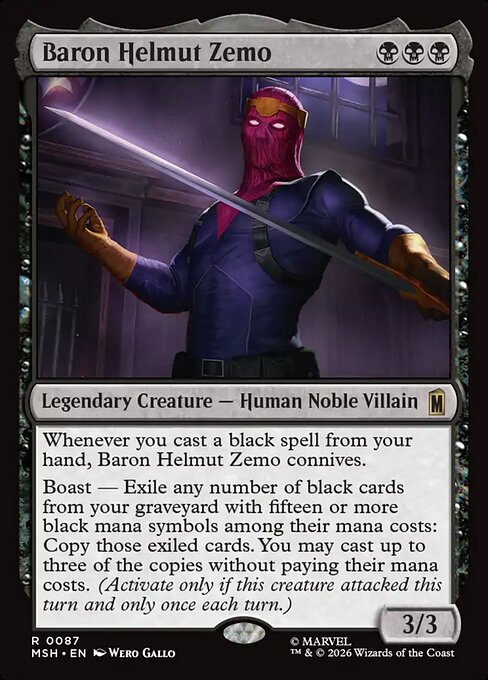
BBB is a real commitment, and boast requires attacking, which mono-black commanders are not always excited to do. What you get for that commitment: a filter trigger every time you cast a black spell from hand, generating consistent card quality across the whole game, and a boast ability that, when activated, lets you exile black cards from your graveyard with fifteen or more total black mana symbols among their costs, then copy and free-cast up to three of them. That is a late-game engine that requires deliberate construction. Your 99 needs high-pip black spells like Corrupt and Consume Spirit and Drain Life, cards that accumulate the mana symbol count you need. Mono-black has the tutors to assemble this (Demonic Tutor, Vampiric Tutor) and the patience to get there. The honest assessment: this is a niche build that rewards dedicated construction and punishes lazy deckbuilding. If you are not specifically building toward the boast payoff, Zemo is a mediocre 3/3 with an interesting connive trigger and nothing else to show for it. If you are, the turn you activate boast feels like pulling off a Rube Goldberg machine that actually works. Whether that is worth the command zone slot depends on how much you enjoy the construction as much as the execution.
Ares, God of War
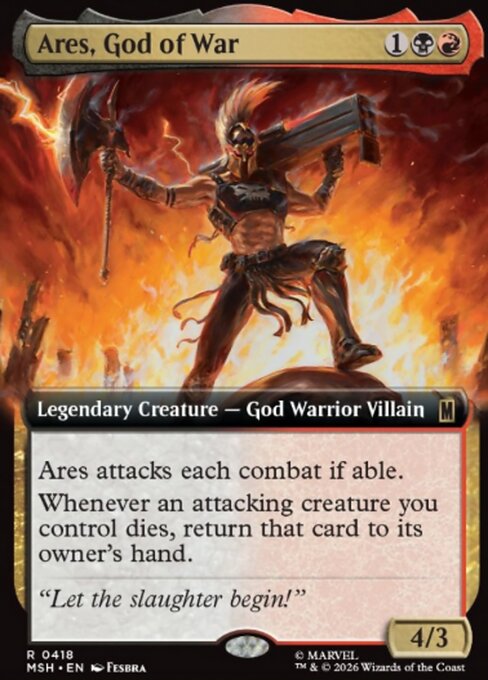
Someone casts a sweeper on turn five. Your whole board dies. You tap nothing, and then at the beginning of your next end step, everything that died with power three or greater walks back onto the battlefield under your control. While your opponents scramble to rebuild, you are already re-established. That is the pitch for Ares, and it is a good one. A 5/5 with flying, haste, and indestructible for 3BR is a legitimate threat before the recursion text even registers: he hits hard, he survives removal, and he outpaces most blockers on rate alone. The recursion clause is the long game. In a Rakdos deck built around high-power creatures and sacrifice outlets, every mass removal spell becomes an asymmetric advantage. The delay is real and meaningful, though. Opponents have a full rotation to exile your returning creatures before they arrive, and Rakdos does not have the protective tools to guarantee the recursion resolves cleanly. That distance between the promise and the execution is what keeps Ares at fifteen rather than higher. Build him with sacrifice-heavy aristocrat pieces that have power three or greater and treat the recursion as a backup, not the plan A. He is also indestructible, which means red sweepers like Pyrohemia can clear your opponents' boards while he watches from the rubble. That alone is a respectable game plan.
The Sentry, Golden Guardian
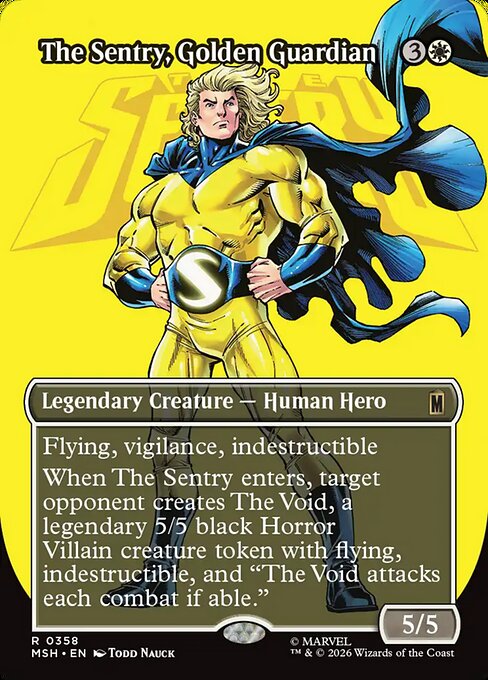
The moment you reveal The Sentry, Golden Guardian as your commander, at least two players at the table will look at each other with an expression that says "is that the one where you hand someone a 5/5?" Yes. It is that one. And then the game starts and you immediately understand that you have been thinking about this wrong. You are not giving someone a threat. You are choosing who gets a threat, and that is a completely different social instrument. Hand The Void to the player in last place and watch them become a blunt weapon pointed at the front-runner. Drop it on whoever has the most counterspells and let the "must attack each combat" clause drain their attention. The Void attacks every turn. It does not ask permission. That is your free pest-control service, redirecting the table's threat assessment while a mono-white 5/5 with flying, vigilance, and indestructible sits on your side of the board doing the same thing. That combination of stats in mono-white is bracket four behavior at any other power level. The Void is not a downside. The Void is a political appointment. Players who dismiss The Sentry because you hand someone a 5/5 are playing a different game than the one actually happening at the table. Pair him with Captain America's Shield for the +0/+8 vigilance boost and blink effects to trigger the ETB again on a different opponent when the first Void becomes inconvenient. The most overreacted-to commander in the set, and that will be a theme we return to.
Namor the Sub-Mariner
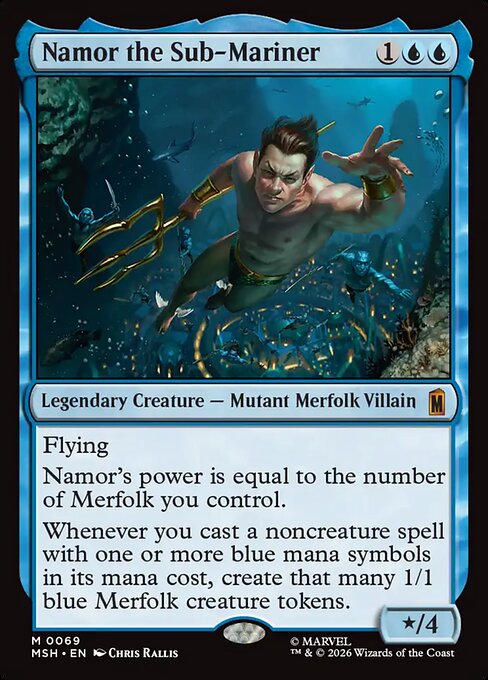
Namor is the Merfolk commander mono-blue players wanted, and he does something genuinely unusual: making Merfolk tokens from noncreature spells instead of creature spells. Every blue-pip noncreature spell you cast creates that many 1/1 Merfolk tokens. A two-pip counterspell generates two Merfolk. A Force of Will generates two Merfolk. The tokens feed Namor's own power, because his power equals the number of Merfolk you control, meaning he is a 0/4 on an empty board and a legitimate combat threat once you have developed the board. The two halves of his design reinforce each other: the more spells you cast to protect your board, the more Merfolk you create, the larger Namor becomes. Attuma, Atlantean Warlord in the 99 provides a Merfolk lord effect and draws a card on each attacking wave. The tension in deckbuilding is real. Pure tribal Merfolk wants creature density, but Namor rewards running a suite of blue interaction that pulls you away from creatures. The best builds probably blend both approaches, creating enough spells to generate tokens consistently while keeping enough Merfolk to make Attuma relevant. Not the most explosive mono-blue option in the format, but one of the more interesting construction puzzles the set offers.
Thanos, the Mad Titan
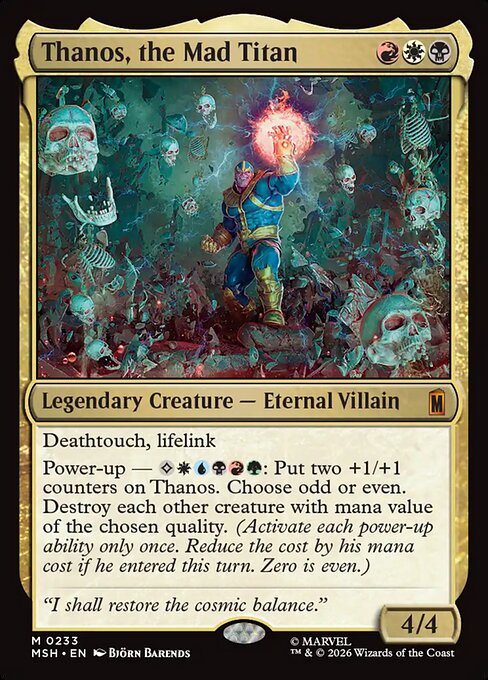
The actual card does not snap half the creatures. No gauntlet. No dramatic finger-motion. What it does, mechanically, is destroy every creature with a specific mana value parity, which is both less cinematic and more strategically interesting than the movies suggested. Thanos costs three mana. RWB, but his color identity is five-color because the power-up activation costs one mana of each color plus a colorless. That power-up puts two +1/+1 counters on him, lets you choose odd or even, and destroys every other creature whose mana value matches your choice. Activate it the turn he enters and you reduce the total cost to just the five colored mana, making this a strong turn-four reset that leaves your commander standing. The deck-building insight that separates good Thanos builds from bad ones: build your creature suite entirely around one parity and populate the board accordingly. Zero is even, which means token creatures and 0-cost artifact creatures get swept in an even wipe, design your board so you are the only one with even-mana creatures, then activate and watch. Or lean odd and keep your zero-drops. The deathtouch and lifelink on the base stats are not flavor text, he pressures planeswalkers and gains life in combat, which matters when you are waiting to trigger the power-up at the right moment. Five-color identity opens the entire support suite. His inclusion numbers undersell how complete a sweeper commander this is.
Molecule Man
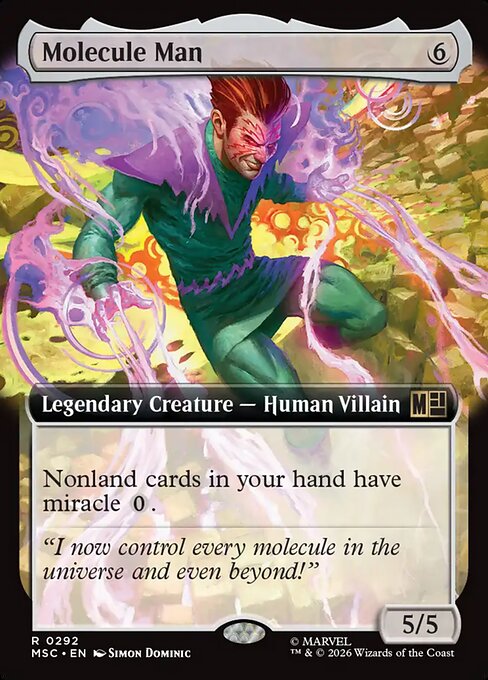
Compare Molecule Man to something like Jodah, Archmage Eternal, another colorless-cost-reduction commander, and the key difference becomes clear: Jodah reduces costs to WUBRG for every spell, while Molecule Man reduces them to zero, but only when you draw the card, and only if it is your first draw of the turn. That constraint is the entire deck-building puzzle. You need consistent top-deck manipulation. Sensei's Divining Top equivalents in colorless, draw-step control, anything that ensures your first draw each turn is a haymaker worth casting for free. Playing colorless means literally any card in Magic can be in your 99. Eldrazi. Planeswalkers. Every powerful artifact in the format. You are not restricted by color, only by the miracle trigger's requirement that you actually draw the card rather than tutor it. This is a genuine must-command-zone case: unlike most legends that are better in the 99, Molecule Man's ability is passive and only works if he is in the command zone generating it. The six-mana 5/5 body is irrelevant. What you are paying for is permanent access to miracle-0 on your most expensive cards, and in a format where turns matter more than anything, casting a free haymaker every single draw step is the kind of invisible value that wins games before anyone realizes what is happening.
Captain America, Team Leader
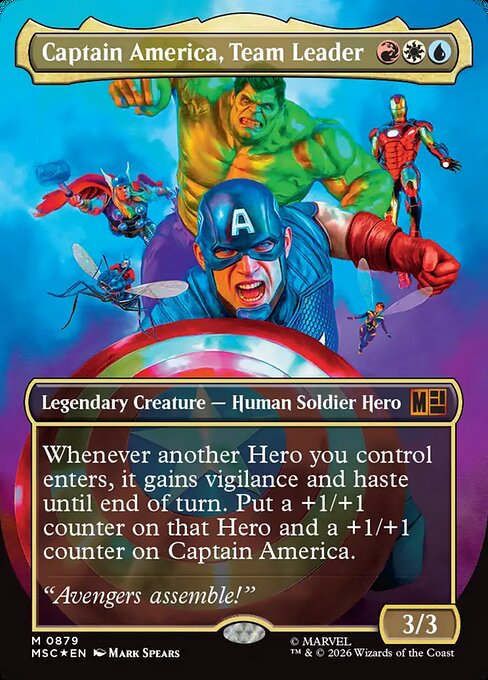
Okay, yes. Another Hero tribal lord. Yawn. Except this one gives every Hero that enters the battlefield vigilance and haste until end of turn, a +1/+1 counter, and a +1/+1 counter on Captain America himself. Every. Single. Hero. In a Hero-dense board, you are generating multiple counters per turn and your entire team is an immediate threat the moment it arrives. That haste grant is the effect players overlook first and regret most: every Hero you play threatens to attack the same turn it enters, which eliminates the "wait a turn, see if it gets removed" vulnerability that makes creature-based decks feel slow. Jeskai identity (RUW) is doing a lot of work here: white provides the anthem effects and protection, blue provides card draw, and the color combination gives you haste redundancy on top of what the commander already supplies. Captain America, Super-Soldier in the 99 provides hexproof to your entire Hero team as long as he has his shield counter, which makes your board much harder to pick apart with targeted removal. Agent Phil Coulson adds a tap ability that puts +1/+1 counters on every other Hero you control, which in a Hero-dense board is immediate value. The honest ceiling: this is the best dedicated Hero tribal commander in the set for players who want to run a Marvel-IP tribal build and have it function at a reasonable power level. The floor is real if your pod leans into combo or heavy control, a creature-centric strategy needs the table to be playing the same speed. At the right table, this is the room-changing commander for anyone who showed up to play Marvel cards and actually win with them.
T'Challa, the Black Panther
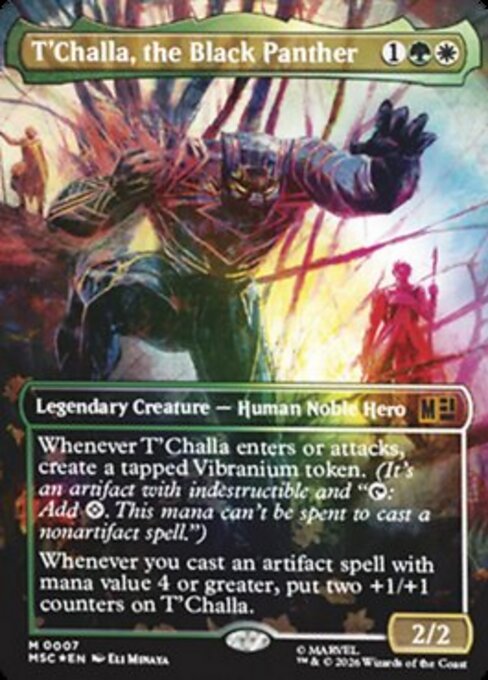
Turn five. T'Challa swings. You tap your Sol Ring, your Arcane Signet, three other artifacts, and suddenly T'Challa has five counters stacked on him before blockers are declared. The defending player does the math and does not like what they find. That is the T'Challa experience in practice: an artifact-dense board turns his combat ability into a power-scaling engine that closes games faster than the card appears to on paper. Tap an artifact, get +1/+1 counters equal to the total number of artifacts you control. With five artifacts on board, that is five counters from a single attack. With ten artifacts, the number stops being relevant because someone is dead. The second ability creates a 1/1 colorless Vibranium artifact creature token whenever you cast a spell with mana value six or greater, which pushes toward a ramp-and-big-spells strategy that eventually feeds back into the counter engine, those tokens become new tappable artifacts for the trigger. Selesnya color identity keeps you in green and white, which means Doubling Season doubles both the counters and the Vibranium tokens simultaneously, turning a medium board state into a very fast conclusion. The two halves of his design want slightly different builds, but the sweet spot is an artifact-ramp list that eventually reaches the mana to cast big spells while keeping artifact density high enough to make each attack explosive. This card has generated more community discussion among Selesnya commanders in the set than anything else, and the discussion is warranted.
The Serpent Society
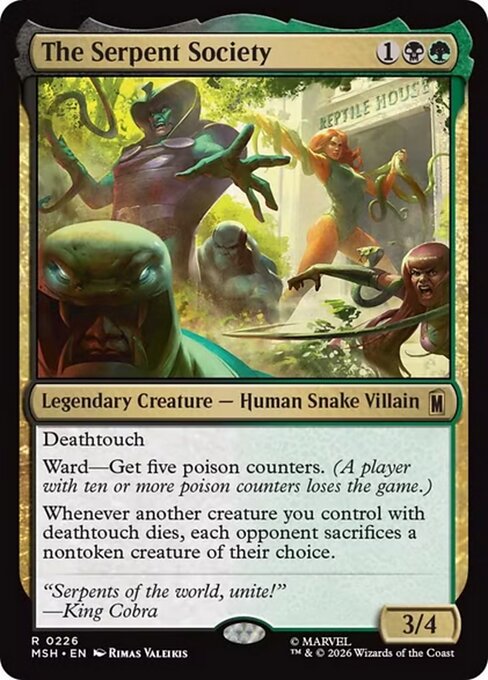
The moment you reveal The Serpent Society as your commander, the table has a conversation. Not out loud. Not really. But you watch three players simultaneously recalculate their removal suite and realize they have a problem. The ward cost is five poison counters. Not five life. Not five mana. Five poison counters. The first time someone targets The Serpent Society, they spend five counters and maybe solve the problem. The second time, they are dead. That is not a downside people want to pay twice, which means the social reality is that The Serpent Society effectively becomes untargetable after one targeting attempt. The room decides collectively that removal is not worth the cost, and then you have a 4/4 with permanent near-immunity sitting across the table from them. And then your deathtouch creatures start dying, because they do, because every Golgari creature strategy involves sacrifice, and each time one dies, an opponent sacrifices a nontoken creature. That is the Grave Pact effect that turns your normal board management into involuntary removal for the entire table. Fynn, the Fangbearer in the 99 converts deathtouch hits into poison counters, pushing opponents toward the ward threshold faster and opening a legitimate poison win condition as a secondary path. Hooded Blightfang adds life drain on every deathtouch attack and destroys planeswalkers on deathtouch damage. The table memory here lasts. I have seen pods refuse to commit resources to a game three weeks after someone used this commander's ward cost to poison them out. That is the apology rate going up in someone's accounting. This is bracket four behavior at a bracket two table, and it is exactly as powerful as it sounds.
Loki, the Deceiver
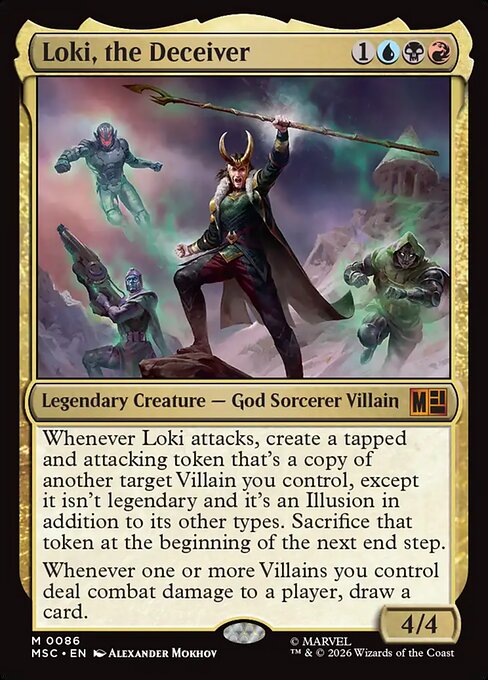
Loki is the best villain tribal commander in the set, and it's not particularly close. The design is tight: on each attack, create a tapped and attacking token that copies another Villain you control, not legendary, Illusion in addition to its other types. The copy inherits all triggered abilities. The copy attacks. Villains dealing damage draws cards. So the attack step generates a free copy of your best Villain, that copy attacks alongside your real Villains, every damage trigger fires on both the original and the copy, and you draw cards for each one that connects. Then the copy is sacrificed at the beginning of the next end step, conveniently avoiding legend-rule complications and resetting the board for another swing. Doctor Doom, King of Latveria in the 99 is the premium copy target: his drain-on-land-discard and connive trigger get replicated across an Illusion token that attacks alongside him, doubling the pressure. Norman Osborn sits in the 99 as a graveyard-value engine, his mayhem and Goblin Formula giving you recursive threat from the discard pile. Grixis opens up counterspells, discard, and burn, a fully interactive shell that can protect the engine while it runs. The copy effect creates a multiplier on every Villain you've built into the deck, and that multiplier compounds across a long game. Build this with enough Villains to make diverse combat boards and enough protection to keep Loki attacking.
Nick Fury, Agent of S.H.I.E.L.D.
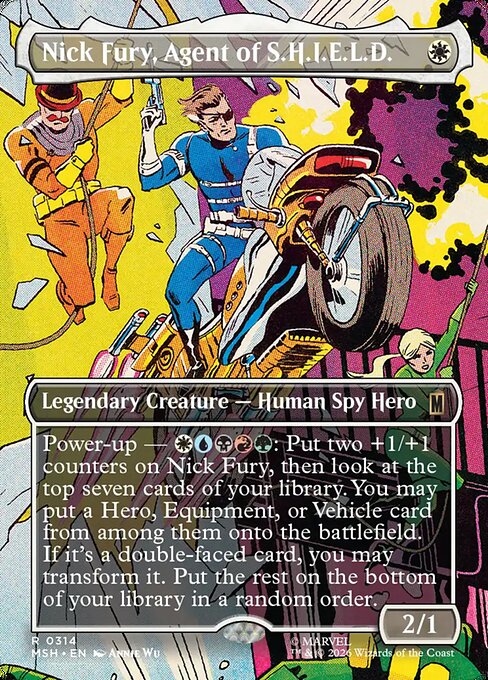
Nick Fury is, by any narrative measure, the least magical person in the Marvel universe. He is a spy. He has an eyepatch. His superpower is organizational management and a very serious expression. He does not shoot lightning or move at impossible speeds or transform into a larger, angrier version of himself. He is, mechanically, a one-mana five-color legendary creature that immediately enables access to the entire color wheel from turn one. That is the most powerful thing any commander can do before your first main phase ends. Magic has never printed a one-mana five-color commander before this. Let that register before we get to what the power-up ability actually does. Pay WUBRG on the turn he enters and you reduce that cost by his mana cost, so the total investment is four colored mana. You put two +1/+1 counters on him, then look at the top seven cards of your library and put any Hero, Equipment, or Vehicle directly onto the battlefield. If it is a double-faced card, you may transform it. You are cheating Tony Stark // The Invincible Iron Man transformed, Captain America's Shield equipped, or any of the set's biggest Hero threats directly into play for four mana on turn one or two. The power-up activates only once per instance, but blink effects reset the "once" by creating a new Nick Fury with a fresh activation. That means blink loops run for four mana per cycle and cheat a new card each time. Five-color identity puts the entire card pool at your disposal. The community is mostly building him as a thematic Marvel tribal assembly, which is the right call, the flavor of assembling the Avengers from the command zone is the whole point, and the card actually does that well enough to justify the thematic construction over a purely optimized pile.
Crystal, Inhuman Princess
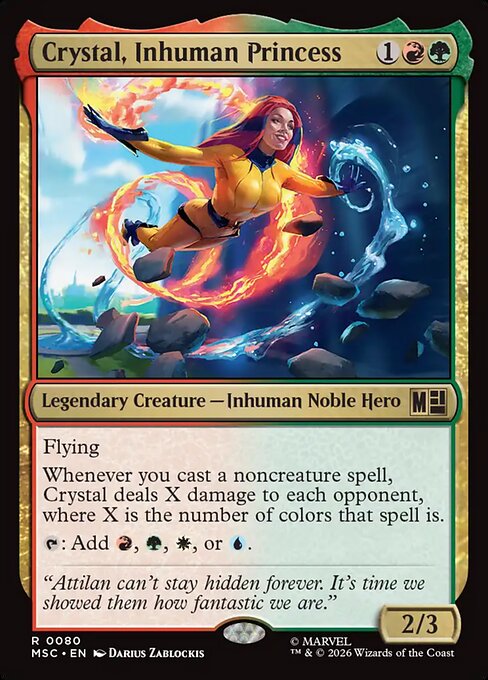
The knock on Crystal looks obvious before you play her: she requires a hit to trigger, which means she needs to connect, which means she needs to not be blocked, which means your opponents can simply put a body in the way and shut down the engine. That is the critique, and it is not wrong. It also misses why Crystal is quietly the most competitive-leaning commander in the set that players outside of specific brewing circles have not fully mapped. When Crystal connects with a player, she copies an instant or sorcery with mana value three or less you control on the stack. The copy resolves separately. No additional cast. No mana paid. Attach Keen Sense to Crystal and a single hit becomes two independent value triggers: one draws you a card, one copies the cheapest instant or sorcery you have on the stack. These are fixed outputs, not a loop, but you do not need a loop when a single connection that copies a cantrip draws you deeper and duplicates your best three-or-less spell. Naya colors (GRW) are the unlock that no one expected. Green provides ramp in Cultivate and Kodama's Reach. White covers protection in Swiftfoot Boots and removal. Haste and burn out of red keep Crystal threatening in combat. The combination means you have tools that pure Izzet storm does not: acceleration and resilience alongside the copy engine. This is one of the only GRW storm-adjacent commanders in the format, and the community builds around combo and storm themes are documented and functional. The evasion requirement is the real ask. If you are willing to build specifically around making Crystal connect, evasion, combat tricks, low-to-the-ground spells to copy, the ceiling is a faster game than most tables are prepared for.
Tony Stark // The Invincible Iron Man
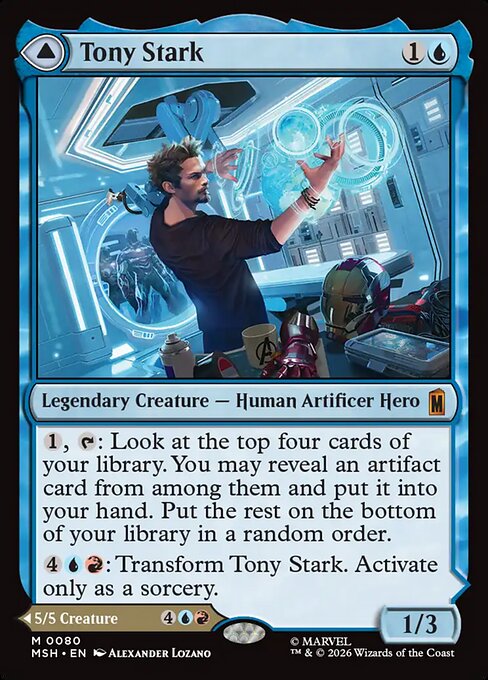
Voltron as an archetype has a standard list of problems: no card draw, one removal spell away from losing your entire game plan, too slow to close before opponents stabilize, and opponents know exactly what you are trying to do from turn one. Tony Stark addresses all three of those complaints from the first face alone. One mana and tap: look at the top four cards of your library, keep an artifact, bottom the rest. Every turn. A repeatable artifact tutor keeping your hand stocked with equipment and payoffs while you wait to transform. Four mana plus UR and he becomes The Invincible Iron Man: flying, haste, and the ability to put an artifact directly from your hand onto the battlefield at the beginning of combat, auto-equipping if it is an Equipment. Mjölnir, Hammer of Thor hits the battlefield attached and immediately doubles all damage The Invincible Iron Man would deal. Genji Glove drops and grants double strike plus an additional attack step. The Ten Rings arrives and your maximum hand size becomes ten, with the end-step draw effect filling your hand at your next end step. The cheat effect works on any artifact, not just Equipment: Adaptive Omnitool lands for free and immediately starts tutoring more artifacts on each attack. Izzet identity gives you blue for counterspells to protect the board and red for haste redundancy. Iron Man, Titan of Innovation exists as a separate, different build. Treasure generation and an artifact-ladder search that climbs your artifact mana values each attack. That card rewards a different construction and a different goal. Tony Stark is the Voltron build, and it is the better commander design. The community has reached consensus on this and the consensus is correct.
Doctor Doom, King of Latveria
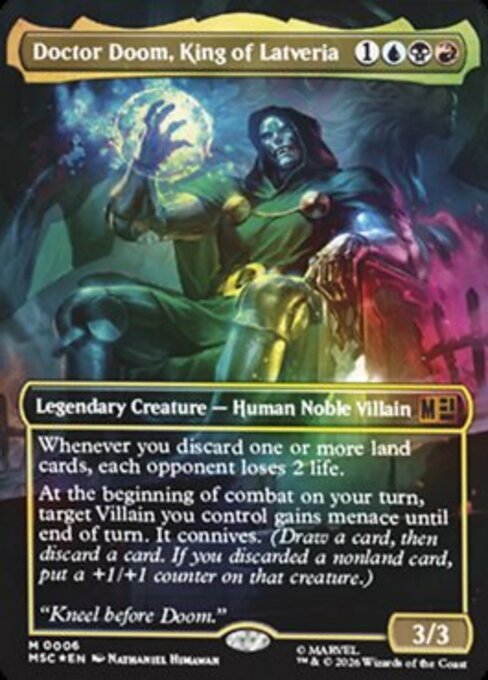
It is turn six. Doctor Doom is on board. Your hand has four lands in it and you are looking across the table at three opponents. You activate the combat trigger, a Villain connives, and as part of the connive you discard a land. Each opponent loses two life. You discard another land. Each opponent loses two life again. You discard a third land. At this point the player to your left, who has been watching this quietly, says "wait, that's lands? Not spells?" and you nod, and the table suddenly recalculates how dangerous the hand full of excess mana you have been carrying actually is. The discard-land-to-drain ability is the most commonly misread part of this card. Players assume it fires on discarded spells because that is what most discard payoffs do. It fires on lands. Every excess land in your hand is two life off each opponent's total simultaneously. Discard three lands in one turn and every opponent drops six life. At a table of three opponents, that is eighteen life drained from what amounts to a filtering effect you were running anyway.
The combat trigger that generates the discard opportunity also grants menace and connive to a Villain you control: the ability resolves, a Villain connives, you pitch a land, three opponents bleed two life, the Villain potentially gets a +1/+1 counter. Leader, Super-Genius in the 99 upgrades every one of those connive cycles, having creatures draw before discarding, turning each iteration into additional value. Prowler, Clawed Thief connives whenever another Villain enters, stacking card-quality triggers across every Villain you deploy. Doom's Time Platform puts exiled cards from the graveyard back on suspend, letting discarded pieces eventually resolve for free. The Plans enchantment subtype gives the deck a flavor-mechanic identity that nothing else in the set accesses.
Grixis Villain tribal with a drain subgame is a legitimately powerful archetype. This is the best commander available for it, and it is not particularly close.
The Unbeatable Squirrel Girl
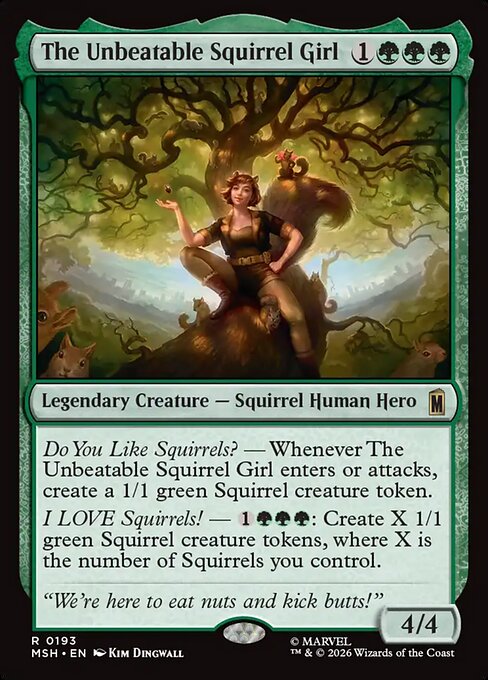
The table reaction to someone sleeving up The Unbeatable Squirrel Girl as their commander passes through several distinct phases. First: laughter, from the players who are treating this as a novelty pick. Second: mild concern, from the players who know what mono-green token doublers do. Third: the dawning horror of phase three, which sets in around turn four when the Squirrel count stops being a number anyone wants to track.
Here is the mechanical reality. Her first ability creates a 1/1 Squirrel token whenever she enters or attacks, consistent, low-cost Squirrel generation that keeps the board growing every round. Her second ability costs 1GGG and creates X 1/1 Squirrel tokens, where X equals the number of Squirrels you control. With four Squirrels, you pay 1GGG and create four more. Now you have eight. You pay 1GGG and create eight more. Now you have sixteen. You see where this goes, and it goes there fast.
Phyrexian Altar is the explicit combo piece: sacrifice Squirrels to generate one mana of any color each, use that mana to activate the ability again, create more Squirrels than you sacrificed, repeat. With a few Squirrels in play, the loop is live and the token count becomes a formality. Cryptolith Rite gives every Squirrel a tap-for-mana ability, which with enough Squirrels means the activation cost pays for itself before you spend a land. These are not fringe synergies, they are the primary engine, and the community discussion around this card reflects that: 227 written pieces, more than any other commander in the set, documenting the lines, the redundancies, and the backup plans.
Toski, Bearer of Secrets provides an indestructible card draw engine: Squirrels hitting players refills your hand, making the army self-sustaining. Squirrel Sovereign and Doubling Season push the ceiling from "a lot of Squirrels" to "an unreasonable number of Squirrels." Parallel Lives does the same job at a lower price point for budget builds.
This card bridges what separates a first-timer's excitement from an enfranchised player's combo sensibility. You can explain it to a new player in two sentences and they will immediately understand both what it does and why it is threatening. That combination is rarer than the community acknowledges. Squirrel Girl is the most complete design in the set.
Bruce Banner // The Incredible Hulk
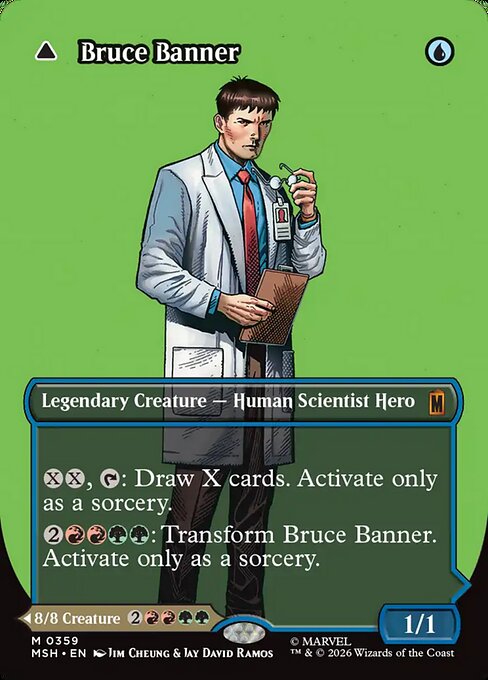
The reason Bruce Banner is #1 is not the infinite combat loop, though that loop is real and it closes games. The reason he is #1 is what a one-mana commander does from turn one of the game.
A one-mana commander in the command zone on turn one means Fierce Guardianship is live. Deflecting Swat is live. Every free counterspell and redirect that requires a commander in play is available immediately, before you have done anything else. Other commanders in this set build toward relevance. Bruce Banner starts with relevance built in. That is the floor this card has that nothing else in the set can match.
Banner himself is a legitimate draw engine: tap and spend XX mana to draw X cards, at sorcery speed. In the late game when you have twelve lands, that is a hand refill. In the early game, it is a mana sink for spare mana after casting free spells. The transform cost is 2RRGG at sorcery speed, and critically, it is an activated ability on the card, not a recast of the commander. Commander tax never applies to activated abilities. The Incredible Hulk comes back for 2RRGG every time, no matter how many times Banner has gone to the command zone.
The Incredible Hulk is an 8/8 with reach and trample. The Enrage trigger fires whenever he is dealt damage: put a +1/+1 counter on him, and if he is attacking when that damage lands, untap him and an additional combat phase follows. Caltrops deals one damage to each attacking creature, which means every Hulk attack triggers Enrage, untaps him, and generates another round of combat. Pyrohemia does the same thing on demand at instant speed for one red mana. Those two cards create an engine of cascading combats with The Incredible Hulk swinging indefinitely. That is a two-card combination in a Temur shell with access to acceleration, countermagic, and red damage sources.
Xenagos, God of Revels doubles The Incredible Hulk's power on the first swing, turning an 8/8 into a 16/8 with trample before the loop starts. Neyith of the Dire Hunt draws a card whenever the Hulk becomes blocked and can double his power at the beginning of combat for a hybrid cost, adding redundant escalation. World War Hulk as a saga gives you a free casting of the next red or green creature, three counters on a creature, and a doubling of power and toughness with trample, all in service of a deck that wants one specific creature to be very large and hit many times.
Acceleration out of green gets you to the transform cost faster. Blue supplies the counterspells and free interaction to protect the combo. The haste enablers and damage sources in red make the loop accessible the turn the Hulk lands. A turn-one free-spell floor, a late-game draw engine, and a repeatable infinite combat sequence on transform: no other commander in this set does all three. The 3,580 commander decks tracking this card and the 95 community articles documenting the lines confirm the community has done the work and agreed. The ranking is not a surprise. The reason for it should be.
The Best Marvel Super Heroes Commanders: Build Advice and the Better-in-the-99 Problem
The set has a recurring editorial problem that the rankings above paper over: several of its most exciting cards are dramatically better in the 99 of another commander's deck than they are in the command zone themselves. This matters for building decisions.
Ultron, Artificial Malevolence is the clearest case. The ETB-copy trigger is genuinely explosive in any artifact shell, and it shows up in a huge number of decks as a 99 piece for exactly that reason. As a commander, he asks you to build a colorless deck around a seven-mana creature with no removal package and no ramp options outside artifacts. The constraint is survivable if you specifically want the colorless-commander experience. If you do not, put him in the 99 of any artifact commander you trust to function and let him be the bomb he was designed to be.
Iron Man, Titan of Innovation and Tony Stark // The Invincible Iron Man are the same character but different commanders, and the distinction matters. Iron Man, Titan of Innovation is a Treasure-generation and artifact-ladder engine that climbs your artifact mana values with each attack. Tony Stark is the dedicated equipment build with consistent card selection on the flip side. Build Titan of Innovation if you want artifact escalation and board presence. Build Tony Stark if you want a Voltron commander with genuine staying power.
Mister Fantastic and Mister Fantastic, Reed Richards are both better as support pieces in artifact or token decks than as standalone commanders. The tap-to-copy-a-triggered-ability on Mister Fantastic is a powerful 99 piece in Bruce Banner or any Temur midrange deck. Shuri, Wakandan Inventor reduces artifact costs and enables copying, but she only fits in blue-based decks, making her a natural role-player in Tony Stark's 99, not a commander worth centering a deck around.
Practical build recommendations, stated directly: Squirrel Girl for players who want to learn how combo works in Commander and also win. Crystal for competitive tables where you want to go faster than the room expects. Bruce Banner for experienced players who want a cEDH-adjacent Temur build with a defined combo line. Nick Fury for thematic Marvel tribal where assembling the team is the experience you are chasing.
Who Are the Best Commanders from Marvel Super Heroes?
The Astonishing Ant-Man is the set's biggest mechanical disappointment relative to character recognition. Scott Lang is one of the ten most famous names in the Marvel cinematic universe. His card is a Simic commander who grows slowly and dies to a light breeze. No evasion. No explosive ceiling. No moment where the table recalculates the threat assessment. For a character this iconic, the mechanical ceiling is embarrassingly low. He deserves better mechanics and the game did not give them to him.
The Sentry, Golden Guardian is the card people overreact to most, and the overreaction runs in both directions. Players dismissing him because "you hand someone a 5/5" are playing checkers at a chess table. The Void attacks every combat. It does not attack you. It attacks whoever you chose when The Sentry entered. That is a political tool, not a liability, and mono-white 5/5 flying vigilance indestructible for four mana is an absurd rate that would justify inclusion on stats alone. The Void is a declaration pointed at someone else. Run him.
The contrarian position worth staking out: Doctor Doom, King of Latveria is better than Tony Stark // The Invincible Iron Man at competitive tables. Voltron kills one player per round, which means opponents know exactly what is coming from the moment they see your deck. Doom's drain effect hits every opponent simultaneously every time you discard a land. Three opponents, three discarded lands, eighteen life drained at once. That scales with the number of players in a way Voltron fundamentally cannot. The politics of draining the whole table quietly are also more forgiving than the politics of Voltron, where everyone agrees you need to die before your third attack. Doom is the better commander for the multiplayer format Commander actually is.
Bruce Banner at #1 is not a surprise. The reason for it is: the turn-one free-spell floor. The combo is the ceiling. The floor is what matters.
Build one commander from this set. Build The Unbeatable Squirrel Girl. Not Bruce Banner. Not Doom. The squirrel. She is the most complete design in the set for players who want to learn how Commander works, also win at it, and also apologize to their pod approximately 4.1 times per month for what the squirrels did to the board. I say that from experience. The apology rate is a meaningful statistic. Mine is trending upward and I am not alarmed.