
How We Ranked These Graveyard Commanders
The top of the food chain has genuinely shifted. Commanders you'd have sleeved up in 2019 aren't the ones you should be running now, and the graveyard space has gotten crowded with options that actually do more work from the command zone. These rankings come down to one thing: how well does this commander do what reanimator decks want to do? Popularity is a data point, not a verdict.
Before the rankings, here's the framework. Commanders in this space fall into three functional tiers, each demanding a different supporting 75. The first tier is built-in self-mill plus reanimation engines, commanders like Teval, the Balanced Scale and Muldrotha, the Gravetide that fill the graveyard and exploit it from the command zone. The second tier is sacrifice-loop reanimators, Meren of Clan Nel Toth and the Abzan crew, which build recursive loops through controlled creature death. The third tier is discard-filter reanimators, commanders like Raffine, Scheming Seer and Hashaton, Scarab's Fist that use draw-discard to load the graveyard deliberately.
Which commander is best for beginners? Meren of Clan Nel Toth, no hesitation. Her experience counter track teaches you the archetype's rhythm: fill graveyard, gain counters, return creatures. The support cards (Entomb, Buried Alive) are cheap. The game plan is legible. If you want maximum commander-does-the-work from day one, Teval is the modern answer, she mills, she ramps, she makes tokens, all from a single on-attack trigger.
Every deck here needs 10 to 15 graveyard-fill effects and at least three ways to sacrifice creatures. Those aren't suggestions, they're the floor. Skip them and the whole machine stalls. The rankings below take consistency, color identity depth, price ceiling, and actual table experience into account. Let's go.
Nethroi, Apex of Death
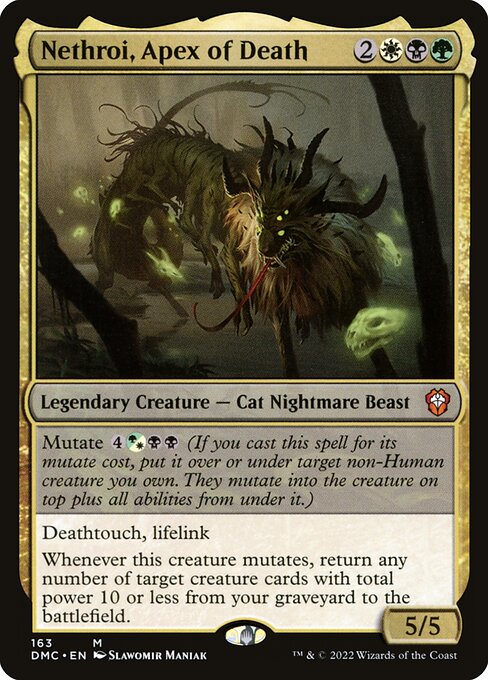
The mutate cost is the whole conversation. Nethroi, Apex of Death costs five to play initially and then requires a second, heavier cast to mutate onto a non-Human base creature you already control. If that base creature eats a removal spell in response to the mutate, you've spent mana and gotten nothing. That is a real, painful failure mode, and you need to build around it with hexproof or indestructible bases to make it consistent.
Okay. Here's where it gets absolutely cracked.
The trigger reads "return any number of target creature cards with total power 10 or less from your graveyard to the battlefield." Zero-power creatures don't count against that ceiling. Viscera Seer, Spore Frog, Stitcher's Supplier, Satyr Wayfinder, stack ten of them in your graveyard and return all ten in one mutation. You're not reanimating one bomb. You're reconstructing your entire utility creature infrastructure in a single moment. Seer is back online. Frog is ready to fog. Supplier fills the graveyard again on entering. The board state goes from zero to overwhelming in one cast.
Mix in actual power and the ceiling gets ridiculous. Woodfall Primus has six power, so one mutation could bring back Primus plus four zero-power enablers. Karmic Guide fits cleanly alongside four more utility bodies. The deathtouch plus lifelink base means Nethroi itself wins combat against basically anything while you wait to set up the kill mutation.
Abzan colors give you access to the deepest reanimation toolkit in the format, and the deck rewards that depth. The mutate constraint is real, the deck is genuinely complex to pilot, but when it goes off, it goes off.
Karador, Ghost Chieftain
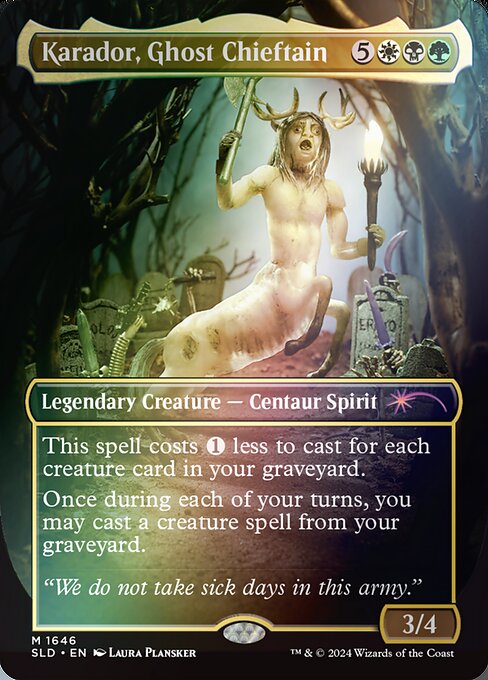
There's something bittersweet about playing Karador at a table in 2025. You slam the card, someone across the table visibly relaxes, not because they're not threatened, but because they know exactly what's coming. The slightly-tired "oh, a Karador deck" reaction is real. The meta has largely seen this movie. And honestly? That reaction isn't wrong. It's just incomplete.
Karador was THE graveyard commander for a generation of Commander players. He taught people how looping Eternal Witness worked, how Spore Frog plus recursion can freeze combat indefinitely, how Reveillark plus Karmic Guide creates one of the format's oldest and most satisfying combo loops. That pedigree is not nothing. And the cost reduction means by mid-game you're casting an 8-mana commander for three generic mana, a 3/4 with a once-per-turn graveyard cast attached. In a long game, casting Viscera Seer every turn cycle for a single scry is understated and quietly oppressive.
One creature per turn is too slow for the current meta. Teval generates three value streams simultaneously on attack. Meren can escalate to full reanimation without spending extra mana. Karador asks you to use your whole turn to get back one body. That's a tempo problem the modern field doesn't forgive.
As a budget entry point, though? Still excellent. Karador himself is genuine bulk at around thirty-four cents, the Abzan core package is widely available, and the deck plays in a way that genuinely teaches the archetype. Start here if you're new. Upgrade from here when you're ready.
Slimefoot and Squee
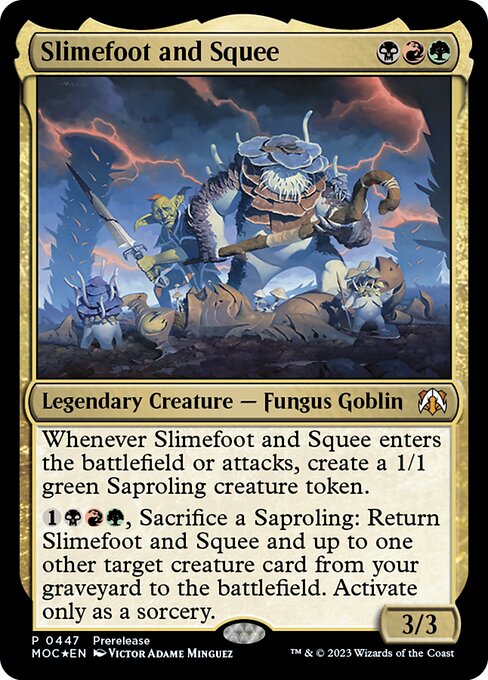
Turn four. You have Slimefoot and Squee on board plus a Saproling token from last turn's attack. You activate: {1}{B}{R}{G}, sacrifice the Saproling. Slimefoot and Squee returns from your graveyard to play, along with whatever bomb you milled or discarded in the previous two turns. Two bodies on the board. Commander reset to dodge any tax you'd accumulated. And when Slimefoot and Squee attacks again on your next turn, you're making another Saproling to fuel the next activation cycle.
That self-bounce is the key. You're not just recurring threats, you're also protecting yourself from command tax inflation. Every time you activate, Slimefoot and Squee returns fresh. Opponents who spent removal on it early just gave you a free reset. The loop is almost entirely self-contained: attack to make the Saproling, sacrifice the Saproling to refuel, swing again.
Jund (B/R/G) is a genuinely unusual shell for reanimator, and red unlocks some graveyard-fill angles that pure Golgari misses. Faithless Looting is in color here. Archfiend of Ifnir turns your cycling and discarding into a one-sided board wipe. Dread Return flashback, sacrifice three creatures, return your biggest bomb, becomes trivially easy when you're generating tokens every attack. Ashnod's Altar converts those tokens into mana that powers even bigger activations.
The weakness is real: sorcery speed only, four-mana activation, can't respond to interaction with a surprise reanimate. But the self-sustaining token loop is hard to fully disrupt, and the deck hits faster than people expect it to. Tendershoot Dryad amplifies the whole plan obscenely once you've got the city's blessing.
Sefris of the Hidden Ways

You know those tabletop RPG sessions where the whole party descends into a dungeon, clears rooms one by one, and finally emerges with the treasure after four hours of careful play? That is exactly the Sefris experience. She's the most deliberately paced reanimator on this ranking, and I mean that as a genuine design observation, not an insult. She models the dungeon-crawl fantasy better than most dungeon cards actually do.
The mechanic: whenever one or more creatures hit your graveyard from anywhere, you venture into the dungeon. Once per turn. Complete a dungeon, return any creature from your graveyard to play, no mana value restriction, no power cap, no strings. In a reanimator deck where creatures hit your graveyard constantly, you're advancing the track every turn. Dungeon of the Mad Mage takes three or four rooms to complete, so you're looking at three to four turns of setup before the first free reanimate.
That's the honest weakness. Three turns of "I'm building toward something" is visible, slow, and gives opponents time to prepare. Massacre Wurm, Void Winnower, both legal targets, no restrictions, but opponents know they're coming.
Esper (W/U/B) gives Sefris access to counterspells and interaction to protect the setup turns, which matters more here than on any other commander in the format. Dread Return as a flashback option, sacrifice three creatures to skip ahead if you're close to completing a dungeon, is worth knowing. The combo is slower, but the payoff when it lands is completely unconditional.
Betor, Ancestor's Voice
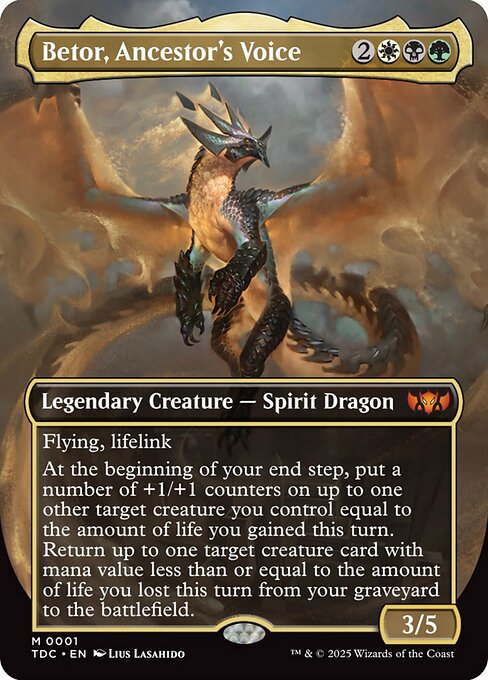
Betor is the most misread commander on this ranking. Players see "flying, lifelink, return creature equal to life lost" and immediately start building a lifegain deck full of Soul Warden effects and Kitchen Finks. That's not the point. The real build is about orchestrating deliberate, controlled life swings every single turn to guarantee both triggers fire.
Here's how it actually works. Betor attacks. Lifelink generates life gained, that goes to +1/+1 counters on another creature you control, growing your board. Separately, you pay life deliberately through something like Doom Whisperer or Priest of Fell Rites. That life lost gates the reanimation: return a creature with mana value less than or equal to life lost. Pay enough life and there is no cap. Razaketh, the Foulblooded is a legal target. Devastating.
The contrast with Terra, Herald of Hope is sharp here. Terra's reanimation is capped at power 3 or less. Betor's is capped by how much life you're willing to spend, which in a lifelink deck is a flexible, player-controlled variable. That asymmetry is the whole reason to build Betor.
Abzan colors mean Betor shares nearly the entire core package with Meren, Karador, and Nethroi. Lathiel, the Bounteous Dawn belongs in the 99 as a counter amplifier that doubles down on the life-gained side. The honest tax is cognitive: tracking life gained and life lost as separate values each turn, while managing a board, is genuinely demanding. Betor rewards players who can think in two separate life-swing lanes simultaneously.
Sidisi, Brood Tyrant
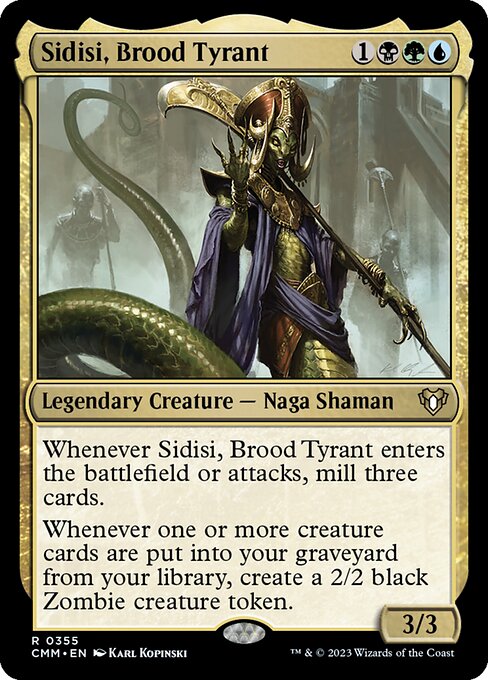
Think of Sidisi as Teval's older sibling who hasn't quite figured out what makes Teval so much better at the same job. Same Sultai colors. Identical attack-to-mill trigger. Identical zombie spawning model. The comparison is direct and the gap is real, but Sidisi has something Teval doesn't, and it matters for a specific kind of build.
Sidisi mills three on ETB and attack, then creates a 2/2 Zombie if any creature was among the milled cards, the trigger fires once per mill event, not once per creature milled. In a high-creature-count deck, one attack creates one Zombie token if any creature hit the yard, plus a yard full of reanimation targets. Chain multiple separate mill events in a turn and those Zombie tokens stack up fast. Gravecrawler synergizes perfectly: Sidisi gives you Zombies to satisfy Gravecrawler's "control a Zombie" requirement, turning the graveyard into a recursive resource for sacrificing and replaying the same one-drop over and over. Life from the Loam dredge keeps triggering Sidisi's mill during draw steps, building both graveyard density and land count simultaneously. Stitcher's Supplier and Altar of Dementia round out the self-mill package cleanly.
Where Sidisi loses to Teval: no land reanimate means no covert ramp acceleration from the combat trigger, and the Zombie spawning only fires on creatures milled, not on any card leaving the graveyard. Teval's second trigger is absurdly wider. Every reanimation, every Dread Return, every opponent exiling your graveyard creates tokens for Teval. Sidisi's window for making Zombies is narrower and slower.
But for players who want Sultai with a clear zombie tribal identity, Sidisi is still the pick. It's a focused game plan and a genuine blast to play. Top pick for beginner Sultai if you want to attack, mill, and feel the board growing every turn.
Raffine, Scheming Seer
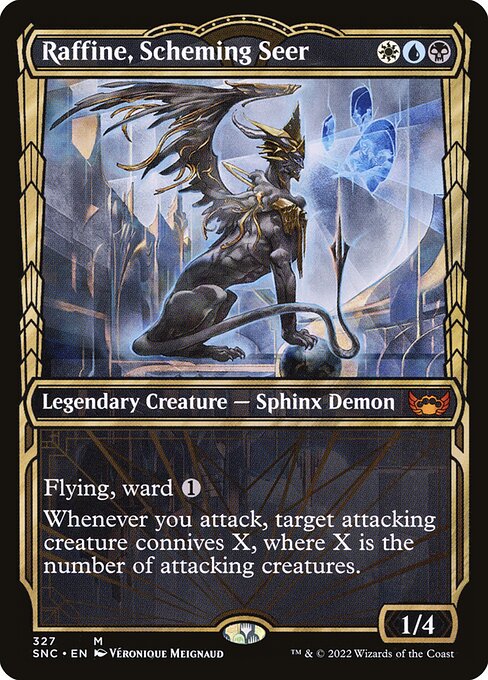
Turn four. You have Raffine plus four token creatures in play, let's say two from Adeline, Resplendent Cathar and Ledger Shredder growing steadily. You attack with all five. Raffine's connive trigger resolves, targeting Raffine: connive 5. Draw five, discard five. In those five discards, you put a bomb creature and some reanimation spells in the graveyard while keeping your best interaction in hand. You pass the turn with seven mana up. At end step, cast Reanimate. That is the dream.
A lot has to go right to get there. The token package: Adeline, Ledger Shredder, and additional wide-board generators eat deckbuilding slots that aren't going to reanimation pieces or cemetery setup. Ward {1} does not protect Raffine from board wipes, and she is an immediate removal magnet the moment the table understands what she's doing. You absolutely need counterspell backup in the 99.
What separates connive from every other discard-filter commander ability is the counter stacking. Each creature you target grows into an aggressive threat in parallel with your reanimation gameplan. You can bring back Massacre Wurm for the board wipe effect while also growing a lethal attacker. Void Winnower returns and immediately prevents opponents from casting most of their deck.
Unburial Rites with flashback is perfectly positioned here: discard it during connive, cast it from the graveyard on your following turn. Animate Dead recurs out of the graveyard cleanly. Raffine has the highest ceiling of any discard-filter reanimator in this ranking, and she's also the hardest to build correctly. Those two facts are not unrelated.
Terra, Herald of Hope
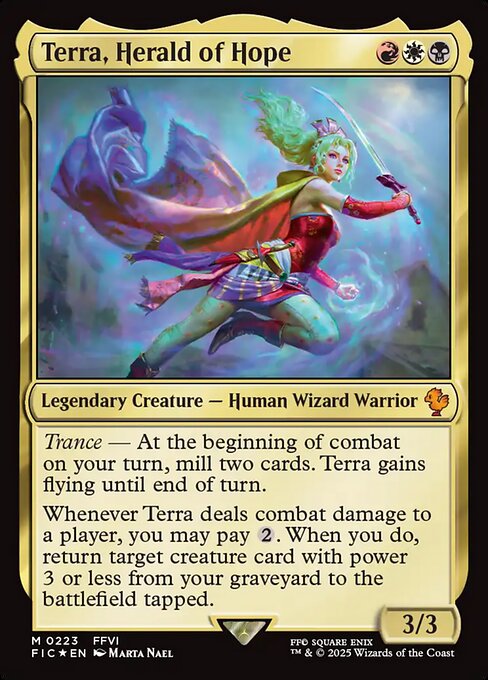
Power 3 or less. That's the line, and there's no point pretending it isn't a real restriction in a format where the dream is returning Razaketh, the Foulblooded to the battlefield from eight or nine mana down to zero. Terra can't do that. If you're building Terra to reanimate bombs, you've misread the card entirely.
The actual pitch: the strongest creatures to reanimate aren't always the biggest ones. Priest of Fell Rites (2/2) sacrifices itself to return any creature from your graveyard to the battlefield, a dedicated reanimation engine you can loop with Terra. Karmic Guide (2/2) reanimates another creature on ETB, creating a chain. Viscera Seer (1/1) gives you a free sacrifice outlet the moment it touches the battlefield. Stitcher's Supplier (1/1) mills three on entry and death. Luminous Broodmoth (3/4) auto-recurs every non-flying creature you control on death, returning your whole utility package to the battlefield without spending a Terra trigger. Terra as a toolbox reanimator, pulling exactly the utility piece you need at exactly the right moment, carves out an identity no other commander here fills.
The Trance keyword does real work: at the beginning of combat, mill two cards and Terra gains flying until end of turn. That single line handles both filling your graveyard and evasion simultaneously, which means Terra can consistently trigger even into mid-sized blockers. Faithless Looting is in color here and pairs perfectly. Luminous Broodmoth keeps every non-flying utility creature returning on death, building a self-sustaining recursion layer underneath Terra.
Mardu (W/B/R) is the freshest reanimation color identity on this ranking, with almost no competition in this slot. If you want to be the player at the table running a graveyard commander nobody's seen before, Terra is your pick.
Meren of Clan Nel Toth
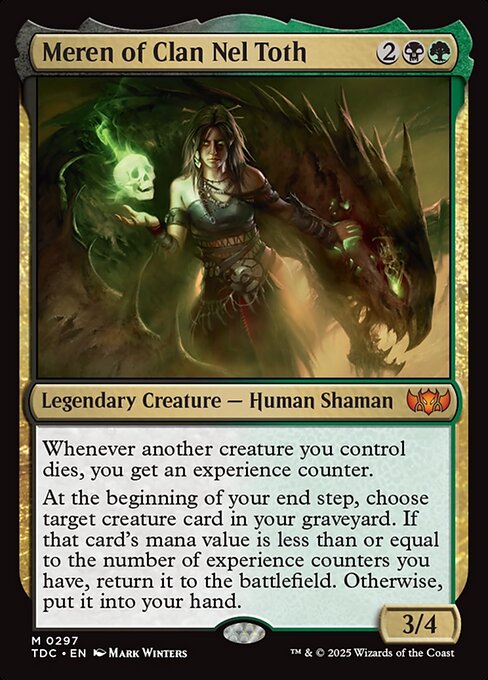
There is a specific moment every Meren player knows. It's around turn five or six. You've been quietly gaining experience counters, and then Spore Frog hits the graveyard. The table watches you place your end step trigger. Frog returns. They groan, because they know what's about to happen: every attack step, forever, unless someone has an exile effect, will be fogged. The board freezes. Meren starts operating in a locked game where she's the only one doing things. That creeping sense of inevitability is the Meren experience, and once it clicks into place, there's no elegant way for most tables to stop it.
The experience counter mechanic is the genius of this design. Counters stay on the player, not the card. Meren gets removed, returns, and picks up exactly where she left off. The loop doesn't reset. At the end of each of your turns, you choose a creature in your graveyard: if its mana value is at or below your counter count, it returns to play. Otherwise it goes to your hand. Both modes are useful; the hand mode feeds cards like Ashnod's Altar or Tortured Existence for additional loops.
Viscera Seer plus any value creature is the clean repeatable loop: sacrifice, scry, Meren returns it next end step for free. Living Death as a one-off nuclear option resets the board in your favor. Eternal Witness recurring every turn cycle gives you any card back from the yard over and over.
The 2025 honest take: Teval does self-mill plus reanimate plus a creature token from a single combat trigger. Meren requires the full 99 to reach that same output. Her floor, consistent, reliable, very hard to fully disrupt, is higher than almost anything else here. Her ceiling is lower. She remains the best starting point for the archetype, but not the strongest commander in it.
Hashaton, Scarab's Fist
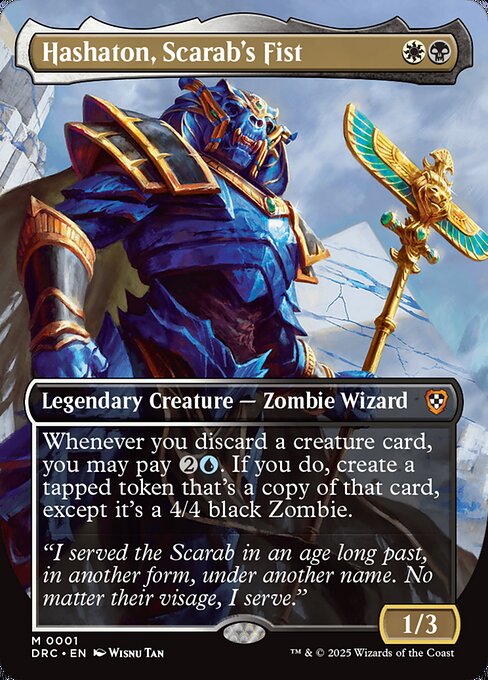
Hashaton is the most undervalued commander on this ranking, and the community has largely slept on it. Players who sleeve it up at tables where nobody knows the card get a real, tangible advantage: opponents don't know when to hold up interaction, what to counter, or which discard outlet to kill.
The trigger: whenever you discard a creature card, you may pay {2}{U} to create a tapped 4/4 black Zombie that's a copy of the discarded card, retaining its abilities at a 4/4 body. That single line does two things simultaneously that most graveyard-based commanders can't pull off together. You're filling the graveyard and building a board. Every wheel effect, every draw-discard engine, every Archfiend of Ifnir cycling activation is also deploying threats. You're not choosing between "load the graveyard" and "develop the board." You're doing both on the same trigger.
The optional {2}{U} payment is actually a feature, not a tax. You choose which discarded creatures become Zombies and which stay buried for later reanimation via Reanimate or Animate Dead. The decision-making texture is real: do you convert a bomb into a 4/4 now, or save it for a proper resurrection trigger that brings back the full body with all its keywords?
Hashaton himself costs {W}{B}, two mana. The commander tax burden is almost nothing. You can recast him three or four times in a game without ever feeling the pain that sinks other commanders. Esper (W/U/B) gives access to counterspells, exile removal, and graveyard protection that the Golgari commanders here don't get. Raffine, Scheming Seer as a 99-card include makes the discard-filter angle degenerate fast. If you play Esper graveyard, this is your commander.
Muldrotha, the Gravetide
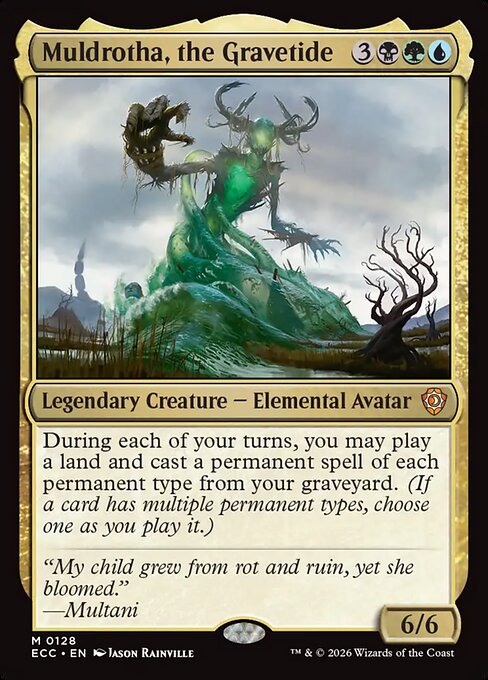
Muldrotha is better understood as a graveyard-permanents engine than a pure reanimator. Compare to Meren: Meren is a dedicated creature recursion engine. Her 99 is full of creatures to reanimate and sacrificers to trigger the loop. Muldrotha's card text reads: "During each of your turns, you may play a land and cast a permanent spell of each permanent type from your graveyard." Not creatures only. Permanents. Every type.
That distinction shapes the entire 99. Muldrotha wants Entomb not just to pitch a creature, but to pitch any permanent, an enchantment, an artifact, a planeswalker, so she can cast it on your following turn. Animate Dead under Muldrotha becomes a recursive engine: reanimate a creature, Animate Dead leaves play, Muldrotha recasts it on your next turn for a new target. Life from the Loam cycles through three lands per turn and keeps refueling the graveyard for more Muldrotha casts. Perpetual Timepiece mills two per turn and guards against exile effects, and Muldrotha just recasts it if it's removed. Everything is a resource.
Calling her a pure reanimator is what sends people down wrong build paths. They run too many creature-only payoffs and not enough permanent diversity, missing the real engine entirely. Sultai (B/G/U) is the deepest graveyard identity in the format, and Muldrotha exploits every inch of it.
Versus Teval: Muldrotha is broader, more versatile, and plays in more directions simultaneously. Teval is faster, has built-in self-mill, and is easier to extract raw power from. Both belong in the top two. Teval edges her out specifically as a pure reanimator. As the widest graveyard commander in the format, Muldrotha has no equal.
Teval, the Balanced Scale
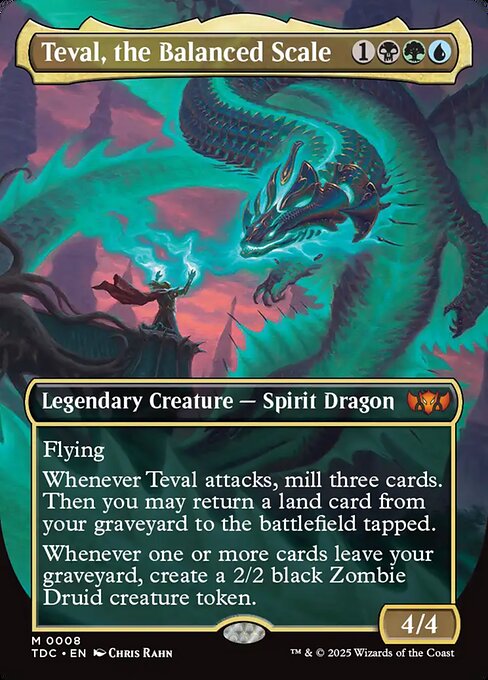
Turn five. Teval is in play. You attack. The mill trigger resolves: three cards go to the graveyard, and one of them is a land. You return that land to the battlefield tapped, you're now at seven mana sources. Two of the other milled cards are Sidisi, Brood Tyrant and a Syr Konrad, the Grim. You cast Living Death with your extra mana. When Living Death resolves, all those cards leave your graveyard simultaneously as a single event, so Teval's second trigger activates once, dropping a 2/2 Zombie Druid onto the battlefield after the spell finishes resolving. Living Death hits. Everything returns. Syr Konrad pings every opponent for damage as creatures enter from the graveyard. The board state has gone from "one 4/4 flying dragon" to "fifteen power across the table, opponents at low life, full graveyard refueled." That's Teval in action.
The land-return trigger is secretly ramp acceleration dressed as value. Every Teval attack that mills a land is mana-positive in roughly the same way Life from the Loam dredge is: you're turning cards in library into mana production ahead of curve. By turn seven, a consistent Teval pilot is often operating on nine or ten effective mana sources.
The second trigger, whenever one or more cards leave your graveyard, create a 2/2 Zombie Druid, is the absurd part. It activates on reanimation spells. It activates on Dread Return flashback. It activates on Living Death. It activates when opponents exile your graveyard with Bojuka Bog. Every act of graveyard interaction produces more board presence. The trigger is so wide that attacking Teval's graveyard actively makes the problem worse for opponents.
Sultai is the strongest graveyard colors in the format, and the precon shell is playable out of the box. Avenger of Zendikar as a primary reanimation target turns the growing Zombie army into a one-shot alpha strike, and at a fraction of the cost of other bombs, it fits perfectly in a budget-friendly build. Syr Konrad, the Grim in the 99 punishes every card that enters or leaves the graveyard, in a Teval game, that's constant damage across an entire table. No other graveyard commander in Commander right now generates this much value from interaction alone. The debate is largely settled.
Rising Stars: New Reanimator Commanders to Watch
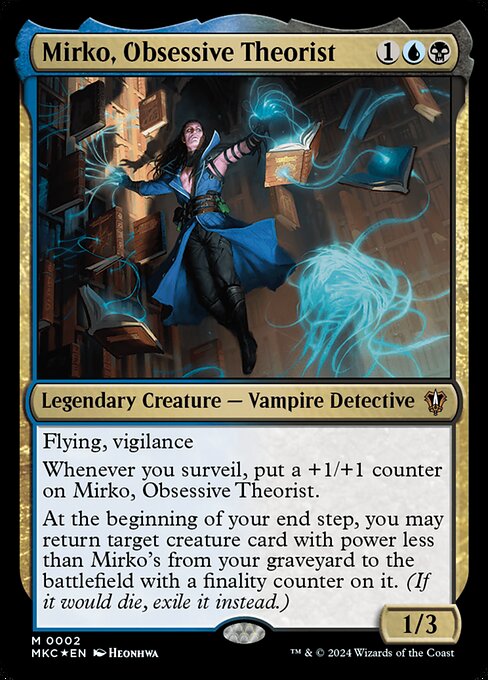
Mirko, Obsessive Theorist is the Dimir commander brewers need to take seriously. His surveil-based scaling creates reanimate targets worth watching as the surveil card pool keeps expanding: the more you surveil, the bigger he gets, and his end-step trigger returns any creature with power less than his own. The finality counter prevents infinite loops, keeping the design honest, but a Mirko who's surveilled eight or ten times is returning enormous threats every single end step. He rewards patience and a heavy surveil package, sitting in a color pairing with incredible interaction to protect the setup.
The budget option nobody's fully solved yet is Moseo, Vein's New Dean. The Infusion trigger at your end step returns a creature from the graveyard with mana value equal to or less than the life you gained this turn. Pair him with Stitcher's Supplier entering to mill while your Pest attacks for a life point, and you're triggering Infusion consistently on a tiny investment. The life-gained gate scales with every additional life source you add, more lifegain means larger creatures eligible for return. Genuinely cracked ceiling for a three-mana mono-black build.
Glarb, Calamity's Augur is the odd one out: not traditional reanimation but a graveyard-adjacent topdeck engine worth watching closely. His {T}: Surveil 2 fuels a hand of high-mana-value spells you can play off the top of your library. Doom Whisperer plus Glarb can survey your entire deck in a few turns at the cost of life, setting up a topdeck full of bombs to cast without ever touching your hand. The deathtouch body blocks almost anything while you set up, and the approach is different enough from the other options here that it won't compete for the same slots in your brewing shortlist.
Building Your Graveyard Commander: The Non-Negotiables
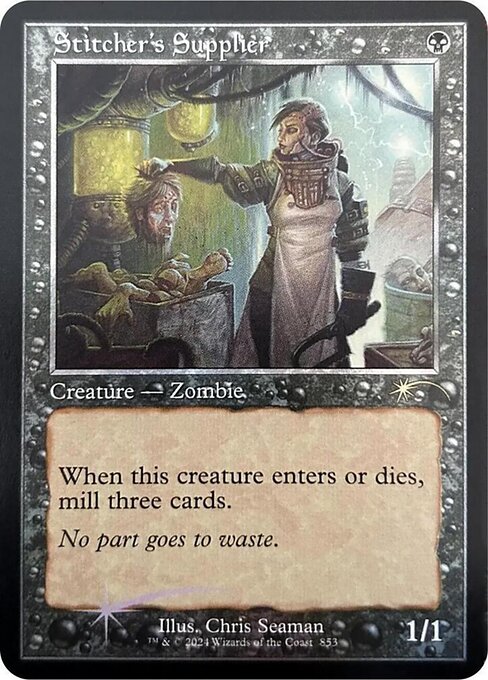
Every reanimator deck needs the same foundational infrastructure, and if you skip any of these three components, the deck stalls. Here's the checklist.
Graveyard fill (10-15 effects minimum). These are your gasoline: Stitcher's Supplier mills three on entry and death. Satyr Wayfinder selects a land from the top four and bins the rest. Skull Prophet taps to mill two at any point you have priority, not just on your own turn. Perpetual Timepiece mills two per activation and doubles as graveyard protection by shuffling your cards back when exile effects hit. Faithless Looting with flashback gives you two graveyard-loading casts from one card. Buried Alive tutors three creatures directly to the graveyard, the fastest setup spell in the archetype. Entomb puts any card from your library into the graveyard at instant speed. Fill the yard through multiple angles; mono-mill is fragile, mono-discard is inconsistent.
Sacrifice outlets (three minimum, creature-based preferred). Ashnod's Altar is the engine here: it converts dying creatures into colorless mana, funding your reanimation loop on the spot. Viscera Seer scries every time you sacrifice, filtering your draws while enabling ETB reuse. Altar of Dementia mills opponents or yourself equal to the sacrificed creature's power, turning every death into graveyard progress. Free ways to sacrifice protect against exile removal and reset ETB triggers every time you bring a creature back.
Reanimation suite (eight to twelve effects, balanced by speed). Reanimate is your fastest play, cost paid in life. Animate Dead is recursive under commanders like Muldrotha. Dread Return offers a free flashback through three creatures sacrificed, essential when your graveyard is full of tokens. Unburial Rites with white flashback gives two reanimation casts from one card. Victimize returns two creatures for one sacrifice. Balance your instant/sorcery split: you want enough flashback and recursion that graveyard hate doesn't shut you off entirely.
Universal support: Eternal Witness works in every build that includes green and loops infinitely with recursion effects. Syr Konrad, the Grim punishes opponents who exile your graveyard, every creature that leaves deals damage to each opponent, turning their interaction into a liability.
The Best Reanimator Commanders: Final Verdict
Teval, the Balanced Scale is the top graveyard recursion commander right now. Not just for beginners, not just in casual pods, not just for players who want a precon starting point. For anyone building graveyard recursion in Commander, Teval is the answer, and the gap between her and the field has widened since she released.
The Muldrotha, the Gravetide discourse is largely overblown in both directions. She's not broken. She's also not mediocre. She's a great graveyard-permanents engine that gets misbuilt constantly because people treat her like a creature reanimator and wonder why the deck feels slow. Build her correctly, with diverse permanent types, graveyard-based recursion loops, Entomb for any card, and she's excellent. Build her like a Meren clone with a six-mana cost and no built-in mill, and you'll be disappointed.
The most contrarian take I'll commit to: Hashaton, Scarab's Fist is quietly better than its community coverage suggests, and the surprise factor at tables where nobody's seen it is itself a competitive advantage. Two-mana commander, creates 4/4 Zombies from your discard pile, optional {2}{U} cost per trigger. That is a busted rate that deserves more attention than it gets.
The archetype is moving toward commander-does-the-work builds. Teval, Mirko, Hashaton, stepping away from enabler-heavy 99s where the commander is just a body with upside. Karador, Ghost Chieftain lists and older Meren of Clan Nel Toth builds that rely on 30+ support cards to get the recursion loop running are going to feel increasingly dated. Meren is still the best place to start the archetype. She's just no longer the best place to finish.