

Who Is Dack Fayden, Helping Hand?
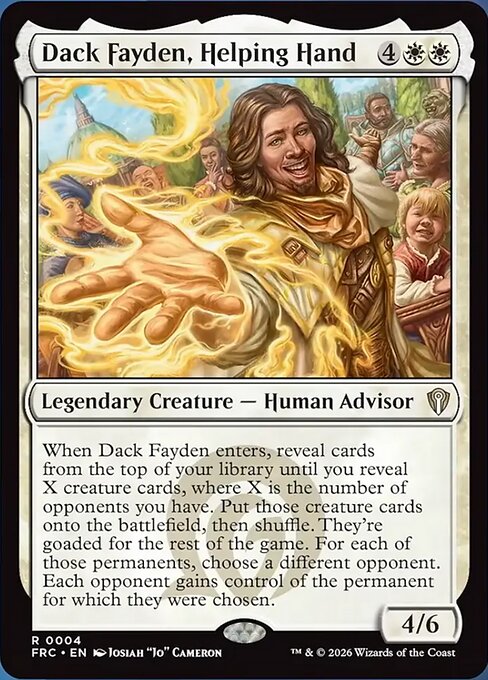
Strip the flavor away and Dack Fayden, Helping Hand does three things off one trigger: reveal cards from the top of your library until you hit as many creatures as you have opponents, slam all of them onto the battlefield under your control, then hand each one to a different opponent while marking it goaded for the rest of the game. That's the whole card. He isn't removal, he isn't a wrath, and he doesn't draw you a single card on his own. He's a 4/6 for six mana whose entire value proposition is a one-time reveal-and-goad burst that scales directly with how many people are sitting across the table from you.
In 1v1, X is one. You reveal until you hit a single creature, put it into play, goad it, and hand it to your one opponent. That's a mediocre gift. I've played this in a four-player pod where X came up three off a single reveal, and the table spent the next several turns fighting itself instead of me, which is a completely different card from the 1v1 version, and the gap between those two experiences is the entire reason this guide exists.
Because Dack is mono-white, he brings nothing to the command zone in the way of card draw or ramp. Every rock, every cantrip, every scrap of mana fixing in the 99 has to come from the deck you build around him. He's also brand new, arriving as the mono-white alternate commander in Reality Fracture, the set hitting shelves October 2, 2026, which means the rules interaction on his own ETB trigger is already getting misplayed at kitchen tables before most players have cracked a second pack. Section two fixes that.
The Plan: Flicker Dack, Goad the Table, Take It Back
Early turns look like any other white value pile: mana rocks, land-fixers, and cheap creatures with ETB triggers doing work before his ability ever comes into play. You're not trying to build a scary board early. You're trying to make sure the top few cards of your library, wherever Dack's reveal lands, are cards you're happy to lose.
Midgame is when you cast Dack, ideally after you've already dug into the deck a bit so you have some idea what's sitting up top. The moment he resolves, you want a flicker spell in hand, because one Dack trigger is a nice value play and a second or third trigger in the same game is a genuinely disruptive turn for the whole table. Late game, the deck becomes a repeatable engine: flicker Dack, goad more creatures, and let the table spend the rest of the game fighting off permanently-weaponized threats that used to be sitting in your deck, while you sit behind removal and protection you didn't have to spend goading anybody.
Here's the part that gets misplayed constantly, and it's the whole rules-explainer hook for this card. When Dack's trigger puts those creature cards onto the battlefield, they enter under YOUR control first. Handing them to opponents is a separate, later instruction in that same ability. So if you reveal an Inspiring Overseer or a Welcoming Vampire, its own enters-the-battlefield trigger belongs to you, not the opponent about to receive the creature. You draw the card and gain the life before that Overseer ever becomes someone else's problem, because the game determines who controls a triggered ability by who controlled the source at the moment it triggered, and at that moment Dack hasn't handed anything away yet. Miss this and you'll watch players give away free value they were entitled to keep. Don't be that player.
The other detail worth knowing cold: standard goad wears off at the start of the goading player's next turn. Dack's text overrides that completely. "Goaded for the rest of the game" means these creatures never come off the leash, forcing their new controllers to attack someone other than you, every combat, for as long as the game lasts.

The Blink Package: Dack's Real Engine
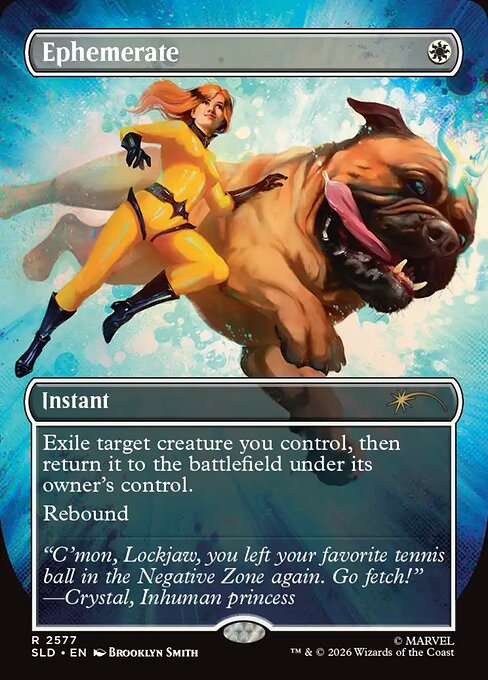
One Dack trigger is fine. A second one is why you're building this deck at all. The cheap one-mana blink spells are basically interchangeable: Ephemerate and Cloudshift both exile Dack and return him to re-trigger the reveal-and-goad ability, and Ephemerate's rebound means one card in your hand buys you two triggers across two turns, with the second one completely free. Run both. There's no reason to pick a favorite when they cost about a dollar apiece and do the identical job.
The creature-based flicker effects are the better long-term investment, since they're threats that stick around instead of one-shot spells headed straight to the graveyard. Flickerwisp is a 3/1 flyer that blinks Dack on a body you can attack with. Restoration Angel does the same thing at flash speed, meaning you can flicker Dack in response to removal aimed at him and dodge the kill entirely. Charming Prince is the flexible one, since exiling Dack until the next end step is only one of his three modes, and the other two still pull weight on turns you don't need the redundancy.
People ask about Displacer Kitten because it's the poster child for repeatable flicker engines. It's also blue, which puts it outside a mono-white Dack list entirely, so it isn't walking into this 99 no matter how good it looks on paper. The white analog is Eldrazi Displacer, which lets you exile and return Dack every time you can pay the activation cost. That's the closest thing this deck gets to an unlimited-use Dack button, and once you're past the early turns I'd rank it above any of the one-shot instants.
Whatever mix you settle on, remember the defensive angle. Flickering Dack the instant someone points removal at him is a real line, not just a value play, because he's a massive target the moment the table figures out what he does.
Draw Engines: Stocking the Top of the Library
Dack's ability doesn't care about quality. It reveals until it hits X creatures, so whatever bomb you were saving for later is exactly as likely to get handed to an opponent as a bear you drafted as filler. The fix isn't trying to control what Dack reveals. It's making sure every creature in the deck already did its job for you before it becomes someone else's problem.
Helpful Hunter and Spirited Companion are about as low-commitment as it gets: cheap bodies that draw a card the moment they enter, so even in the worst case where Dack ships them straight to an opponent, you already banked the value and they're only getting a 1/1. Inspiring Overseer is the same idea with a flying body and a life gain trigger stapled on. Welcoming Vampire and Enduring Innocence both draw off other small creatures entering, which lines up directly with Dack dumping a pile of creatures onto the battlefield at once, since all of them enter simultaneously and can trigger each other before any of them changes hands. Rumor Gatherer scries or draws whenever another creature you control enters, so it's not a flicker target for its own sake, but leave it on the battlefield and every creature Dack puts into play alongside it sets off that trigger before any of them get handed away.
The filter for this deck is simple: reward "ETB payoff that already happened" over "ongoing threat you're handing away." A five-mana bomb looks exciting on paper until you remember Dack might just gift-wrap it for the player on your left. A cheap cantrip creature that already drew you a card is a win no matter whose battlefield it ends up on.

The Removal Suite
This isn't a control deck, and the removal package shouldn't pretend otherwise. The whole plan wants opponents fighting each other with permanently-goaded creatures, so every card spent wrathing the board is a card that isn't stocking the library or protecting Dack. Keep it light and efficient.
Skyclave Apparition is the best piece here because it hits any nonland, nontoken permanent you don't control with mana value 4 or less, covering the artifacts and enchantments mono-white otherwise struggles to answer, not just creatures. It can't touch tokens, and it isn't limited to opponents specifically, so in multiplayer it's fair game against anything you don't control. Add Loran of the Third Path for a second answer to artifacts and enchantments on a body that also draws a card later, and its tap ability handing an opponent a card is a small political gesture in a deck that already relies on the table not hating you out first. Neutralizing an alpha strike without destroying anything: that's what Teferi's Reproach does, phasing out a problem player's board and freezing their life total until their next turn, which keeps the political temperature lower than a wrath would. Keep Sunfall as your single mass-removal option, held for the moment the table stops fighting each other and turns on you instead; exiling everything, including the creatures you goaded away, resets a game that's gone sideways, and the incubated token is yours to keep.

Homeward Path and the Ownership Loophole
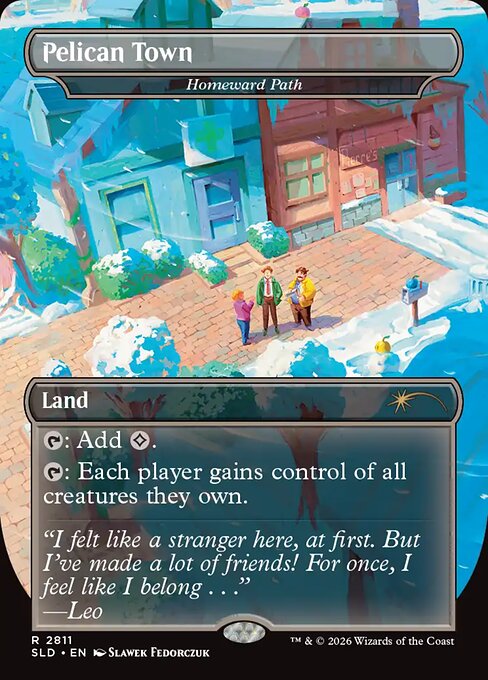
Homeward Path is Dack's single best card, and it isn't close. The creatures Dack puts into play still came out of your library, so you still own those cards no matter who's currently controlling them. Homeward Path hands control back to each player for the creatures they own, which for you means every creature Dack ever gave away comes right back onto your side of the table whenever you need it. It also means any opponent's creature you'd somehow ended up controlling would go back to them, but in this deck that's rarely the side of the ability doing any work.
Here's the payoff most players miss entirely. Goad doesn't care who currently controls the creature, it cares who caused the goad in the first place: a goaded creature must attack a player other than the controller of the permanent that goaded it, forever. Take one of those creatures back with Homeward Path and it's still goaded, still forced to attack every combat, and still legally barred from ever attacking you. You just turned an opponent's board presence into a forced attacker aimed at your other opponents, sitting on your side of the battlefield. That's not a cute rules trick. That's the best card in the deck doing exactly what it says on the tin.
Pair the ownership loophole with Panharmonicon, which doubles Dack's own ETB trigger the very first time he enters, producing two full reveal-and-goad sequences off one cast before you've spent a single flicker spell. Conjurer's Closet turns that into a repeatable, no-cards-required engine, flickering Dack at every end step without eating your mana on your own turn. Once the board is full of forced attackers who can't touch you, close with Grand Crescendo: making your own army indestructible right as the goaded creatures start swinging is exactly the insurance policy a deck built on other people's combat math needs.
How to Build It: Precon Rebuild vs. Competitive Mono-White Blink
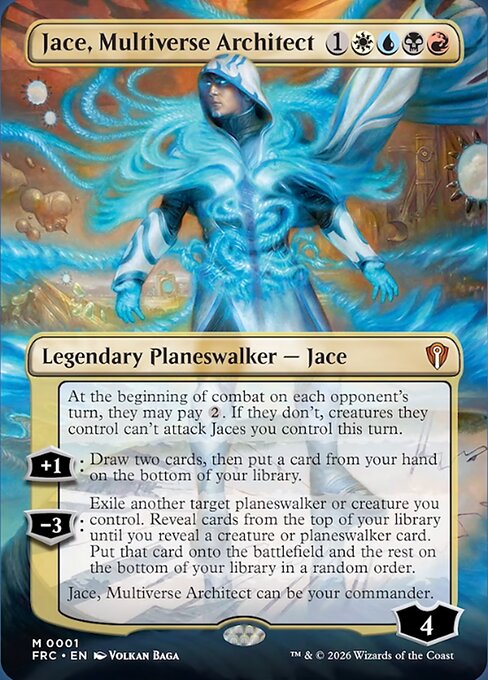
Be honest about what you're starting from. Dack ships as the alternate commander inside Reality Fracture Commander's precon, and that box's actual 99 is built around Jace, Multiverse Architect's four-color polymorph plan, nowhere near mono-white. Swapping to Dack means cutting the overwhelming majority of that decklist on day one. This isn't an upgrade path where you trade twenty cards for twenty better ones. It's a rebuild, and you should plan for it like one.
Budget path: keep whatever cheap white creatures survived the swap, add Homeward Path on principle, and pick up a handful of the cheap flicker spells from section three. That gets you a functional deck that runs the core loop without any of the doublers.
Tuned build: the full flicker suite, the denser draw engines from section four, Panharmonicon and Conjurer's Closet both in the 99, and just enough removal to survive to the point where the engine takes over.
Political or group-hug build: lean all the way into "goaded for the rest of the game" as table-wide deterrent. You're not trying to win fast here. You're making everyone else's board a liability for everyone else, and holding up Teferi's Reproach while the table burns itself down is the whole plan.
The Verdict: Is Dack Fayden, Helping Hand Worth Building?
This is a build-your-own-fun commander, not a stax piece and not a combo finisher. At four players, with the blink package online and Homeward Path ready to steal your own goaded creatures back, Dack is a genuinely nasty repeatable engine that turns your opponents' combat steps against each other while you sit out of the crossfire. That's the ceiling, and it's a real one.
The floor is a mediocre one-shot. In 1v1 or a small pod with a low creature count, X never gets big enough to matter, and you've spent six mana on a 4/6 that handed one opponent a decent creature and called it a day.
Run this if you love white-based blink shells and political tables where forced combat actually changes who's attacking whom. Skip it if you mostly play 1v1, or if you want a commander that wins the game by itself instead of one that wins by making everyone else fight. Dack doesn't close games. He starts fights and lets the table finish them.

