
Who Is Jace, Multiverse Architect?
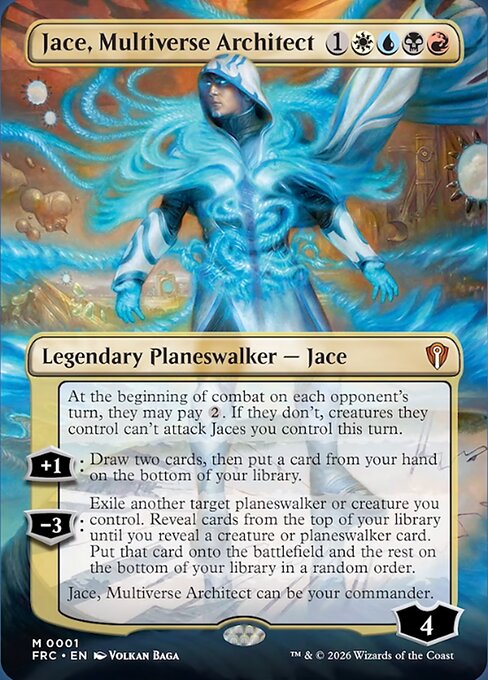
Jace, Multiverse Architect is a five-mana trap that looks efficient until you do the loyalty math. On paper he reads like a model face commander, the kind of planeswalker a precon builds an entire card advantage engine around, efficient and self-sufficient in the way good five-drops are supposed to be. His passive ability makes opponents pay {2} before they can swing creatures at any Jace you control, his +1 draws two cards and bottoms one, and his −3 exiles another planeswalker or creature you control and reveals cards off the top of your library until he hits a creature or planeswalker, which he then puts onto the battlefield. That's an efficient package for five mana in a commander slot, but the loyalty numbers tell a different story once you actually use him.
He enters at four loyalty, and the −3 that does the actual work leaves him standing at one, barely clinging to life the turn he starts earning his cost back. The static ability only taxes attacks aimed at Jace himself, not at your face, so it offers you zero protection as a player, and there's no hexproof, no indestructible, no board wipe baked in anywhere on this card. He also only works in exactly one four-color identity, white, blue, black, red, no green, which is rare design space for a planeswalker and the reason this deck can't lean on any of the green ramp or green recursion that props up most other big-mana commanders.
The Plan: Resolve, Minus Three, Never Look Back
Here's the core line the casual and cEDH builds are both chasing: Jace resolves on turn five, immediately exiles a cheap creature or token you already have in play, and reveals off the top of your library until he finds a creature or planeswalker to slam down in its place. That one turn is what the polymorph package and the bounce-combo package are both built to set up. There's a third build, covered below, that skips this loop altogether and leans on Jace's tax ability to protect a second planeswalker instead, but for the two builds that do run the −3 as the payoff, everything else in the 99 exists to make that one turn happen reliably and then to make the aftermath worth sitting through.
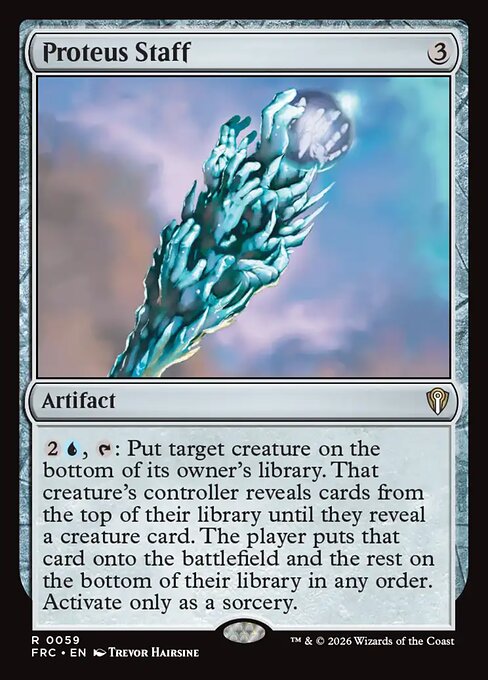
This is where the community argument actually lives. Is a five-mana planeswalker that does one powerful thing once and then grinds at +1 "efficient," or is it a one-trick pony wearing a four-color coat? Both are true. The −3 drops him to one loyalty, and climbing back to three takes two full turns of +1 activations assuming nobody so much as looks at him funny. Proteus Staff exists in this shell precisely because of that math, it reproduces a version of the −3 effect on an artifact that doesn't care what Jace's loyalty total is doing. Think of the turn windows honestly: turn five is deployment, turn six or seven is the payoff swinging, and everything after that is Jace sitting at the back of the board filtering your draws while you wait for the loyalty counters to climb back to relevance.
Your Win Conditions: What the Minus-Three Cheats Into Play
Hullbreaker Horror and Tidespout Tyrant are the two best hits, and not by a small margin, both punish every spell you cast afterward by letting you bounce something back to hand, which turns a single successful −3 into a repeating engine for the rest of the game. Archon of Cruelty is close behind: landing it off the −3 immediately forces a target opponent to sacrifice a creature or planeswalker, discard a card, and lose three life, while you draw a card and gain three, a brutal three-for-one against whoever you point it at, even without touching anyone's graveyard. Avacyn, Angel of Hope is the pillowfort answer, wrapping your whole board in indestructible the instant she lands. Void Winnower and Darksteel Angel round out the colorless top end, both are enormous, hard to kill, and mostly just a very large problem rather than an immediate blowout.
Here's the honest part: a real chunk of any creature-heavy stock library is filler against this plan, vanilla beaters that do nothing when they land off a random hit. Every slot you dedicate to the top of your library should justify itself the moment it's revealed, not three turns later.

The Polymorph Package: Enablers Beyond the Commander
Polymorph, Mass Polymorph, and Reality Scramble function as one unit, not three different strategic pillars, they're all additional shots at the "destroy something, hit a bomb" loop Jace's −3 already does for free. Polymorph can target any creature on the battlefield, not just your own, which means in a pinch it can also turn an opponent's threat into their own random gamble, usually not what you want, since you're handing them a new creature, but worth knowing. Reality Scramble is the riskiest of the bunch: it doesn't guarantee a creature, it guarantees a card that shares a type with whatever you put away, so if you're not aiming it at a creature specifically, you can whiff into a land. Mass Polymorph plays by different rules entirely: it exiles your whole board of creatures at once, then refills from the top of your library until it hits that many creature cards. It's the highest-ceiling swing of the three, flip a wide board into a pile of random bombs, but it's also the one that can cost you a creature you'd already landed off the −3, so fire it when you've got bodies to spare, not when you've got one precious hit sitting on the battlefield. Run a second or third copy of this effect only once Jace's own −3 is proven consistent in your build, redundancy here is good, but it's redundancy on a theme, not a second game plan.

Draw Smoothing and the Tax That Doesn't Protect You
Opponents can ignore the {2} cost entirely and just swing at your face while Jace sits there completely unprotected. Ghostly Prison and Propaganda fix that by making every attacker pay {2} to come at you specifically, buying the actual turns you need to get to five mana and resolve the commander in the first place. That's not a luxury include in this deck, it's load-bearing.
Once you're past turn five, Brainstorm and Brainsurge keep the +1 loop honest. Brainstorm digs for exactly the land or interaction piece you need for one mana, and Brainsurge's four-card rummage does the same at a higher volume when you're sitting on extra mana late. Both are cheap insurance that the digging you're banking on from Jace's +1 isn't the only thing standing between you and a dead draw step.

cEDH Crossover: The Bounce-Loop Combo Lines
This is the part of the card competitive players take more seriously than its precon reputation suggests. Cheat Tidespout Tyrant into play off the −3, and every spell you cast afterward lets you return any permanent to its owner's hand. Point that at your own Sol Ring and you can bounce and replay it every time you cast a cheap spell, netting mana back each loop. Hullbreaker Horror runs a tighter version of the same trick, it can only bounce nonland permanents, or an opposing spell instead, so it won't send back a land the way the Tyrant can, but against artifacts like Sol Ring it loops exactly the same and adds a pseudo-counterspell mode on top. Add Underworld Breach to the stack and your graveyard stops being a pile of spent cards. It becomes a second engine: cheap spells you've already cast come back for an escape cost, feeding the Tyrant or Horror's trigger over and over until you've either drawn through the deck or assembled lethal. This is a real cEDH angle, not a stretch, and it's the reason Jace gets taken seriously in rooms that otherwise dismiss precon commanders outright.

How to Build It: Precon Polymorph vs. Superfriends vs. cEDH
Three directions, and they don't overlap much. The casual value build keeps the original polymorph chassis: Jace, the polymorph package, a pile of honest payoff creatures, with Ghostly Prison and Propaganda holding down survival while the deck just wants to resolve the bomb once or twice a game. The superfriends build, sometimes called "Oops All Jaces," leans into the fact that Jace's tax ability protects any Jace you control, so it wants The Theorist, Jace Beleren alongside the commander for a second planeswalker drawing you cards off opponents' draw steps while sharing in that same protective tax. The stripped-down competitive build cuts almost all the stock creature targets and keeps only Hullbreaker Horror, Tidespout Tyrant, Sol Ring, and Underworld Breach as the actual engine, with everything else as lands and protection.
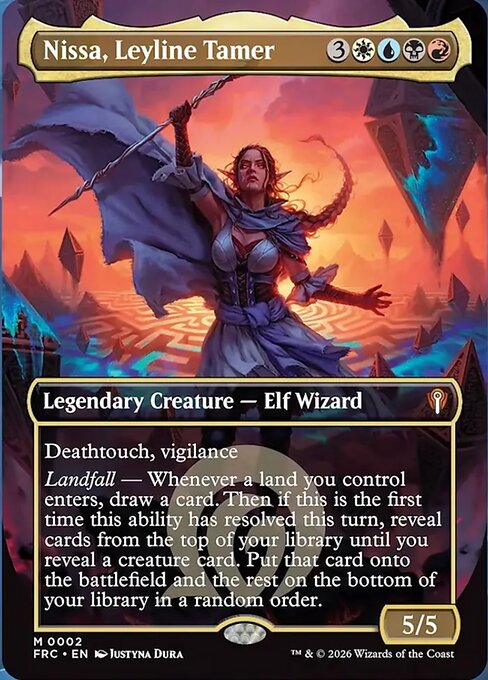
If you want a four-color face commander that doesn't force you into the one-trick −3 math at all, Nissa, Leyline Tamer does a comparable job. Every land draws you a card, and the first one each turn also reveals until she finds a creature to put straight onto the battlefield, so you get a payoff every turn without ever needing to be sacrificed for or protected the way Jace does.

The Verdict: Is Jace, Multiverse Architect Worth Building?
Yes, with conditions. Jace, Multiverse Architect is good in Commander specifically because he's a built-in gimmick, not a deckbuilding assignment, you don't have to engineer a combo from scratch, you just need to get him to turn five, exile something cheap, and let the top of your library do the rest. His floor is a fine, affordable value engine that whiffs some games and grinds out card advantage the rest. His ceiling, with Hullbreaker Horror or Tidespout Tyrant and a copy of Underworld Breach, is a legitimate cEDH bounce-combo enabler, which is more than most five-mana precon commanders can claim. If you'd rather skip the −3 math entirely, Nissa, Leyline Tamer gets you a similar payoff every turn without it. If you're fine doing one thing extremely well and drawing cards forever after, Jace is worth the build.

