
The Word Reviewers Keep Missing
Pull the card text on Tinybones, Pocket Nuisance and read the second line slowly: "Whenever a player discards one or more cards, Tinybones deals 1 damage to each opponent." Not "whenever an opponent discards." A player. Any player. That one word is why you've probably already seen two completely different takes on this card since Reality Fracture dropped, and why building a mono black discard commander deck around it means betting on one of them being wrong.
Camp one calls it limited chaff, a cute three-mana body that does a Duress impression and pings for chip damage, fine in a sealed pool and forgettable everywhere else. Camp two calls it the fix for discard's oldest Commander problem: finally, a payoff that doesn't care if the discard spell is fair, because its trigger fires off anyone's hand hitting the bin and only ever punishes the table.
Both camps are reading the same card and landing somewhere different, which tells you the card is being evaluated in different contexts. The rest of this piece settles it with rate, deckbuilding role, and what actually happens when a symmetrical edict like Liliana of the Veil's plus-one goes off with Tinybones, Pocket Nuisance on the battlefield: everyone loses a card, but the damage only ever points one way.

Quick Answer
Yes, Tinybones, Pocket Nuisance is good in Commander, but only in a specific seat. It's a strong, efficient addition to the 99 of an existing mono black discard shell, and a mediocre choice to anchor a 100-card deck on its own. Run the math and you'll see why: 1 damage per discard event is half of what Megrim does per card. The home that makes it sing is a deck already built around Tinybones, Bauble Burglar or Tinybones, Trinket Thief, not the spot at the top of your deck.

How It Stacks Up Against the Discard Payoffs Already in the Format
Start with the number, because the number is the honest part of this evaluation: Tinybones, Pocket Nuisance deals 1 damage per discard event, no matter how many cards left that hand in one action. Megrim deals 2 damage every single time a player discards a card, and it checks per card, not per event, so a spell that forces a big dump of cards at once can rack up a lot more damage off Megrim than Tinybones ever sees from the same play. That gap isn't double. It gets worse the moment a real mass-discard spell shows up.
The Rack and Shrieking Affliction play an entirely different game. The Rack scales its damage against any hand under three cards, so it's chipping away even at a hand of two, while Shrieking Affliction waits specifically for an opponent sitting at one card or fewer and then drops 3 life flat. Neither cares how the hand got small. Tinybones only cares that a discard happened.
The math that redeems it: Tinybones isn't just a damage trigger, it's a 3-mana 2/1 that forces a discard the moment it enters. You're paying for a body and a Duress effect on one card, and the damage engine rides along for free on top of that. Rate alone undersells it.

Why Discard Decks Die at Three Players
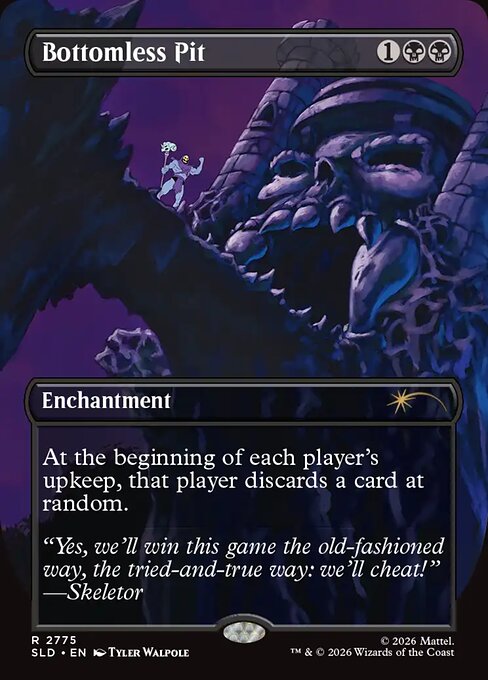
You've been there. Turn four, you slam a discard spell, feel great about it, and by turn eight the game looks exactly the same because hand disruption alone never closed a game in the history of the format. Bottomless Pit is the clearest example of how this trap works, because it isn't the single-target spell people assume it is. It hits every player's upkeep, forever, forcing a random discard from the whole table including you. It taxes your own hand right alongside everyone else's, turn after turn, and if your deck isn't set up to profit from your own cards hitting the yard, you're volunteering resources into a fire with no payoff waiting on the other side.
Delirium Skeins has a similar problem in one-shot form. Three mana to make every player, yourself included, pitch three cards is a massive swing of total cards off the table, and if nothing you control converts that into damage or advantage, you've just accelerated everyone's library equally.
Even Arterial Flow, which only makes opponents discard, runs into the oldest problem in the discard playbook: the opponent chooses what goes. A sharp player feeds you two lands and keeps the bomb. Hand disruption with no clock attached is theater. The board doesn't change.
The Counterintuitive Case: Symmetrical Discard That Isn't
This is the mechanism the "draft chaff" crowd never walks through, so let's walk through it. Say Tinybones, Pocket Nuisance is on the battlefield and someone activates Liliana of the Veil's plus-one. Every player at the table discards a card, you included. That's about as fair as Magic gets. Except Tinybones' trigger doesn't check who discarded, only that a discard happened, and the damage clause always reads "to each opponent." You discard right alongside the table and you're the only one who doesn't bleed for it.
Delirium Skeins plays out the same way. Everyone still pitches three cards, you included, but every one of those discard events is now pointed at your opponents' life totals and never at yours. The "even trade" framing that made Delirium Skeins feel risky in a vacuum stops applying the second Tinybones is online.
Arterial Flow doesn't need the loophole at all since it already only makes opponents discard, but pairing it with Tinybones still stacks extra burn on top of a spell that was already asymmetric. The trick only matters for the genuinely fair effects, and it only matters once you've built a shell deep enough to cast them repeatedly.

Discard Isn't Dead, the Numbers Say Otherwise
Discard in Commander is socially miserable, and that's stopped a lot of players cold before they ever try the archetype. Nobody loves getting Liliana'd turn after turn. But the archetype has a real, built-in audience that the skeptics keep underselling, and the clearest proof is how many tables keep coming back to Tinybones, Bauble Burglar specifically. It's the flagship discard commander in black by a wide margin, stashing exiled cards and letting you cast them off any color of mana, which turns discard from pure denial into a value engine you're stealing from. Tinybones, Trinket Thief takes a different approach: at the end of each turn where an opponent discarded, it rewards you with a card draw at the cost of a point of life, then holds a separate, expensive activated ability in reserve to drain any opponent sitting on an empty hand.
Waste Not is the card that explains why the archetype has staying power even when it's slow: every creature card an opponent sends to the graveyard this way becomes a 2/2 Zombie, every land they lose turns into a burst of black mana for you, and every other card nets you a draw. Discard isn't just hand attrition here, it's pseudo land destruction and ramp rolled into one enchantment, and that's the most powerful, most socially risky lever this color has.

The 30-Second Build Rule for Tinybones, Pocket Nuisance
Never lead with Tinybones, Pocket Nuisance unless your deck already runs mass-discard enablers and something doubling the damage. Always run it in the 99 of a Tinybones, Bauble Burglar or Tinybones, Trinket Thief shell instead. The numeric target that makes this work is 6 to 8 discard-triggered payoffs, think Megrim, Waste Not, Liliana's Caress, and Syr Konrad, the Grim punishing every creature that dies or hits a graveyard from anywhere at the table, paired with 3 or more guaranteed mass-discard sources like Bottomless Pit and Delirium Skeins that don't rely on a single targeted spell resolving. Hit those numbers and Tinybones' 1-damage trigger stops being a trickle and starts being a real clock, because now every wheel is firing four or five payoffs at once.
If your list can't hit that count, skip it or run it as a body-plus-ETB and move on. The "draft chaff" take isn't wrong about what the card does in isolation, it's wrong about which deck it's being evaluated in. Tinybones, Pocket Nuisance is a good card, not a good commander, and the one build style where that flips is a dedicated hard-discard shell where its wording turns every fair wheel into one-sided burn. The one I'd cut from a shell that hasn't built those numbers is Bottomless Pit run solo, it taxes you as much as the table and does nothing on its own. The one people overrate as too slow and is actually fine at any table running discard payoffs: Megrim. Build around Tinybones, Bauble Burglar, whose stash-and-steal plan actually denies opponents their cards, or lean into Tinybones, Trinket Thief's draw-and-life-loss payoff with its hellbent finisher waiting in the wings, slot Tinybones, Pocket Nuisance in as your fourth or fifth payoff, and save the command zone for a commander that actually wants to lead.

