
Who Is Neheb, the Eternal?
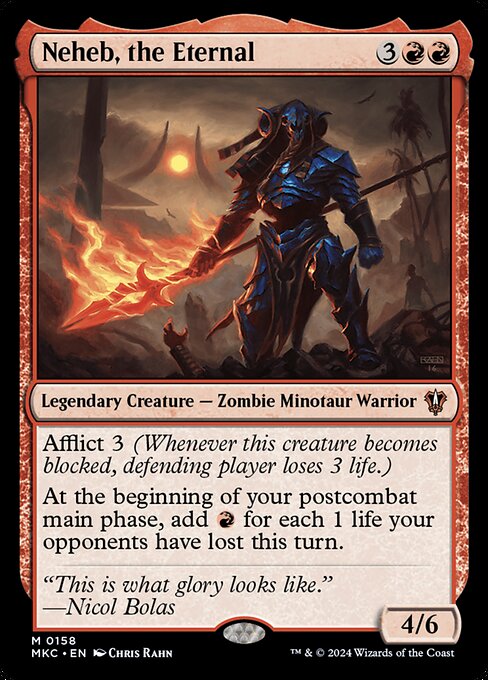
Neheb, the Eternal is a combat damage commander. He attacks, he connects, the game ends. That is the entire strategy. The whole thing takes maybe four turns once he's in play and the sequencing is about as complicated as making toast.
Except. The postcombat main phase trigger reads "add {R} for each 1 life your opponents have lost this turn." Not "for each damage dealt this turn." Life lost. From any source. The Flame Rift you cast before attackers are declared, the Guttersnipe that fired off three times while you were chaining spells, the Afflict 3 from blocking, the passive ping from Thermo-Alchemist, all of it, cumulative, feeding a single trigger that resolves after your attack step. All three opponents down 10 life before you swing means 30 mana appearing at the start of your second main phase. From one trigger. One turn.
"Simple" is doing a lot of lifting here. What Neheb actually rewards is knowing exactly how much mana you're about to print before you ever declare attackers, and building every card in the 99 around maximizing that number. He is a 4/6 with Afflict 3 on the surface. Underneath, he is the most efficient mana engine mono-red has access to in the format.
The Plan: Deal Damage Before Combat, Win After It
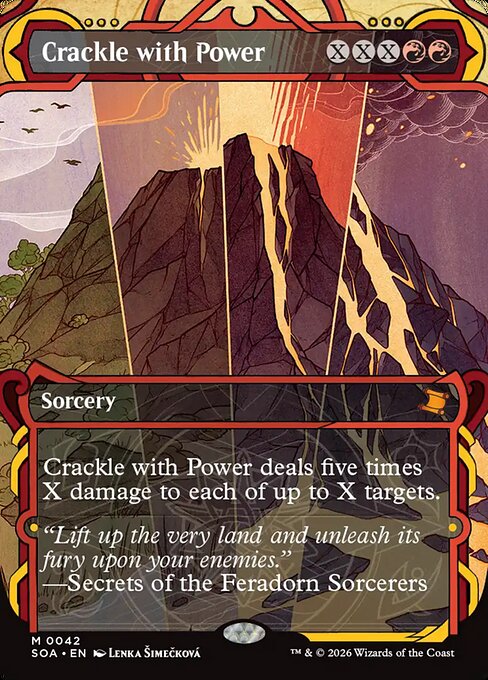
I will say sorry in advance. Not for what Neheb does, exactly, but for how fast it happens. You will sit down at a table, say "I'm running a Minotaur Zombie thing," and then on turn seven you will cast Crackle with Power for X=7 and hit each of up to seven targets for 35. The apology needs to be delivered before that turn, not during it, because during it you will be doing math.
The game plan has three clean phases. Early turns, you accelerate. You are trying to have five mana available on turn four or five, ideally with a haste enabler already on board. The cards you play in this phase are also setting up the trigger: passive damage sources hitting the table before Neheb ever arrives. Mid game, Neheb resolves, swings immediately, and generates the first big mana wave. That wave goes into draw or setup, not the kill, unless opponents were already low. Late game is one turn. Spells accumulate life loss before the attack step. Neheb swings. The trigger fires. You spend twenty or thirty of that mana on an X-spell finisher and everyone checks their life totals.
The three win clusters are X-spell finishers like Crackle with Power and Jaya's Immolating Inferno, the damage doubler plus group burn combination where a Dictate of the Twin Gods converts a modest pre-combat sequence into a massive trigger, and the Heartless Hidetsugu nuclear option where his tap ability does the heavy lifting before the attack step. The kill window in the base build is turns seven to nine, though it compresses to turns five and six in optimized builds with favorable draws, and the Group Slug build wins reliably on turns seven and eight. It is not a midrange value pile. It either fires or it loses to attrition, and the deck is built to know which one is happening by turn four.
The Ramp Package: Getting to Neheb and Beyond
Rituals are ramp. That is a sentence that sounds wrong the first time and obviously correct the second time. In a deck where a single turn can generate 30 mana from Neheb's trigger, a card that adds five red right now is not a one-shot trick. It is infrastructure. It is the card that gets Neheb to the table a turn early, which is frequently the difference between winning and watching an opponent untap with an answer.
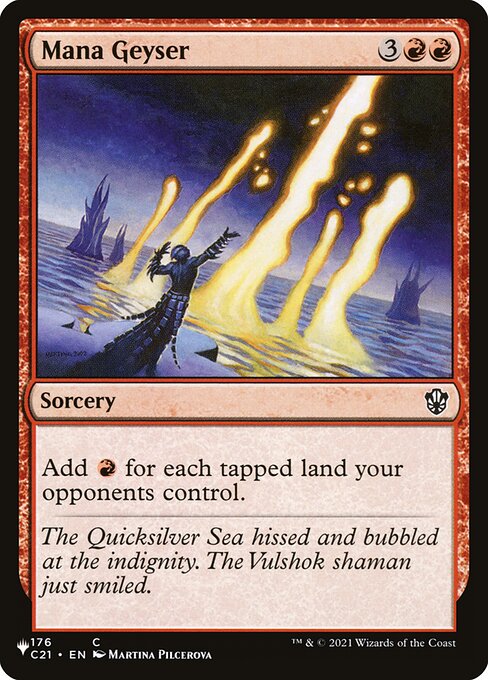
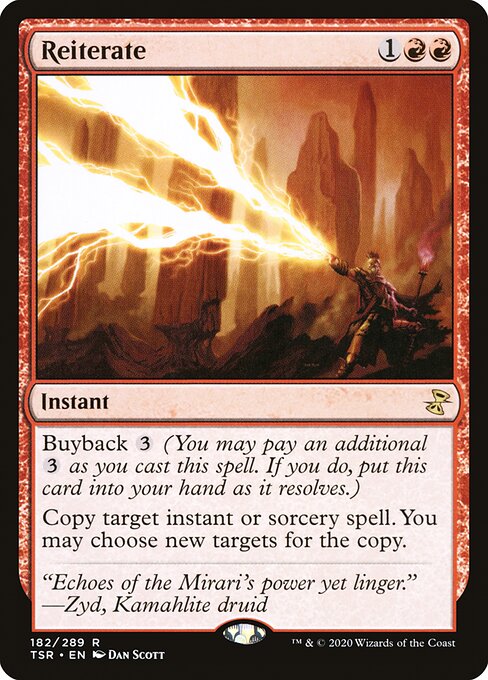
Jeska's Will is, without exaggeration, the best two-for-one this deck has access to. It adds red mana equal to target opponent's hand size AND exiles three cards to play this turn. Six mana and three new cards from a three-mana spell is bracket four behavior at a bracket two price point. Seething Song nets three mana at instant speed and gets Neheb on board ahead of schedule. Mana Geyser in a multiplayer midgame is frequently ten or more from a single sorcery, which is already absurd and gets even better when you add Reiterate: copy the Geyser with buyback for a second helping of mana, and the buyback puts Reiterate back in your hand for later. It's a one-time doubling of the Geyser's output, not a loop, since Reiterate needs an actual spell on the stack to copy.
Birgi, God of Storytelling refunds a red each time you cast a spell, which means she chains your pre-combat burn sequence into itself before the post-combat flood even fires. Ruby Medallion quietly shaves a generic off every red spell, and when you're casting four or five in a turn that discount compounds into something real. Ancient Tomb and Mana Vault provide the fast colorless mana that gets you to five on curve without leaning on resources you haven't earned yet.
Pre-Combat Damage: Setting Up the Trigger
The combat step in this deck is mostly administrative. It is the bureaucratic transition between "damage we dealt" and "mana we earned." Neheb swings, Afflict 3 fires if blocked, and then the trigger counts every point of life shed across the whole turn. Which means the real game is happening in your precombat main phase, where every spell you cast is both doing its job and padding the mana total you're about to collect.
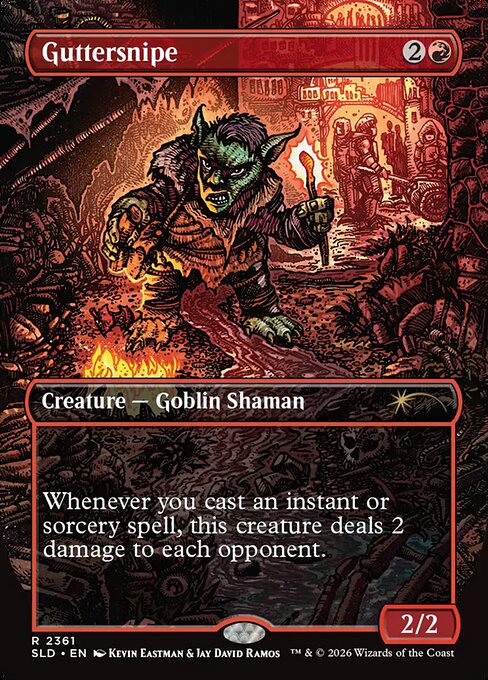
The passive ping creatures are the engine's foundation. Run enough of them and the math compounds fast. Guttersnipe, Thermo-Alchemist, Kessig Flamebreather, and Firebrand Archer each hit every opponent for one or two damage whenever you cast a spell. Cast three or four spells in a single precombat window and you are looking at 18 to 24 points of damage padding the postcombat total from cards that were already doing other things. Thunderdrum Soloist scales with the turns where the mana flowing from the trigger lets you cast bigger spells, swinging between one and three damage depending on what you spent.
Flame Rift is the breakeven case that isn't. Four damage to everyone at the table for two mana: the card eats itself in damage dealt, and against a full table that single card contributes 12 to the postcombat count. Fanatic of Mogis does something similar on a different axis: if your own board is running nine or ten red mana symbols, its ETB is eight or nine damage to each opponent without spending a spell slot. Acidic Soil and Price of Progress aren't even close: against greedy manabases they frequently hit six to ten damage apiece, turning opponents' land decisions from earlier in the game into a liability right now.
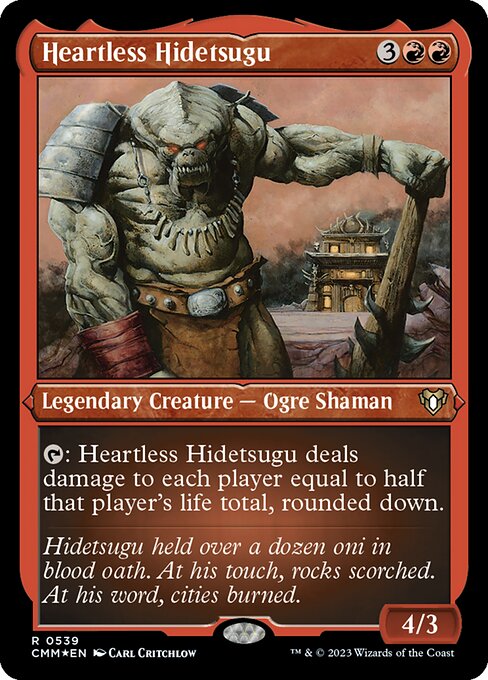
Then there is Heartless Hidetsugu. Give him haste. Tap him before Neheb swings. He hits each player for half their life total rounded down, which at a fresh table means 20 damage to every opponent simultaneously. That is 60 points feeding the postcombat trigger. Sixty red mana. The table will recognize what just happened approximately one second after you tap the Ogre, and at that point the apology is already overdue.
Chandra's Ignition on Neheb clears the board of anything smaller than Neheb's power while simultaneously dealing damage to every opponent. That is substantial life lost from one spell, and if you have both Solphim, Mayhem Dominus and Torbran, Thane of Red Fell in play, the affected opponent chooses how those replacement effects stack: they will choose to apply Solphim's doubling before Torbran's addition, meaning Flame Rift goes to ten per opponent rather than twelve. Either way, the apology rate spikes every time it resolves.
The Damage Doubler Package: Making Neheb's Math Embarrassing
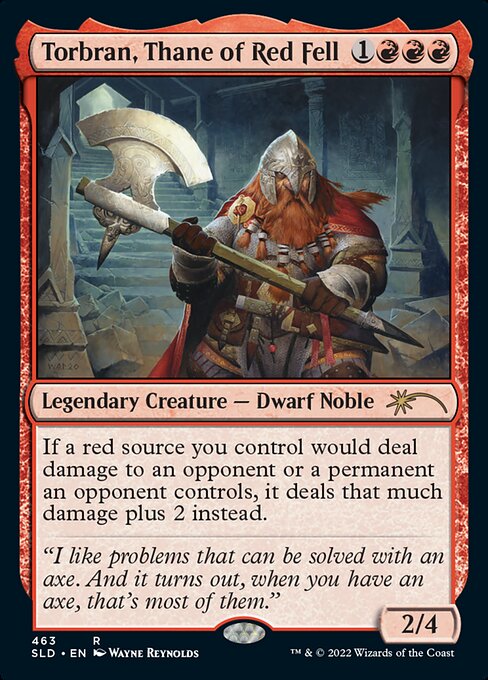
Torbran, Thane of Red Fell is an incremental improvement. He adds two to every red damage source hitting opponents. Flame Rift still deals its base 4 to you, but each opponent's instance becomes 6 instead. Across three opponents the trigger collects 18 from them instead of 12. Modest. Reasonable. Totally fine for a four-mana creature.
Solphim, Mayhem Dominus doubles all noncombat damage to opponents. The affected opponent gets to choose the order replacement effects apply, so they will choose to apply Solphim's doubling before Torbran's addition, meaning Flame Rift goes to ten per opponent rather than twelve. That is still 30 points across a three-player table from a two-mana sorcery, and the trigger returns a corresponding flood of mana. Reasonable is no longer the word anyone at the table is using.
Fiery Emancipation triples all damage from your sources. Dictate of the Twin Gods doubles all damage from any source, and critically it has Flash, which means you drop it in response to your own spell chain to ensure the doubling applies to everything still on the stack. Either one of these on board redefines what a "normal turn" means at the table. Both together means you have left the negotiation and entered something closer to a declaration. Afflict itself is unaffected by any of this, though: it's a life-loss trigger, not damage, so Torbran, Solphim, and Fiery Emancipation all leave Neheb's Afflict 3 at exactly 3. Every layer of the actual damage engine still scales together, which is the reason the "simple burn commander" framing eventually stops being funny.
Draw Engines: Solving Mono-Red's Oldest Problem
A deck whose plan is "cast lots of spells" has an embarrassing relationship with running out of spells to cast. Mono-red's card advantage problem is real and it is worse in Neheb specifically because that postcombat mana is temporary. You get one main phase to spend it. If your hand is empty when the trigger fires, you are sitting there with thirty mana and nothing to sink it into. I have been that person. It is a specific kind of suffering that only happens when you designed the engine correctly and forgot to load it.
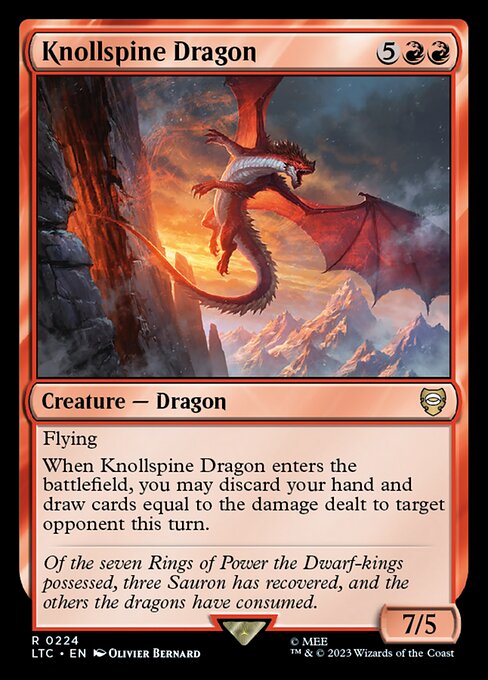
Knollspine Dragon is the deck's best draw spell wearing a creature's clothes. Cast it after combat when you've dealt fifteen or more damage to a single opponent, discard your hand, draw fifteen cards. You now have a full grip and enough mana to empty it. That is the turn the table runs out of answers. The Dragon gets answered constantly, which means running it is almost always a two-for-one for opponents, and you should run it anyway because the upside is too disgusting to ignore.
Cast Commune with Lava at the start of your second main phase using Neheb's output, exile a dozen or more cards, spend the rest of that pile of mana playing them that same phase. This is why impulse draw and Neheb specifically pair together. The exiled cards are playable this turn, and the problem solves itself. Standard draw engines that give you cards for next turn are actively worse here because you generate the mana before you know what you need. Commune with Lava is the correct philosophy.
Tectonic Giant provides ongoing card advantage on attacks and when opponents target it, demanding an answer in a way that opens up your other threats. Wheel of Misfortune and Magus of the Wheel refill empty hands. War Room, Faithless Looting, and Valakut Awakening handle the slower turns between explosive ones, filtering dead cards and reshuffling excess lands into live draws.
Your Win Conditions: What to Do With 30 Red Mana
The win condition is simple. You have thirty red mana. You spend it all at once on a spell that kills everyone. That is the whole section.
Except the specific spell matters a lot, because this mana expires at the end of the phase and incremental plays are a trap. You are not paying five mana for a kill spell and five mana for a creature and saving the rest. You are finding one spell or one sequence that converts all that mana into three dead opponents in one shot. All-in every time. Anything less is wasted value off Neheb's ability.
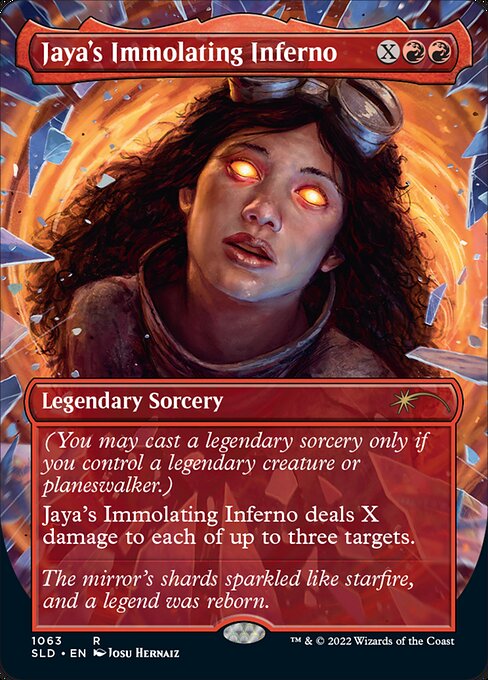
Crackle with Power at X=5 deals 25 damage to each of up to five targets, since the card deals five times X damage to each of up to X targets. All three opponents and their two most threatening permanents take 25. Cast this once with thirty-plus mana available and everyone is dead before the stack clears. Jaya's Immolating Inferno taps a legendary creature as an additional cost and deals X to each of up to three targets. Neheb is a legendary creature. You do not need anything else in play. Cast it for X=20, tap Neheb, hit the table for 20 apiece. The built-in synergy is so clean it is almost considerate.
Comet Storm is the instant-speed option. Opponents try to remove Neheb in response to his combat trigger and you pivot into a table kill before resolution. The multikicker adds more targets rather than more damage per target — every target still takes the same X, which matters most when you need to spread lethal across several opponents at once rather than dump it all on one. Earthquake and Rolling Earthquake double as board wipes and player damage simultaneously, clearing blockers while padding Neheb's payout and finishing anyone already in range. Electrodominance hits a target for X and then lets you cast a free spell of that mana value, converting one large payment into two effects at once. Boltwave deals damage to each opponent only, and in a chain-heavy turn it rewards the spellslinger game plan directly.
Interaction and Protection: Keeping Neheb Alive Long Enough to Matter
Opponents will identify Neheb as a threat approximately one postcombat trigger after he resolves. You just generated twenty-five mana from a single attack and spent it on cards. The table has done the math and has collectively decided that you are the problem. The interaction budget here is almost entirely devoted to keeping one creature alive through the removal phase, because without Neheb the deck has a critical lack of purpose. Everything else is kind of decorative by comparison.
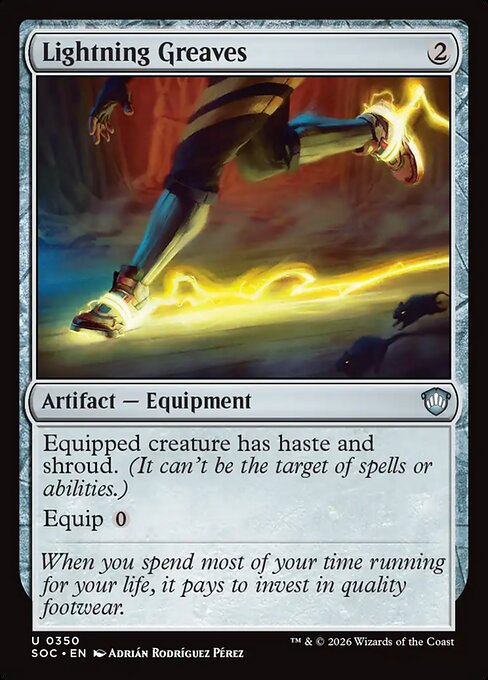
Haste is not optional. Lightning Greaves at equip zero with shroud, Swiftfoot Boots at equip one with hexproof. Both are mandatory inclusions. The Boots are preferred because shroud prevents you from targeting Neheb with your own spells. Equip the Boots unless you need the free equip immediately, in which case Greaves first and then Boots on the next turn if you can manage it. Getting Neheb through combat unanswered matters, but note that the postcombat trigger itself doesn't require him to attack or even survive combat — it fires at the start of every postcombat main phase and counts all life your opponents lost that turn from any source. Attacking is just the most reliable way to add to that total, not a precondition for the trigger firing at all.
Deflecting Swat is free when you control your commander and redirects any spell or ability to a new target. Point it at the controller's best creature when someone comes after Neheb. Bolt Bend costs a single pip when you control a creature with power four or greater, which Neheb satisfies, and it changes the target of any spell or ability with a single target. A second copy of the Deflecting Swat effect for redundancy, and together they cover most of what opponents will throw at him.
Chaos Warp handles enchantments and indestructible permanents that mono-red otherwise struggles to answer. Blasphemous Act is the primary board wipe, scaling down to essentially free when the board is full and dealing 13 to every creature. Vandalblast at overload hits every opposing artifact simultaneously. Pyroblast and Red Elemental Blast are meta calls against blue-heavy pods and are worth including if your table runs three or more blue decks regularly.
The Copy and Storm Package: Making One Big Turn Into Two
Spell efficiency is about casting the right spell at the right time for the right amount of mana. That is a reasonable framing for most Commander decks. In Neheb, spell efficiency means casting Jaya's Immolating Inferno for X=15, copying it with Reverberate, and watching as thirty damage to all three opponents becomes sixty. The table dies twice. Redundancy becomes overkill. Overkill becomes table memory.
Reverberate copies any instant or sorcery. Reiterate does the same but has buyback, returning to hand when it resolves if you pay a little extra. With Mana Geyser generating twenty or more mana, Reiterate can copy the Geyser, pay the buyback, and come back to hand with plenty left over to spend on the finisher. It's a fixed one-time bonus, not a repeatable loop, since Reiterate needs a fresh spell to target once the Geyser has resolved. The game can still end that turn.
Increasing Vengeance copies a spell you control and, cast from the graveyard via Flashback, copies it twice instead, three copies of the original effect across two cast opportunities. Past in Flames gives every instant and sorcery in your graveyard Flashback for the turn; after a big Neheb sequence, that means recasting the entire chain out of the bin. Underworld Breach provides ongoing graveyard access at the cost of exiling three other cards per cast, enabling multiple turns of recursion when the engine needs to reload. Storm King's Thunder sits in hand until you are ready to cast a large X-spell, then the next instant or sorcery gets copied X times. Cast it before the finisher and watch the math become something no one at the table wants to do.
How to Build It: Burn Everything vs. Storm Everything
All three build directions share the same commander and the same general plan. You are always trying to generate mana from Neheb's postcombat trigger and spend it on something that ends the game. The difference is which cards get you there, how fast, and how often the engine misfires when opponents apply pressure. They are the same skeleton wearing different armor, built for different tolerances.
Group Slug / Pure Burn maximizes passive damage sources. You are running Guttersnipe, Thermo-Alchemist, Flame Rift, Acidic Soil, Price of Progress, and Heartless Hidetsugu as the pre-combat damage engine. Fewer spells to chain, more redundant pingers, consistent setup regardless of hand quality. Wins reliably on turns seven and eight. This build is for players who want to know the game plan will execute every time and do not want to think about whether their spell chain fizzles mid-sequence.
Spellslinger / Storm-lite leans into Birgi, God of Storytelling, Storm-Kiln Artist, and Runaway Steam-Kin for mid-combat mana chaining. Add Ashling, Flame Dancer, Volcanic Torrent, and Boltwave. The ceiling is genuinely higher because a good chain turn generates mana that feeds into the chain that generates more mana. The variance is also higher. This build rewards hands with multiple cheap spells and punishes hands that open with three lands and a seven-drop.
Optimized / cEDH-adjacent adds Wheel of Fortune, Underworld Breach, Past in Flames, Mana Vault, and the full fast mana suite. The slow permanents come out, the curve drops, and the kill window moves to turns five and six in favorable draws. This version cuts the group-slug pingers entirely in favor of pure efficiency and is built to fire once, reliably, before opponents stabilize.
Budget note: the core engine works without any premium slots. The mana Neheb generates is intrinsic to the commander, and the X-spell payoffs are cheap. The expensive slots are fast mana and lands. The deck you can build for fifty dollars does the same thing as the deck you build for five hundred. It just does it one turn later.
The Verdict: Is Neheb, the Eternal Worth Building?
Neheb is a straightforward burn commander. You deal damage. You make mana. You spend the mana on a spell that ends the game. Everybody at the table understands this plan within one resolution of Neheb's trigger. They will tell you they understand it. They will try to stop it. And then you will generate thirty-five mana anyway and cast Crackle with Power anyway and someone is dead anyway.
That is the honest thing about this deck. It does not hide. There is no long con, no invisible value accumulating under the surface. Neheb tells the table exactly what he is about to do, every single turn, and the question is whether anyone can stop it fast enough. Most of the time, they cannot, because that trigger can produce more mana in one phase than most decks accumulate across five turns, and that kind of resource asymmetry does not care much about the room's feelings on the matter.
Build this if you enjoy knowing the exact moment the game ends and engineering that moment yourself. The deck rewards players who can look at a board state on turn six and calculate, with reasonable precision, the turn they will fire the kill and what life totals they need to reach first. The Heartless Hidetsugu plus Neheb line specifically, where you give the Ogre haste and tap him pre-combat, then collect the trigger, then cast the finisher, is one of the most satisfying sequences in the format and alone justifies the build for a certain type of player.
Skip this if you want resilient value engines, political tools, or a deck that can operate at mid-power tables without painting an immediate target on yourself. Lightning Greaves and Swiftfoot Boots are doing a lot of work here and opponents will respect that work by pointing everything they have at Neheb the moment they understand what that trigger means. The floor is a glass cannon that needs one explosive turn before the table can coordinate removal. The ceiling is a genuine competitor against optimized pods that produces more mana off a single trigger than most decks will ever see.
Neheb does not win by being clever. He wins by generating so much mana that the concept of "not winning" stops being available. The table was warned. The table watched it resolve. The apology rate goes up regardless. Happy brewing.