
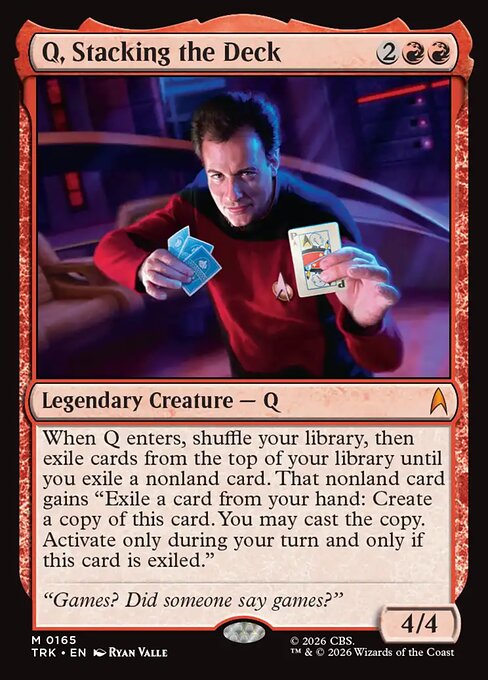
Spoiler season is a popularity contest, and popularity is a bad judge of power. Pre-release interest charts for the Star Trek Commander cards have Q, Stacking the Deck and Dr. Beverly Crusher near the top. That tells you where people are looking. It tells you nothing about what wins pods. Treat the cards below as a watch list built from previewed cards, not a set of verdicts. The set releases November 13, 2026, with prerelease events starting November 6.
Star Trek Commander Cards Are a Multiplayer Set First, a Tribal Set Second
The set's real contribution to Commander isn't one bomb. It's two Commander-only ability words, Battlefront and Seek out, plus the first real modal-matters support in the form of "face a dilemma." Officer is the new tribe, and Officer tokens come off a pile of cards, including Captain Jean-Luc Picard. But the tribe is the wrapper. The mechanics are the product.
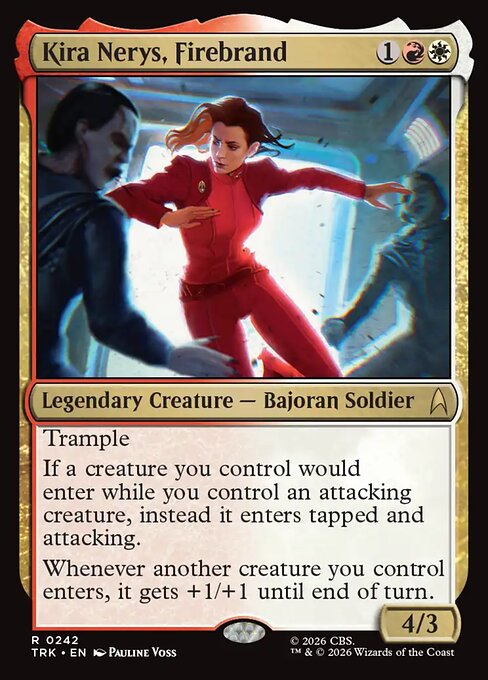
The cards to track on what's been previewed are Mr. Spock, Science Officer, U.S.S. Enterprise-D, Galaxy-Class, Captain Kathryn Janeway, Kira Nerys, Firebrand, and Borg Queen, Perfection Manifest. Seven of Nine is the accessible entry point for the modal crowd. I've sorted everything by mechanic and rules interaction instead of by a flat ranking, because that is where the set's ideas live and where most of the misplays will happen. If you're looking for a Star Trek MTG list that just tells you which mythic is "best," this isn't that.
Face a Dilemma: Modal Matters Finally Gets an Engine
Modal-matters finally has real support, and it starts with Seven of Nine. She draws a card every time you face a dilemma, which turns Cryptic Command into a counterspell that also replaces itself. Elim Garak, Simple Tailor drains for 2 on the same trigger. Captain Benjamin Sisko turns each dilemma into an Officer token at your end step, and The Caretaker hands you a free spell from an opponent's library at each end step if you faced one that turn. Gabriel Lorca, Mirror Menace rewards paying {B} on a dilemma by returning himself to your hand.
Know the gotchas before you sleeve up. Choosing two or more modes is still one dilemma, so Cryptic draws Seven one card, not two. A countered or fizzled spell still counts because you chose the modes. But a trigger with no legal mode means no dilemma, and plain "or" text without a bulleted list doesn't count at all. Sisko can run as a dilemma deck or as an Officers pile that spills free spells. Whether either build works depends on how many modal cards your colors actually offer. Dimir looks stocked. Narrower identities may not be.

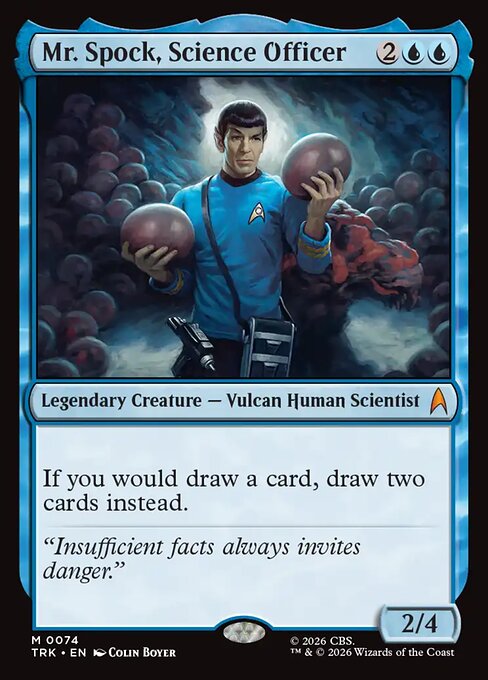
Seek Out: Mr. Spock Turns a Fair Mechanic Into a Combo Piece
Seek out triggers on your second card each turn. On its own that takes real effort, and the payoffs are modest. Spock fixes the effort. His replacement turns every draw you make into two cards, so your draw step alone fires every seek out permanent you control, every single turn. He also doubles Seven of Nine's dilemma draws, and anything else that draws. It only affects you, so he never accidentally feeds the table.
The payoffs vary. Ro Laren, Double Agent pings each opponent for 2, and her own loot ability gets you to the second card without help. Rom and Leeta, Unlikely Pair makes two tapped Treasures, and Chief Miles O'Brien doubles counters. The best of the bunch is Data, Exploring Humanity, whose discover 4 is a free spell every turn once Spock is online. Without Spock, a single Wheel of Fortune effect is a one-shot trigger, not a plan. With him, the mechanic works as a real engine.
Battlefront: The Reward for Attacking the Whole Table
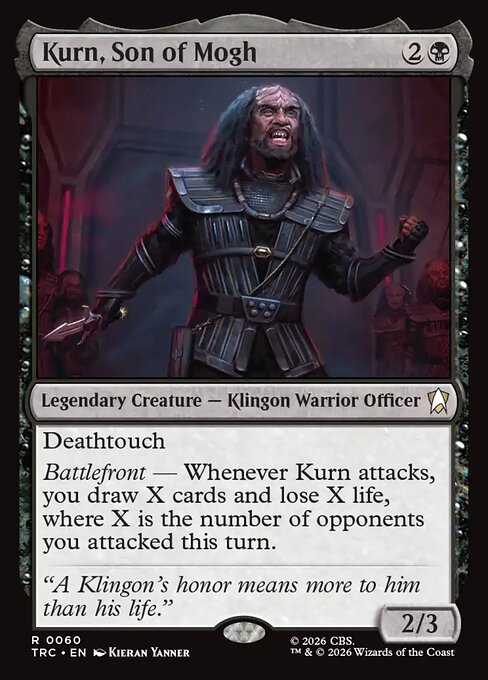
Battlefront counts opponents you attacked this turn, so in a four-player pod it scales to 3. That makes it strong in aggressive pods and awkward in slower ones, where you attack one player and each trigger is a mild bonus. Kurn, Son of Mogh is a deathtouch body that draws up to three cards per swing, and Martok, Hero of the Empire puts counters on up to three creatures. Worf, Defiant Commander is the Mardu midrange engine. Own the Day drops to as little as 3 mana in a four-player pod and untaps your team for another combat. Rite of Ascension makes a tapped and attacking 2/1 for each opponent hit.
Mind the counting rules. Only creatures you declared as attackers count. Tokens that enter attacking don't, and an opponent hit twice across combats still counts once.
Kira Nerys, Firebrand rewards flash creatures and flicker more than any other card here. While you control an attacking creature, anything you add enters tapped and attacking with +1/+1. Flash a creature in after blockers are declared and it can't be blocked at all. Restoration Angel on a blocked creature is the clean example, because the creature returns tapped, attacking, and no longer blocked.
Beam Me Up: Scotty Is the Spellslinger Card to Watch
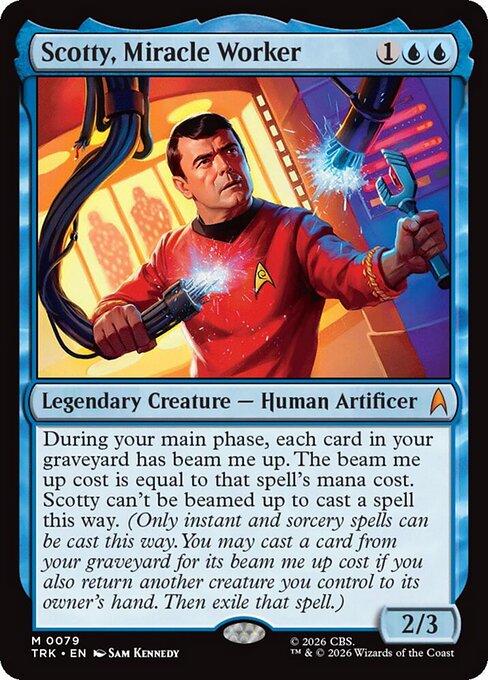
Scotty, Miracle Worker is the most Commander-friendly spell recursion in a while. He gives every instant and sorcery in your graveyard a cast option at its normal mana cost, as long as you bounce another creature. Bouncing is part of the cost, so nobody can respond by killing the creature you were about to return. The cast spell is exiled afterward, so it's a one-shot per card, not an engine you loop. Scotty's grant only works in your main phase, so your counterspells aren't coming back on an opponent's turn.
That bounce requirement shapes the build. You want creatures with ETB abilities, so every beam retriggers one. The cards themselves are fine glue. Open Communications is a cheap cantrip, Energize bounces an opposing creature, and Federation Resupply tutors an Aura, Equipment, or Spacecraft. Mana value stays the printed one even when you beam, so cost-based effects still read normally. The bounce makes it clunky in creature-light spellslinger lists, but a flicker-friendly Scotty deck looks great.
Spacecraft Are the Colorless Cards Every Deck Can Look At
Spacecraft are the bridge between the Officers and the rest of your deck. Station asks you to tap another creature you control, so a spacecraft in a creatureless deck is a three-mana rock with a text box. But U.S.S. Enterprise-D, Galaxy-Class is colorless card advantage at 3 mana that exiles a card you may play every time counters hit it, once per turn. It's my pick for the best colorless piece in the set. You can keep stationing after it becomes a 4/5 flying vigilance artifact creature at 7+ counters, so the impulse draw never turns off. Outside of decks with plenty of creatures, it dies a quiet death.
Deep Space 9 costs 9 and can't be a commander. It exiles the top four cards and puts every permanent among them onto the battlefield both on entry and each upkeep, so it's a ramp-deck finisher and little else. Starship Enterprise is a slower, landfall-based version that draws on combat damage.
Captain Jean-Luc Picard connects the Officer plan to the Spacecraft. He makes Officers whenever you cast a creature or Spacecraft, and tapping seven of them tutors a Spacecraft onto the battlefield with seven charge counters. Since entering from an ability still triggers ETB, tutoring Deep Space 9 skips the nine-mana price. Crystalline Entity is a one-sided sweeper only in artifact decks, because "if you cast it" blocks any cheating it out. At eight mana, even there, it's a luxury.

The Borg Give Mono-Black Artifacts a Real Payoff
Assimilate puts a creature card onto the battlefield under your control with a +1/+1 counter, and it becomes a Borg artifact creature. That's the payoff mono-black artifacts have lacked. Borg Queen, Perfection Manifest is the six-mana version. She pumps every artifact creature you control by +2/+0 (herself included) and steals a creature from an opponent's graveyard on entry. In a pod where someone's already reanimating, she's a graveyard-hate card that also attacks.
Step outside mono-black and the Borg get louder. The Borg Queen is the Esper, repeatable upgrade: at seven mana she assimilates a creature from an opponent's library on entering and on every attack. Locutus of Borg is Esper too, and it turns each of your artifact attackers into a token maker on combat damage. Borg Cube only needs white and black, and it's the best of the bunch, since it steals or exiles a creature each time it enters or attacks, and that kind of repeatable removal is what a top-end artifact should do. Hugh, First of Many is Esper as well, and he's the weak link: replicating artifact spells for {2}{U} each, copying them as tokens, is a steep price for what you get.
Borg and Federation don't overlap. Federation counts creature types among non-Borg creatures, and assimilated creatures lose their other types. Join the Collective is a token-friendly sweeper, but it destroys your own artifact creatures too and only makes tokens for the nonartifact ones. Don't pair it with this plan.

Land Captains: Janeway and Pike Reward Greedy Mana Bases
Strange new worlds counts differently named lands, which in a singleton format is nearly free. Nonbasics each count, and basics only count once per name. Captain Kathryn Janeway gives you an extra land drop each turn, and every creature you control that enters explores, either filling your hand with lands or growing itself. Captain Pike, Fullness of Time lets you play lands from the top of your library, and his stats grow with the number of different lands you control.
Utility lands and shocklands are natural homes, and they stack with Janeway's extra drops. The Destruction of Praxis is a sweeper scaled by that same count, and it also hits your own board. Commander Spock checks that count when casting off the top of your library, and Excalbian Gamemaster turns it into a pile of Officer tokens. Deep Space Scan is the weakest card here, a six-mana draw-X sorcery that I'd cut first when the list gets tight. The ceiling is high once you're cracking fetches, but a two-color deck with lots of basics will fall flat.

Off-the-Beaten-Path Commanders Worth Brewing
Q, Stacking the Deck is a four-mana mono-red 4/4 whose enter trigger exiles a nonland card and lets you pitch cards from hand to copy it. The variance is real: hit cheap removal or a rock and it hums, hit a seven-drop and you pay seven each time. Georgiou, Terran Emperor treats life as a resource. She draws a card for 3 life each end step, and once you sit at 0 or less you get ten 1/1 Officers every turn. Take her out, though, and you lose on the spot.
Quark, Humble Proprietor is a trap if you expect ramp. He makes a Treasure at every upkeep, but you can't sacrifice Treasure tokens, so none of them ever make mana for you. He's an artifact-count engine, not a mana source.
Dr. Beverly Crusher doubles lifegain triggers and grows with each one. Dathon, His Heart Open draws on enchantments and leads a saga lane, using his {2} ability to push counters up. The City on the Edge of Forever is a phase-out reset. If you make another creature token after chapter I and still have it to sacrifice at chapter III, the 0/1 Human survives and keeps everything phased out. Q is the one I'd bet on splitting the table.
Format Impact: Star Trek Cards Reward Brewers, Not Netdeckers
Brewers get the most out of this set. Mr. Spock, Science Officer is the card I'd build around first. U.S.S. Enterprise-D, Galaxy-Class is colorless, but it wants a deck with creatures to station it. Captain Kathryn Janeway is the pick for greedy land decks, Kira Nerys, Firebrand belongs to players who attack the whole table, and Borg Queen, Perfection Manifest hands mono-black artifacts a real payoff. Enterprise-D may displace some three-mana colorless card-advantage artifacts in creature decks. Expect the loudest early takes, and the most mixed results, on Q, Crusher, and Quark.
Deep Space 9 is the card I'd cut from most decks: at nine mana it finishes games for ramp decks and does nothing for anything else. Q will get overreacted to in both directions. It's a fine, swingy four-drop that's fun when it hits. Spock is my bet for the best card in the set, and I'm putting that on record before the November 13, 2026 release.


