
How We Ranked 25 Commanders From Two Products
Reality Fracture dropped two very different piles of legends at once: the Echoverse main set (FRA) and the Multiverse Reforged Commander precon (FRC). Plenty of reviewers call the precon the most powerful ever printed. Plenty of fun-first tier lists will tell you to build whatever makes the table laugh. Those two approaches don't agree, and I don't want either one on its own.
This ranking blends four things: raw power, how unique the build-around is, how it feels when the thing resolves, and how wide a bracket range it plays in. Power is judged on what you build, not the stock list, because precons feel stronger out of the box than their 99 deserves. Colorless commanders fit any deck, which counts in their favor. The top 16 get full entries, counted down from #16 to #1, each tagged with set, colors, bracket range and one signature enabler. Nine more get a quick appendix.
The Elder Sphinx five run through the list as a thread: Aerid Konstrari at #2, Ingris Stingerquill at #3, Kwia Vigorbloom at #4, Denzilore Fatehold at #10 and Uldaros Theorix at #14. Here's the claim you can argue with: Jace, Multiverse Architect is #1 and it isn't close. Fun-only lists love putting Kwia on the podium. I won't.
Tetsuko Umezawa, Fugitive
FRA reprint | U | Brackets 1-2 | Signature: Wizard's Staff
Cheap, honest and a reprint, so nothing about it is new. Making every creature you control with power or toughness 1 or less unblockable is a real plan in mono-blue at the bottom brackets, and Wizard's Staff makes the equipped body's triggers fire twice. Keep your creatures small, because a prowess pump that lifts both power and toughness above 1 turns the unblockable off. At about 35 cents, this is the commander for someone building their first mono-blue deck. Don't expect it to scale past bracket 2.

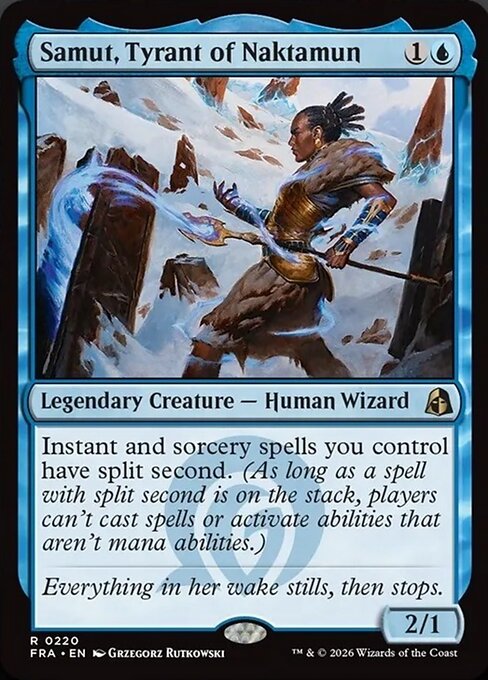
Samut, Tyrant of Naktamun
FRA | U | Brackets 2-3 | Signature: Brain Freeze
Turn six. Four cheap spells are already behind you, so you slide Brain Freeze onto the stack with a storm count to match. The player across the table taps three Islands for their counterspell and then just sits there, because Samut gives your instants and sorceries split second and nobody can cast spells or activate non-mana abilities while it's on the stack. That's the whole pitch: a mono-blue spellslinger plan where the storm turn can't be interrupted. Samut makes no mana and draws no cards, so every other slot in the 99 has to do that work. He runs about ten dollars, but the shell is cheap. If you're tired of getting countered on the turn you go off, this is your guy.
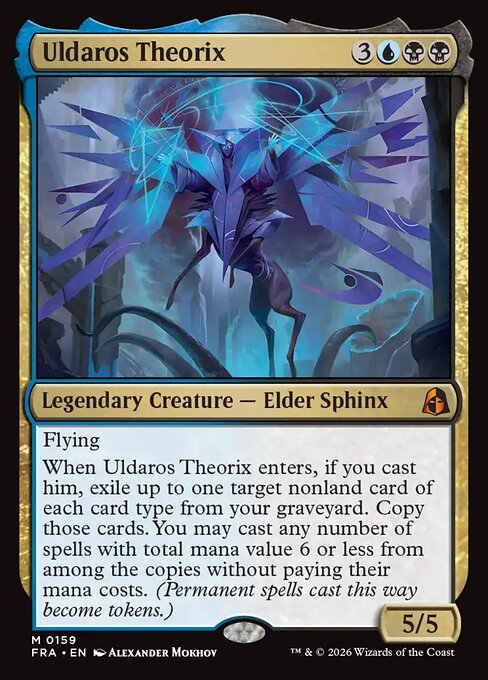
Uldaros Theorix
FRA | UB | Brackets 2-3 | Signature: Glimpse the Unthinkable
Six mana for a 5/5 flier whose real text does nothing with a clean graveyard. That's a rough ask. But with a stocked yard, the cast trigger exiles one nonland card of each type, copies them, and lets you cast up to six total mana value for free. That's a big swing in a UB self-mill deck, and Glimpse the Unthinkable fills the yard for two mana. Because the trigger only checks that he was cast, commander-zone recasts still pay out, which is nice. Cheap clones like Phantasmal Image make premium copy targets. Still, he's last of the Sphinx five. You pay full price for a trigger that hands back the same total in spells, and unlike the others you can't just blink him for value. He's best in grindy bracket 2-3 pods where a slow turn six doesn't get punished.
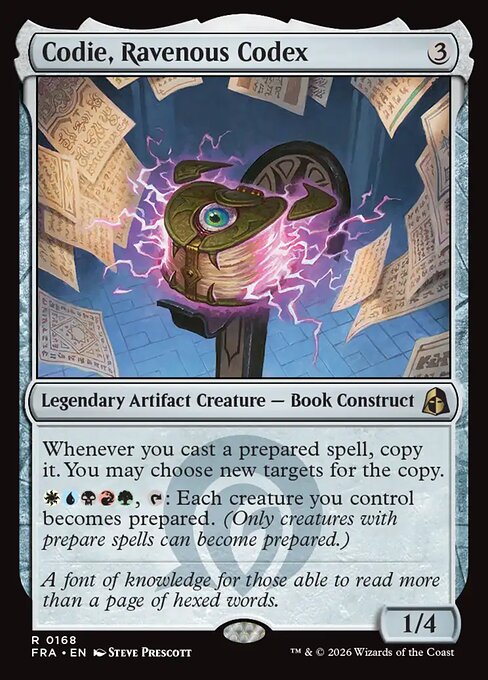
Codie, Ravenous Codex
FRA | WUBRG | Brackets 1-3 | Signature: Emeritus of Woe
Every fantasy library has that cursed spellbook that fires off spells on its own. Codie is the one that doubles everything. For three mana you get a 1/4 artifact creature that copies every prepared spell as it's cast, and for one mana of each color it re-prepares your creatures to do it again. Emeritus of Woe is the headliner: cast its Demonic Tutor half, copy it, tutor twice. Variable Chaser wheels everyone's hand twice, and Emeritus of Abundance returns two cards from your graveyard. The shell is narrow, since only creatures with prepare spells count, and the activation eats your whole turn's mana. But it's a genuine puzzle with a payoff, and fun-first builders at bracket 1-3 will love it.
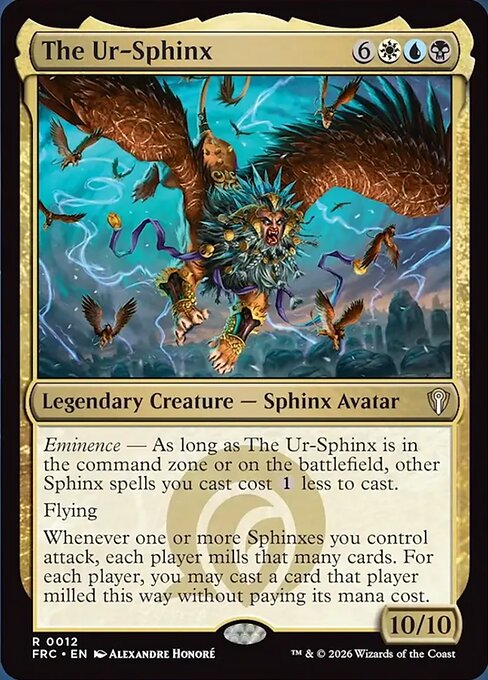
The Ur-Sphinx
FRC | WUB | Brackets 2-3 | Signature: Omni-Changeling
Edgar Markov pays you tokens for every other Vampire spell you cast. The Ur-Sphinx just hands you a discount: other Sphinx spells cost {1} less while it sits in the command zone or on the battlefield. Plainer, yes, but cheaper to build. The trick is that Omni-Changeling, Graveshifter and Firdoch Core are all changelings, so they count as Sphinxes without a pile of real ones. Firdoch Core is a mana rock that discounts to two, and Graveshifter rebuys a creature for less. The attack trigger is the reason to bother: each player mills for each attacking Sphinx, and you may cast a milled card from every pile for free. It's a nine-mana, 10/10 flier, so expect to be cast late and answered fast. Bracket 2-3 tribal pods that want a long game will get plenty out of it.
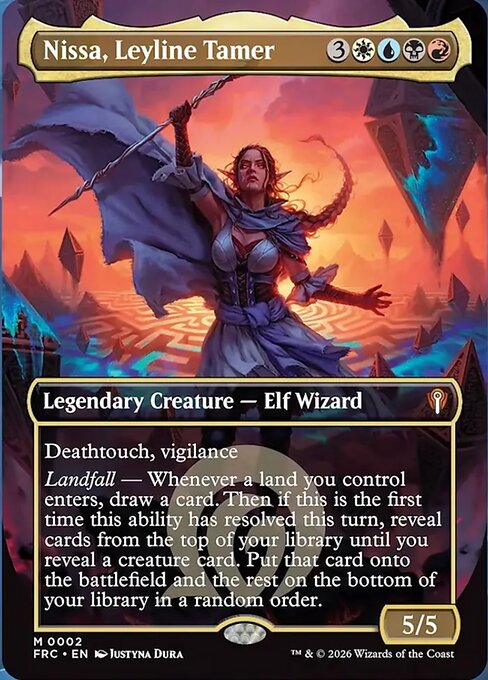
Nissa, Leyline Tamer
FRC | WUBR (Sans-Green) | Brackets 3 | Signature: fetch lands
Watch the table go quiet when you play a land and draw a card, and then a creature falls out of your library onto the battlefield. Then you do it again off the fetched land, and the second draw is a gift. Nissa is a 5/5 deathtouch, vigilance, and every landfall draws a card, but only the first resolution each turn reveals until a creature. A fetch land gives you two landfall triggers: one draw plus a free creature, then one more draw. You pay for it with seven mana in a four-color identity with no green, which is just rude. Ramp that doesn't care about color does the job. Omnath, Locus of the Void is the colorless landfall rival you're up against. Bracket 3 pods that like value engines love her, and bracket 2 tables will hate every free creature.
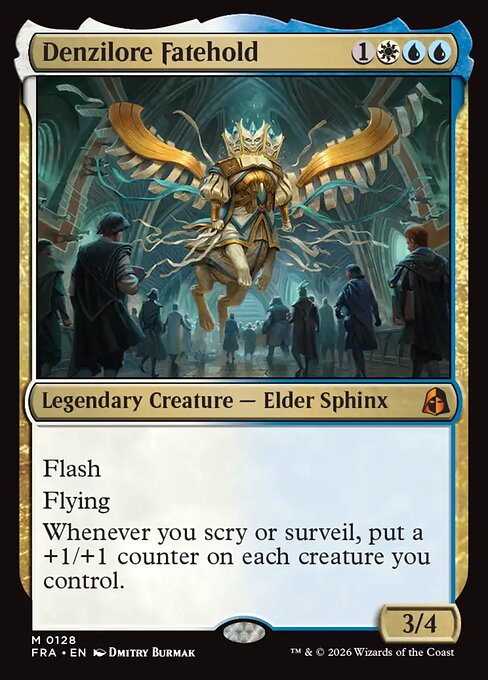
Denzilore Fatehold
FRA | UW | Brackets 2-3 | Signature: scry and surveil engines
A clean build for a scry and surveil shell. Flash lets you ambush a combat or flash in at the end of turn, and every scry or surveil puts a +1/+1 counter on each of your creatures. Multiple scry sources or a proliferate effect scale it fast. He's fourth of the Sphinx five, ahead of only Uldaros: narrow, but he does exactly what he says.
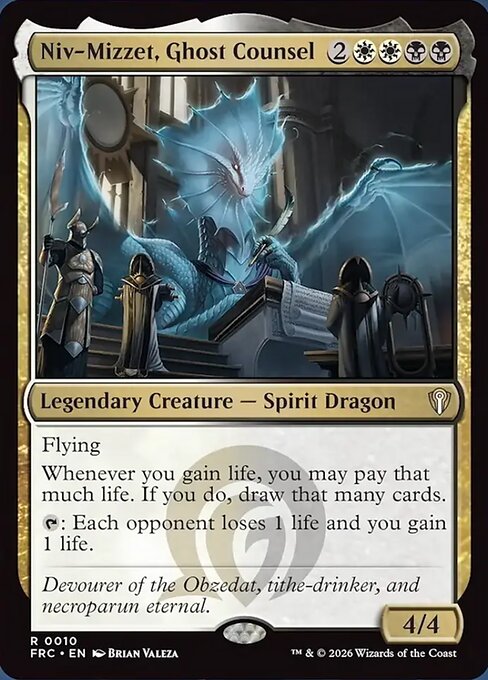
Niv-Mizzet, Ghost Counsel
FRC | BW | Brackets 2-4 | Signature: Soul Warden
No lifegain payoff in the set does more for an Orzhov lifegain pile, so this is a no-brainer. The loop is tiny: tap Niv to drain each opponent for 1 and gain 1, then pay that 1 life to draw a card. One card per turn, no help needed, plus every extra lifegain trigger on top. Soul Warden turns every creature entering the battlefield, yours or theirs, into a card. Whip of Erebos gives the team lifelink, so each combat connect is a draw. The early powerhouse pairing is Sheoldred, the Apocalypse: each draw gains you 2, Niv pays 2 to draw 2 more, and the loop only stops when you do. Blind Obedience adds extort for a cheap drain on every spell. Niv needs lifegain pieces, and the precon list barely has any, so a stock Niv bricks. Add the pieces and it pops off.
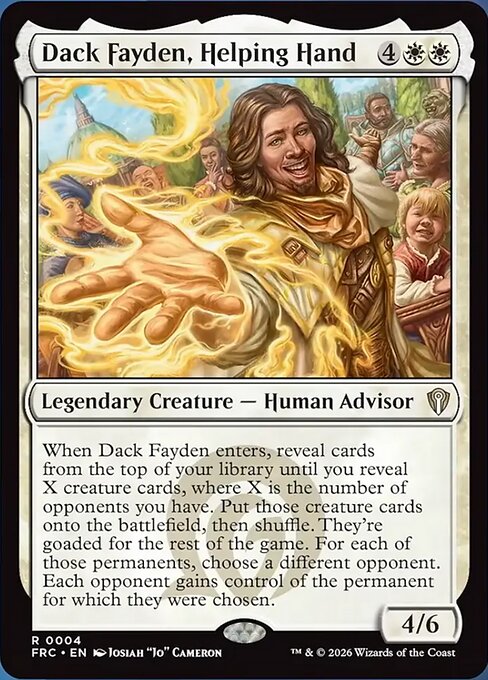
Dack Fayden, Helping Hand
FRC | W | Brackets 2-3 | Signature: Flickerwisp
Turn six, three opponents. Dack hits the table as a 4/6 for six and reveals three creatures, one per opponent. You put them onto the battlefield, so all their enter triggers fire for you, and they're goaded for the rest of the game. Then you choose which opponent gets which. Hand the fat 5/5 to the player who's been quiet, and the mana dork to the one who's ahead. Goaded creatures want to attack someone other than you, so the table starts fighting each other. I've watched a four-player pod have no idea who to attack for two full turns. Flickerwisp is Dack's ideal partner: its enter trigger exiles him, and he returns at the end step to do it again. You're handing opponents free bodies, and that's the whole point of a politics and Group Hug commander. For casual pods that enjoy chaos, it's a favorite, and it isn't oppressive because the turn takes forever and the table trades creatures off each other.
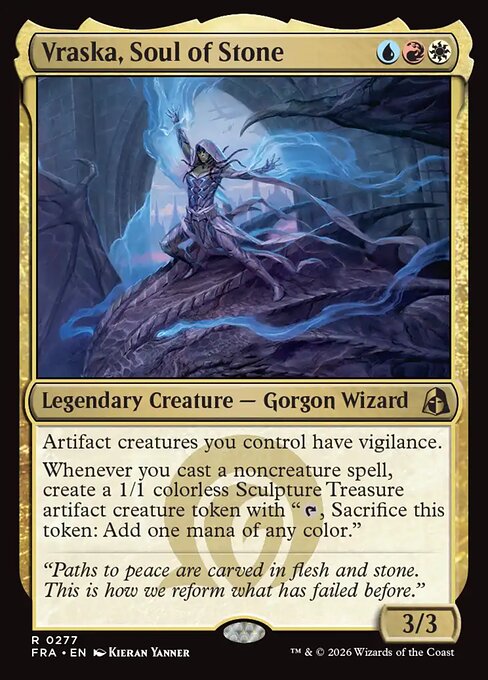
Vraska, Soul of Stone
FRA | URW | Brackets 2-3 | Signature: Alibou, Ancient Witness
Treasure is the strongest economy in Magic because it's a mana dork you don't have to cast, and Vraska is a gorgon, so yes, the deck is stone cold. Each noncreature spell you cast makes a 1/1 Sculpture Treasure artifact creature that taps and sacrifices for mana, and artifact creatures get vigilance. Vraska is a Wizard, so Wizard's Staff and Harmonic Prodigy double the trigger. Alibou, Ancient Witness gives the Sculptures haste so they pay for something the turn they're made, and it deals damage when artifact creatures attack. Saheeli, Jewel of Avishkar is the cousin that makes flying Thopters instead of mana. At 85 cents and a three-drop, this is cheap, easy to build and a great pick at bracket 2-3.
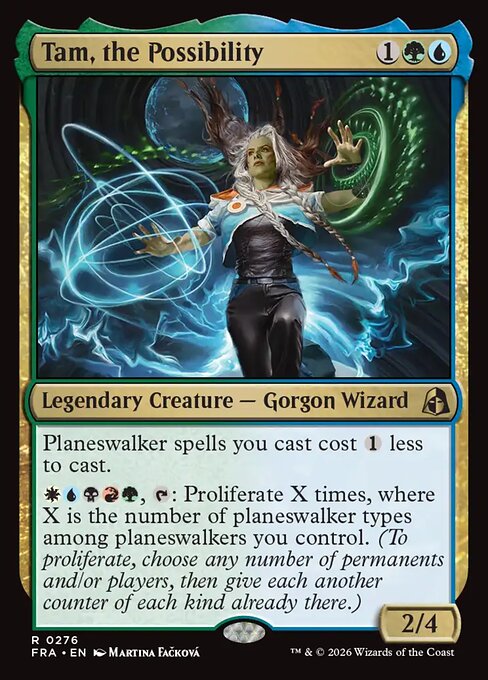
Tam, the Possibility
FRA | WUBRG | Brackets 3 | Signature: Elspeth, Sun's Champion
You get a 2/4 body for three and an activation that costs all five colors plus a tap. That's a steep ask. What you get is a real superfriends engine: planeswalker spells cost {1} less, and the activation proliferates once for each distinct planeswalker type on your side of the table. Elspeth, Sun's Champion drops for five instead of six, and The Theorist, Jace Beleren drops for three instead of four. Two Jaces only count as one type, so variety matters. By turn six you want Tam and two different walkers on board, and one activation bumps both of them twice per use. That's how Elspeth reaches the emblem and The Theorist reaches its ultimate without dying to a stray attack. It won't break the table, but it's a fair, fun planeswalker payoff and a strong bracket 3 pick.
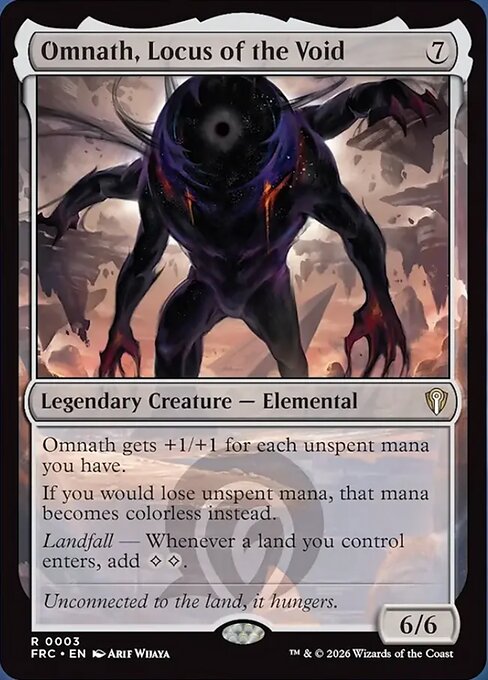
Omnath, Locus of the Void
FRC | C | Brackets 3-5 | Signature: fetch lands
Sol Ring nets you one mana for one. Omnath doubles every land drop: landfall adds CC, and a fetch land becomes four mana before the land itself taps. Unspent mana becomes colorless instead of disappearing, so it carries between phases and pumps Omnath's size, which is the whole mana-engine fantasy. It's a colorless 6/6 that fits any deck, so you choose colors for the ramp and the payoffs. Emrakul, the Exigent Doom is the natural destination: ten mana is a normal turn once Omnath is out, and its cast trigger untaps your lands. The cost is real. Seven mana is a lot, and Omnath has no evasion, so he dies to the first removal spell that shows up. But as an engine at bracket 3 and above, he's filthy.
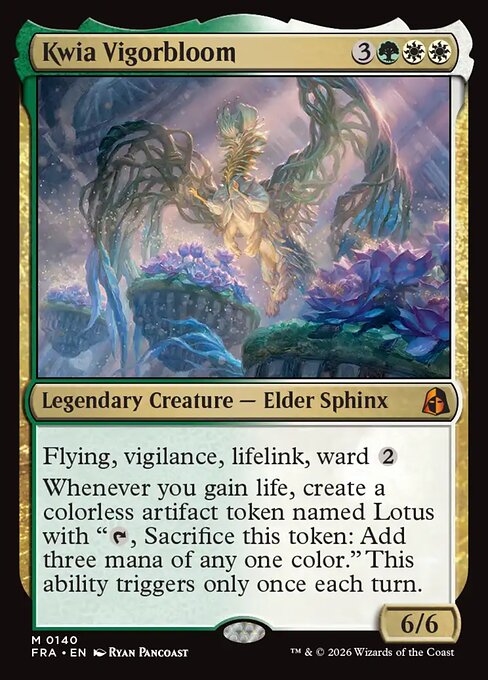
Kwia Vigorbloom
FRA | GW | Brackets 3-4 | Signature: Soul Warden
The groan when a Lotus token hits the board is the loudest sound at the table. Kwia is a 6/6 flier with vigilance, lifelink and ward {2}, and her lifelink alone can trigger the Lotus: one token per turn, sacrificed for three mana of any one color. That's a Black Lotus on a stick, and Black Lotus is banned in Commander for a reason. Soul Warden makes it worse: every creature that enters, from any player on any turn, gains you 1, so you can pull a Lotus on each player's turn. Add a token doubler and each turn's Lotus becomes two, which is six mana. The once-per-turn limit still caps it, so there's no loop here, just a lot of mana.
She sits below Aerid and Jace because a six-drop is slow, and because the first player to make a Lotus becomes the archenemy. She's strong in green and white, and she's a lightning rod. She's great at brackets 3-4, but she isn't the strongest commander in this set.
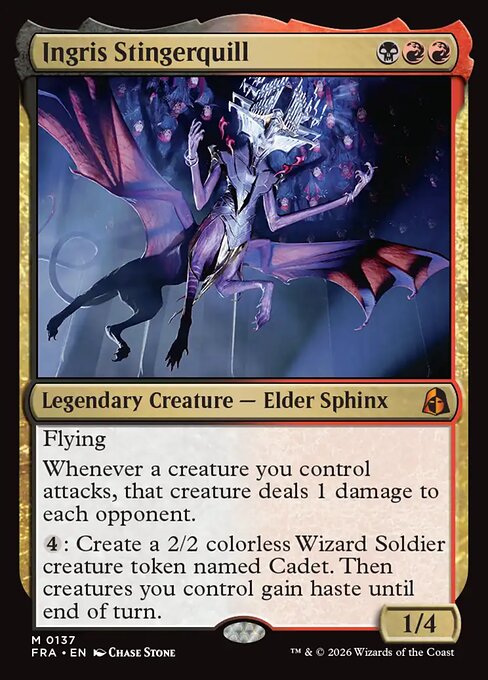
Ingris Stingerquill
FRA | BR | Brackets 3-4 | Signature: Mana Echoes
Turn four. Ingris has been on board since turn three, and Cavalcade of Calamity has been sitting out since turn two. Four mana makes a 2/2 Cadet, the team has haste, and Ingris and the new Cadet swing before anyone has set up blockers. At a three-opponent table that's a lot of pressure from two bodies.
The Rakdos build is a pinger deck that goes wide with cheap bodies. The scarier build is infect, with Skithiryx, the Blight Dragon as the finisher. The high-bracket line is Mana Echoes. Each Cadet is a Wizard Soldier, so a new one adds {C} for each Cadet on the battlefield, and the fourth Cadet pays for the activation by itself. Every Cadet after that is free, and haste means the whole pile swings. It's a $57.41 enchantment, so it isn't the budget way to win, but Ingris is cheap and strong without it. It's a legit Elder Sphinx threat.
Cheap, mean, correct.
Aerid Konstrari
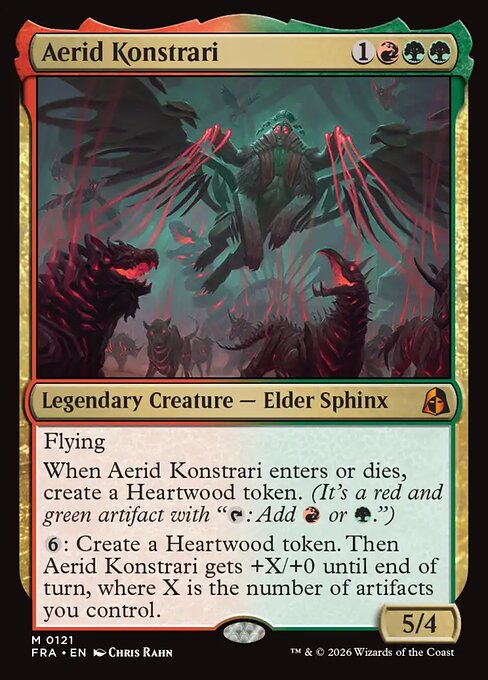
FRA | RG | Brackets 3-4 | Signature: Devastating Onslaught
Aerid tops the Sphinx five and it isn't close. A 5/4 flier for {1}{R}{G}{G} would be fine on its own. But it makes a Heartwood token, a red-green mana rock artifact, when it enters or dies, so the commander tax pays for itself: each recast gives you two Heartwood, which covers exactly one tax increase. The six-mana activation makes another Heartwood and pumps Aerid by your artifact count, so the late game goes vertical.
The real payoff is the clone package, and it plays as a ramp turn more than a combat turn. Turn four is Aerid and a Heartwood. Turn five brings five lands and that Heartwood, which is enough to fire off Devastating Onslaught for X=2. Each token copy makes its own Heartwood on enter, then the legend rule trims the extras, and every Aerid that hits the graveyard makes yet another Heartwood. One Aerid swings as a 5/4 flier while the Heartwoods pile up, and a token you keep gets sacrificed at the end step for one more. Molten Duplication creates the same line for two mana with a single token. Twinflame hits the same legend rule, so the enter triggers and the deaths are the whole payoff.
The weakness: it's an artifact deck wearing a creature, so you need to draw the clones. When they show up, Aerid pops off. At brackets 3-4 it's the best pick on this list for anyone who wants a pile of mana rocks, and the weakest pick for anyone expecting a team swing.
Jace, Multiverse Architect
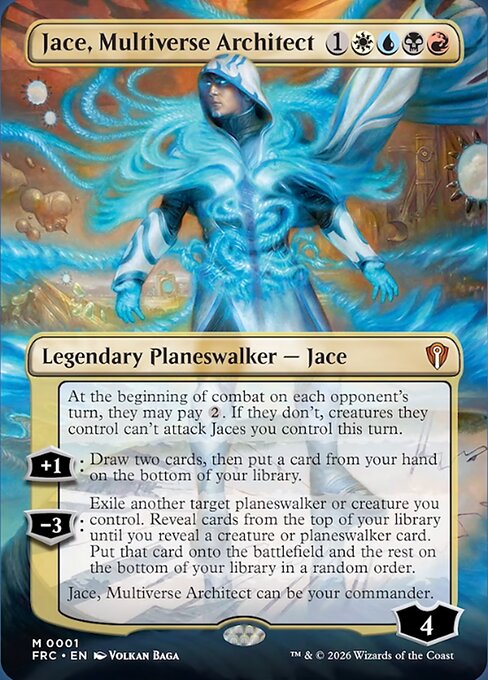
FRC | WUBR (Sans-Green) | Brackets 3-5 | Signature: Spark Double
Jace is the commander of the set. He's a planeswalker you can actually run as your commander, he protects himself, he draws cards, and he cheats in your best threat. At five mana he comes down and his passive does the protecting: at the beginning of combat on each opponent's turn, they may pay {2}, and if they don't, their creatures can't attack your Jaces. It's the cousin of Propaganda with a flat cost instead of a per-creature tax, and it only guards Jaces, but those are the planeswalkers that matter.
The +1 draws two and puts one back on the bottom, a clean loot that lifts loyalty. The -3 is the polymorph: exile another planeswalker or creature of yours, then reveal cards until you hit a creature or planeswalker and put it onto the battlefield. Turn that 1/1 token into Archon of Cruelty and the table doesn't need to guess what happened. Spark Double copies Jace for a second +1 each turn, and it isn't legendary, so both stay. Mass Polymorph is a cousin in the precon.
At the high end, cEDH-flavored lists stack the library or tutor so the -3 lands Hullbreaker Horror or Tidespout Tyrant, and from then on every spell triggers a bounce on an opposing permanent. Mana-rock bounce lines and Underworld Breach finish it. At low brackets you just land a bomb like Archon and watch the table scramble. The failure case is a bad flip: avoid low-impact creatures in the deck, because the -3 reveals until a creature or planeswalker, so you don't pick which. The precon's power creep also means you have to build it to be good, not just slam the stock list. Four colors without green is a cost. But Jace costs under two dollars, works from bracket 3 to 5, and every build is a different deck. Nobody else in this set can claim that.
The Rest of the Field
- Avacyn, Angel of Horror: an eight-mana black recursion body and a strong polymorph target, but black sacrifice commanders do the same job faster, so run it in Jace piles.
- Venser, Fervent Forger: a flash six-drop that copies an opponent's instant or sorcery twice, or copies their best permanent with haste. Sundial of the Infinite skips the end step so the copies dodge that turn's sacrifice.
- Karn, Gilded Guardian: a five-color artifact draw puzzle that gets better with Leyline of the Guildpact and Breya, Etherium Shaper, and Momentary Blink repeats the draw.
- Jhoira, Weatherlight Corsair: steals a historic permanent from an opponent's library on enter and attack, and pairs best with lifegain like Whip of Erebos to pay for the life loss.
- Ginger, Queen of Sweets: a colorless six-drop that makes you the monarch and spits out Gingerbrutes each upkeep, great for any color that wants card flow.
- Tamiyo, Upriser Crowned: Boros monarch defense with flying, double strike and haste, which taps and stuns anything that hits you while you're the monarch.
- Memnarch, the Warden: a ten-mana colorless body, indestructible, that draws a card for each artifact when it attacks. Built for artifact piles that cheat costs.
- Ob Nixilis, the Ascended: a seven-mana white flier that destroys all tapped opposing creatures and makes Angels, so cast it after opponents attack and their creatures are still tapped.
- Fblthp, Impossibly Lost: a self-mill alternate win condition that draws two off combat damage, a cousin of Thassa's Oracle for builders who want to win through combat.
Honorable Mentions: Cheap Legends to Watch
These almost made the cut, and nearly all of them cost a few dollars or less.
- Liliana the Faultless: a one-mana lifegain legend that feeds Kwia or Niv-Mizzet from the 99.
- Geist of Saint Thalia: a blue flier that makes every noncreature spell cheaper, so it's a great budget spellslinger lead.
- Koth, the Geomancer: a three-mana landfall pinger that adds red mana off a Mountain, a decent fit for burn-ish red decks.
- Tinybones, Pocket Nuisance: a discard pinger that makes everyone's discard hurt, and it brings the whole table's attention.
- Pia, Aether Ascetic: a green enchantress tutor, a nice cheap way to find your best enchantment.
- Saheeli, Jewel of Avishkar: a UR Thopter spellslinger that gives them haste, 29 cents of artifact-token fun.
The Verdict: Who Actually Wins the Set
Jace, Multiverse Architect is the top commander in Reality Fracture because he's a commander, a protector and a ramp into the strongest late-game threats, all at once. Kwia Vigorbloom is the one people overreact to. She's strong, but she's a table-politics lightning rod with a once-per-turn limit, and that's why she's #4 and not the top. Among the Sphinx five, Aerid is the clear pick. Uldaros Theorix is the one I'd cut from my own lists, because it costs as much as the spells it helps you cast, and that doesn't pay the rent.
Pick by bracket. At a low-bracket, fun-first table, build Vraska, Soul of Stone or Dack Fayden, Helping Hand. At high brackets, pick Jace, Ingris or Aerid. Jace is the best commander in either product, and I'll defend that at any table.


