

What Counts as Heartwood and Artifact Ramp in This Set
This archetype asks three things of every card in it: whether it makes a Heartwood token, whether it scales off the number of artifacts you control, or whether it turns a surplus of artifacts into something useful. Answer no to all three and the card doesn't belong here, no matter how good the rest of the text reads or how many decks it shows up in. Aerid Konstrari answers yes to two of those questions on a single card, which is exactly why it's the signature piece of the archetype and not just a popular one. Draconic Visitor looks like it belongs too, right up until you read what its replacement effect actually does to how many of those tokens you end up with.
Reality Fracture's ramp cards built around the token are a genuinely new design space, not a reskin of Gruul ramp you've already played. This rundown only pulls from cards that released with the set, and it ranks them on how directly they push the ramp-into-artifact-payoff plan rather than how flashy they look in a vacuum. Some cards share the colors and the token-making verb without sharing the plan. Flag that now, because at least one high-profile inclusion here is going to actively fight your own payoffs if you're not paying attention.
What Does the Heartwood Token Do in Reality Fracture?
Heartwood tokens do two jobs on a single body: they fix and ramp your mana the way any two-color rock would, and they count toward every "artifacts you control" payoff sitting in your deck at the same time. It's the first token of its kind to hit the game, a predefined red and green artifact that reads "{T}: Add {R} or {G}." That's the whole pitch. Aerid Konstrari and Craterclaw Colossus both care directly about how many artifacts are on the table, and a board with four or five of these tokens feeds both of them without you spending another card.
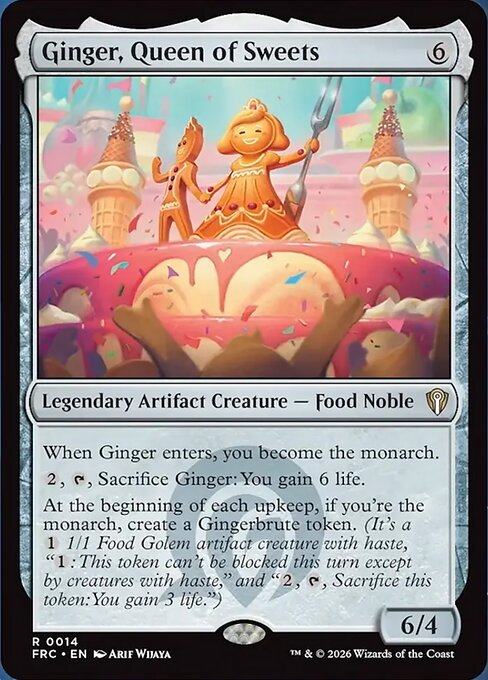
Ginger doesn't make this kind of token, but it isn't dead weight for these payoffs either. Its recurring Gingerbrute tokens are artifact creatures, so they stack right into the same counts: Craterclaw Colossus's entry trigger, Aerid Konstrari's activated ability, Memnarch, the Warden's entry trigger, and Pia, Determined Rebuilder's pump all go up every time one hits the battlefield.
Ginger, Queen of Sweets
Ginger steals the monarch and keeps paying you off: a Gingerbrute every upkeep you hold the crown. That's not nothing. Those tokens are artifact creatures, so they do feed your Craterclaw Colossus math, Aerid Konstrari's activation, Memnarch's entry trigger, and Pia's pump, just not the Heartwood plan specifically, since those tokens come from a different source entirely. Run Ginger for a monarch shell with a steady stream of bodies that happen to pad your artifact count along the way.
Memnarch, the Warden
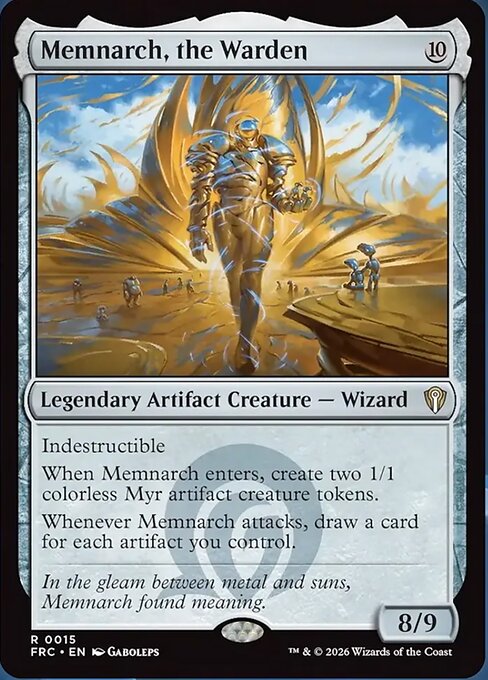
Ten mana puts Memnarch, the Warden in the same tier as Blightsteel Colossus: both are colorless finishers that need double-digit mana before they do anything, and both reward a deck that's already built its board rather than one still assembling it. Memnarch is the more honest payoff of the two for this shell. It draws a card for every artifact you control when it attacks. Lots of cards, if the board is stacked with artifact tokens. Five or six of them sitting around turns a single swing into a hand refill. Indestructible and two Myr tokens on arrival mean it survives the wipe that usually follows a ten-mana bomb resolving, but you still need those artifacts in place before it's worth the slot.
Hungering Puppetbeast
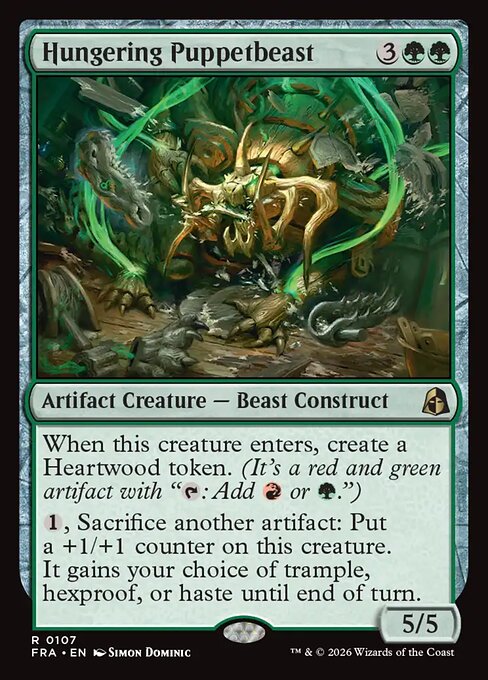
Turn five. You slam a 5/5 for five, it enters, and a Heartwood token rolls out behind it, you've replaced the card on arrival and you haven't spent an extra mana doing it. Now the real decision starts. Hungering Puppetbeast's sacrifice ability eats a spare artifact for a permanent +1/+1 counter, plus your choice of trample, hexproof, or haste until end of turn, meaning every token you're not actively tapping for mana can grow bigger turn over turn and still punch through or dodge a block when it matters. That's the release valve this archetype needs once your board gets cluttered with rocks you don't need anymore.
It's also a tell. Feeding artifacts into this creature turn after turn tells the table you're accelerating toward something specific, and a sharp opponent reads that signal and starts pricing in removal before you're ready for it. The upside is real. Just know you're broadcasting your plan while you execute it.
Woodwork Prodigy
Run this one. Of the cheap, repeatable Heartwood producers in the curve-filler tier, Woodwork Prodigy is the strongest. It isn't a one-shot: it becomes prepared again at the beginning of each of your upkeeps if it isn't already, so you get a fresh token on a loop rather than a single burst and done. That's the whole pitch.
You're paying for that recursion with a turn of patience: you don't get the token the moment it hits the battlefield, you get it the following upkeep once it's prepared and you cast the copy. What you get in exchange is a 3/3 for three mana that's combat-relevant on its own terms, not just a ramp spell wearing a creature costume. Over a long game that repeating supply outproduces anything that only fires once, and the body means it isn't a dead draw if the game never gets that long.

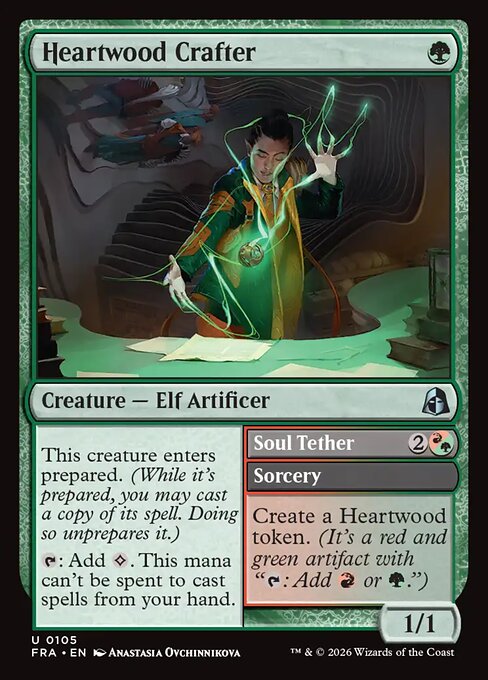
Heartwood Crafter
Don't mistake this for a mana dork. Heartwood Crafter's front side taps for {C} that explicitly can't pay for spells from your hand. That's a real restriction. It makes the creature worse than it looks at a glance, and you can't just slam it turn one and start casting your curve off it.
What it actually does well is get you into the token engine for a single mana, a turn earlier than nearly everything else on this list. It enters prepared, so the Soul Tether copy sitting in exile is ready to cast the moment you have a spare mana for it, and that copy makes your Heartwood token. Evaluate it as the cheapest on-ramp into the archetype, not as a mana creature competing with actual dorks, and the one-mana price tag looks a lot better.
Tenured Tethermage
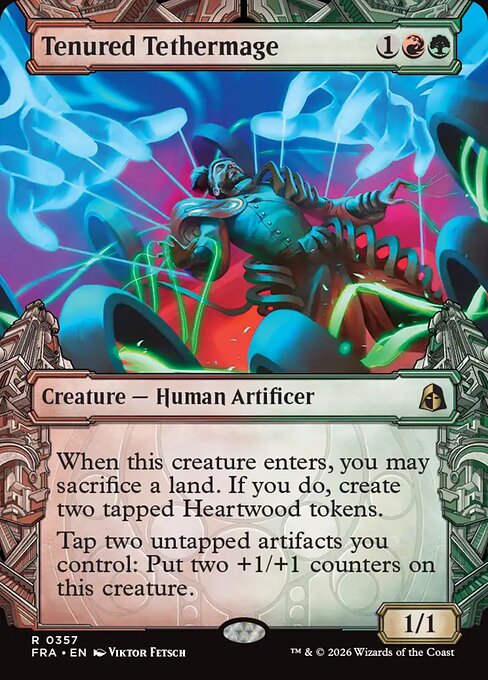
You've seen this moment at the table. Turn three, Tenured Tethermage resolves, and you're staring at the choice to sacrifice a land for two tapped Heartwood tokens. Everyone at the table watches you make that call, because it's visible, you're trading a land for two artifacts that can be answered in ways a land can't. It reads as a commitment to the ramp plan whether you meant it to or not, and a table that's paying attention starts planning around the fact that you're going wide on mana rocks instead of lands.
The math behind the bet is good. Two Heartwood tokens produce more total mana over the rest of the game than the single land they replaced, and unlike a land they also feed every artifact-count payoff you're running. Once the early game passes, tapping two untapped artifacts banks two permanent +1/+1 counters on the Tethermage, turning spare rocks into a bigger body instead of letting them sit idle. The downside is the one everyone at the table already clocked: you're down a land for good, and if you get blown out before those tokens pay themselves back, that tempo hit was for nothing.
Craterclaw Colossus
Compare this to Aerid Konstrari's {6} ability and the difference in role becomes obvious. That ability pumps Aerid Konstrari alone; Craterclaw Colossus hands trample and an identical +X/+0 boost to your entire team the moment it enters, where X is however many artifacts you control. Haste on a 5/5 for seven mana is already a fine rate on a card that can swing the turn it lands, the trample-and-pump trigger is the part that turns a good body into a finisher.
The math that matters: a deck that's been churning out Heartwood-token engines since turn three or four is realistically sitting on four to six artifacts by the time it has seven mana up for Craterclaw Colossus. That's not a marginal buff, it's your whole attacking line gaining trample and a four-to-six point power boost in the same turn you deploy a hasty 5/5. The sequencing question answers itself: this isn't a card you play to kickstart your acceleration, it's the card you play once that early mana investment has already paid off and you need to convert a stocked board into lethal damage. Play it early with two artifacts out and it's just a vanilla haste creature. Play it on turn seven after banking Heartwood tokens all game and it ends games.

Draconic Visitor
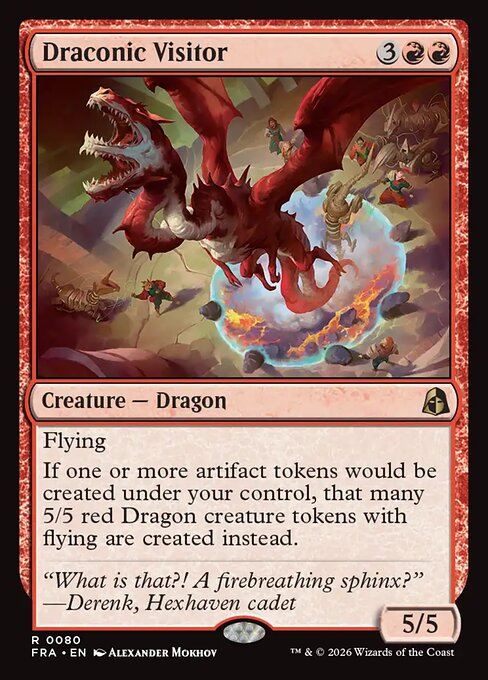
Here's the trap. Draconic Visitor reads like a payoff for this exact shell, it's red, it's an artifact-adjacent dragon, it shows up in a huge number of decks running this archetype. Read the actual replacement effect and the picture flips: every artifact token that would be created under your control becomes a 5/5 flying Dragon token instead. That includes every single Heartwood token you'd otherwise be making. Cast this and your Aerid Konstrari stops making those tokens and starts making Dragons. Your Tenured Tethermage sacrifice turns into two Dragons instead of two rocks.
In isolation, that's an incredible rate, a one-time army of evasive 5/5s is a real board presence. The problem is what it does to the rest of your artifact-scaling payoffs while it's out. Craterclaw Colossus wants a stack of artifacts on the table to scale its pump; Draconic Visitor is actively converting those artifacts into creatures instead, which drains the exact resource Craterclaw Colossus needs to be big. You can't build toward "go wide with Dragons" and "go tall with artifacts" at the same time with this creature in play, it forces the choice for you the moment it resolves.
The adoption numbers on this card reflect how strong a 5/5 flier that doubles as a token factory is on raw power level, not whether it's correct in a deck built around stacking artifacts for Craterclaw Colossus and Memnarch. Decide which deck you're building before you sleeve it. If the plan is Dragons, it's great. If the plan is stacking artifacts, it's the card actively working against you.
Aerid Konstrari
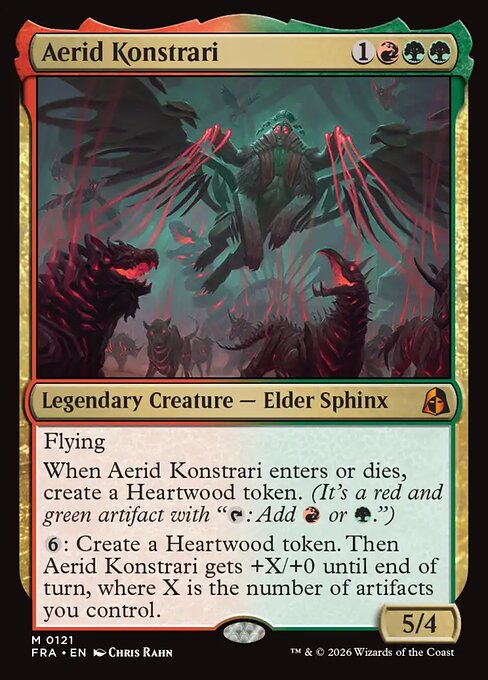
You knew this was going to be the pick. Here's the case, because "it's the archetype's namesake card" isn't an argument on its own. Aerid Konstrari is the only card in this format that ramps, replaces itself when it dies, and scales its payoff off the exact board state it's been building, three jobs on one card, and all three point the same direction.
Start with the floor: a 5/4 flier for four mana is already a fine rate before any of the rest of the text matters. Then look at the triggers. Aerid Konstrari makes a Heartwood token when it enters and makes another one when it dies, which means removal doesn't actually stop your ramp, it just delays the second token by a turn. Compare that to Hungering Puppetbeast or Tenured Tethermage, both of which get one shot at their artifact trigger and that's it. Aerid Konstrari gets two bites, and one of them is specifically insurance against the removal spell that's coming for a 5/4 flier.
The activation is where it earns the top slot instead of just a good slot. Six mana creates another one of those tokens and then pumps Aerid Konstrari by however many artifacts you control, which means the ability gets better every single time you use it, it's quite literally a Craterclaw Colossus-style scaling attack stapled onto a creature that's also been generating the fuel for that attack all game.
Now the honest counterpoint: six mana for "a rock and a one-turn pump" is a real tax, and if your board is light on artifacts the activation just isn't efficient. That's fair. Aerid Konstrari alone doesn't close games the way a stocked board with Second Harvest or a real artifact-count finisher does. But you're not evaluating the activated ability in a vacuum. You're evaluating a four-mana 5/4 flier that triggers twice over its lifespan even if you never activate it again, and that floor is worth the slot by itself.
The Rest of the Field
Not every artifact or Gruul-adjacent card in the set earns a ranked slot. Here's the rest, with the one-line verdict each one actually deserves.
- Konstrari Improviser. Cheaper than Woodwork Prodigy on the front side but pricier than Heartwood Crafter, so it sits stuck between two better versions of the same prepared-spell shell with no reason to pick it over either.
- Craftwork Crusher. Lets you pick two of damage, a token, or a card draw when it enters, which is real value on a single body, but none of those modes care how many artifacts you already control.
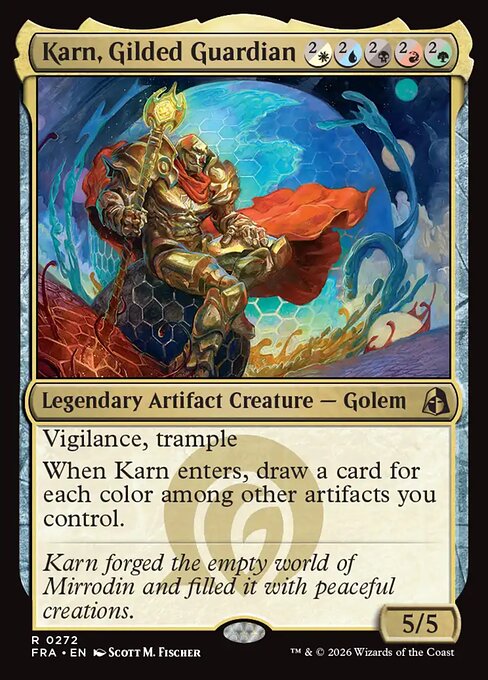
- Karn, Gilded Guardian. A five-color hybrid creature that draws a card for each color among your other artifacts on arrival. That's a one-shot payoff, not a reason to build the deck around it.
- Puppet Crafting. Turns any artifact into a 5/5 Construct, a fine way to make one of these tokens into an actual threat, but it belongs in an enchantment shell more than this kind of mana-rock deck.
- The Echoverse Fulcrum. Draws you a card and makes you discard one on arrival, plus a one-time board wipe stapled to a cheap artifact. Nothing about it accelerates anything.
- Archive Arbiter. A generic artifact flier with a removal-or-lifegain choice. It's one more body on the board, but it doesn't move the needle on how many artifacts you control.
- Pia, Determined Rebuilder. Makes a Thopter on arrival and its pump does scale with artifacts, which pairs nicely with Ginger's recurring Gingerbrutes padding the count, but on its own the rate is slow enough that you're not building around it.
- Marwyn, the Clearcutter. A sacrifice-to-draw outlet that's fine utility but doesn't advance the ramp plan on its own.
- Traxos, Scourge Eternal. A big trampling body that needs a critical mass of artifact and creature spells to keep untapping, which this shell isn't built to supply consistently.
- Wrecking Gecko. Ward and a late-game pump on a green artifact body. Serviceable, with no real payoff interaction to speak of.
- Karn, Argent Defender. Looks like a cheap colorless fit for an artifact deck and is actually hostile to this one specifically. More on that below.
The Real Payoffs: What Actually Wants a Pile of Heartwood Tokens
Second Harvest is the cleanest way to turn ramping into lethal. It creates a copy of every token you control, so a board with three Heartwood tokens becomes six and a board with four becomes eight, instantly, at instant speed. That's the difference between "I ramped" and "I ramped so hard the table has to answer it right now."
Agatha of the Vile Cauldron reduces the activation cost of your creatures' activated abilities by its power, which takes pressure off Aerid Konstrari's six-mana reactivation once Agatha's power climbs. Jiang Yanggu, Never Alone untaps all your tokens at the beginning of your end step, so those tokens aren't just available on your turn, they're back up for instant-speed mana before anyone else gets a turn. Sarinth Greatwurm stacks a second ramp stream on top of the plan, turning every land that enters the battlefield into a tapped Powerstone token alongside whatever else you're generating.
Roxanne, Starfall Savant deserves special mention: her second ability triggers whenever you tap any artifact token for mana, including the ones this archetype is built around, adding a mana of a type that token can already produce. That's a real mana doubler riding on top of a board you were already building. When you're ready to turn the pile into damage, Depthshaker Titan can turn your noncreature artifacts into 3/3 attackers with melee, trample, and haste for a turn, while Devastating Onslaught can copy a Heartwood token, or any other artifact or creature you control, for a burst of mana on the spot. These are what separate ramp from blowout.
Why Karn, Argent Defender Doesn't Belong in This Shell
This is the card people slot in on reputation and color identity alone, and it's worth walking through why that's backwards. Karn, Argent Defender's static ability stops artifacts and creatures from triggering abilities when they enter the battlefield. That sounds like generic disruption until you notice it's sitting on your own side of the table, silencing your own engine.
Run the list: Aerid Konstrari's Heartwood trigger on entering goes quiet. Tenured Tethermage's token-making trigger off sacrificing a land never fires. Hungering Puppetbeast's entry token never shows up. Three of your best token generators lose the half of their text that actually makes them worth running, and Karn, Argent Defender did that to you, not an opponent. It fits the color identity and the type line perfectly. It fights the strategy it looks built for just as perfectly. Read the whole card against your own engine before you sleeve anything, not just the mana cost and the creature type.
The Verdict on Reality Fracture's Artifact Ramp Package
Aerid Konstrari is the correct centerpiece and it isn't close. Nothing else on this list ramps, replaces itself on death, and scales its own finisher math off the board it's quietly building the way Aerid Konstrari does, and that's before you even get to the fact that it's a fine four-mana flier if you never activate anything else on it.
Draconic Visitor is the card I'd push back on hardest. It's genuinely powerful, it's in a huge number of decks running this archetype, and it's also the card most likely to get auto-included on reputation without anyone checking what it does to the rest of the shell. It doesn't support artifact-count payoffs, it converts the exact resource those payoffs need into something else. That's a different deck's finisher wearing this archetype's colors.
The ceiling here isn't "stack more Heartwood triggers and hope." It's token doublers and artifact-count scalers turning a quiet mana plan into a board the table can't answer. Build toward Second Harvest and Craterclaw Colossus, not just toward more rocks.

