

Star Trek: The Next Generation of Commander cards looks like a pile of new vocabulary. It is really two kinds of design plus one rules term. Federation, strange new worlds, battlefront and seek out are ability words, and ability words are italic labels with no rules weight. They count something and nothing more. Beam me up, station and assimilate are the real mechanics. They carry costs and timing windows, and they are where your table will argue. Face a dilemma is neither an ability word nor a mechanic. It is a new rules term for choosing modes on a modal spell or ability, and cards like Captain Benjamin Sisko count it.
Players who treat all eight alike misbuild or misplay. They bring a rules question to an ability word, or they skim the one keyword that needed a full read. Know which is which before you sleeve anything. The set releases Nov 13, 2026, with prerelease events starting Nov 6, so this is planning time. Nobody has to rush a list.
Quick Answer
Learn beam me up, station and assimilate. Those three change what you can do on the stack and on the battlefield. Face a dilemma is just a rules term for choosing modes, so the modal spells you already own count. A singleton mana base suits strange new worlds, and a table with several opponents suits battlefront. Battlefront and seek out are Commander-only, and battlefront is the one that rewards a full table. Pick one counting mechanic per deck and build to maximize it.
Beam Me Up: The Cost Nobody Can Respond To
"I'll respond by killing the creature you're returning." No, you won't. Returning a creature you control to its owner's hand is part of the cost of casting the spell from your graveyard, so the creature is in hand before anyone gets priority. Save the removal for something else.
The other failure mode is forgetting the exile clause. A spell cast with beam me up is always exiled afterward. That holds whether it resolves, gets countered, or fizzles on illegal targets, so you get one extra use and no more. Mana value still comes from the printed mana cost, so a cheap card stays cheap for anything that checks. Card types still set the timing. An instant beams up whenever you have priority, but a sorcery waits for your main phase with an empty stack.
The value is reusing enters triggers and shedding Auras. Beam a creature home to dodge a removal spell, then cast the spell again later and replay the creature with its trigger. That is a real engine in blink shells, and it costs less than most dedicated recursion.
Station: Big Creatures Make Small Ships
Start from first principles. Station is sorcery speed. You tap another untapped creature you control, summoning-sick or not, and the Spacecraft gets charge counters equal to that creature's power. Everything else follows from that one number. A 1/1 takes forever to charge a ship. A 4-power body gets you more than halfway to the 7 counters that turn U.S.S. Enterprise-D, Galaxy-Class wants. Your best attacker is now also your best battery, and stationing taps your attackers, which is the cost of running a Spacecraft deck.
Once a threshold is hit, the Spacecraft gains that section's abilities. If the section has no power and toughness, it just has the abilities and is not a creature. Enterprise-D is just an artifact until it reaches 7 counters, and only then does it become a 4/5 flying vigilance artifact creature. You can keep stationing after that, and you should. Its trigger exiles the top card of your library the first time counters land each turn, and you may play it that turn. Any creature with power 1 or more that you are willing to tap gets you an extra card to play.
The downside is real, though. Station is slow, it taps your team at sorcery speed, and the ship dies to artifact removal after you have invested the turns. Spacecraft commanders have underwhelmed, and a legendary Spacecraft only leads a deck if it has a power and toughness box. It also needs to actually become a creature. Without anthem or counter support, the archetype stays mediocre. Captain Kirk, Boldly Going gives Spacecraft creatures +3/+3, which turns that 4/5 into a 7/8 flier.

Face a Dilemma: Your Old Charms Just Got Better
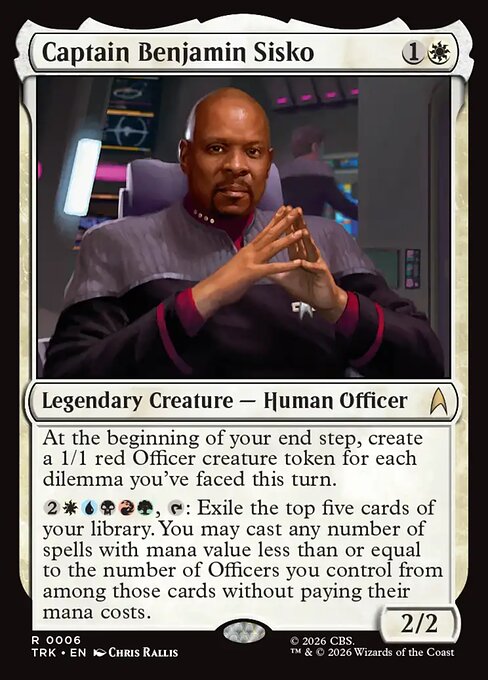
Take Captain Benjamin Sisko as the case study. He is a two-mana 2/2 in five colors. At the beginning of your end step he makes a 1/1 Officer for each dilemma you faced that turn, and his activated ability casts free spells with mana value at or below your Officer count. You face a dilemma when you choose modes from a bulleted list. Return to Nature counts. Naturalize does not, even though it says "or," because there is no bulleted choice.
Four details matter. Choosing multiple modes counts as one dilemma, so a double-mode Cryptic Command is one Officer, not two. The spell does not have to resolve. A countered modal spell still counts, and so does one that fizzles. And if you cannot legally choose any mode, you did not face a dilemma. Sisko's trigger is also yours alone, so only dilemmas on your own turn make tokens.
That gives you two builds. One is a modal pile that makes a steady trickle of Officers. The other is Officers go-wide soup, where the tokens feed Sisko's free-cast engine. The budget angle is real. Charms, Commands and Confluences you already own count retroactively, so you are not buying into a mechanic. You are re-sleeving cards you like.
Federation Versus Borg: The Set's Built-In Argument
Conventional Commander wisdom says to go tribal and play ten of one type. Federation says the opposite. It counts creature types among non-Borg creatures you control, so you want variety, not depth. A non-Borg changeling is excellent here, because it has every creature type and maxes the count by itself. Build for a broad, weird team, not an Elf pile.
Borg are the other direction. Assimilate takes a creature on the battlefield by giving you control of it, or puts a card from a non-battlefield zone, like a graveyard, onto the battlefield under your control. Either way it gets a +1/+1 counter and becomes a Borg artifact creature with no other creature types. Borg creatures contribute zero types to federation. Assimilating something adds nothing to your count and does not lower it, unless you assimilate one of your own creatures. That is why assimilate bridges theft and reanimator so well. It is a clean way to turn an opponent's graveyard into your board.
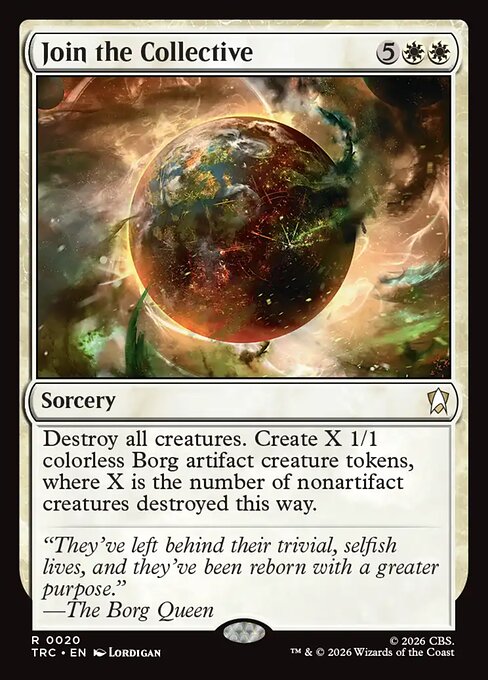
Join the Collective is the payoff for the Borg side. It costs seven and destroys all creatures. You get a 1/1 Borg token for each nonartifact creature destroyed this way. In a four-player pod with a crowded board, that is a wrath that replaces most of what it kills. It does not replace artifact creatures, and the tokens add nothing to federation. In a federation deck it hurts, and in a Borg or token deck it is the card to have.
Battlefront, Seek Out and Strange New Worlds: The Counting Words
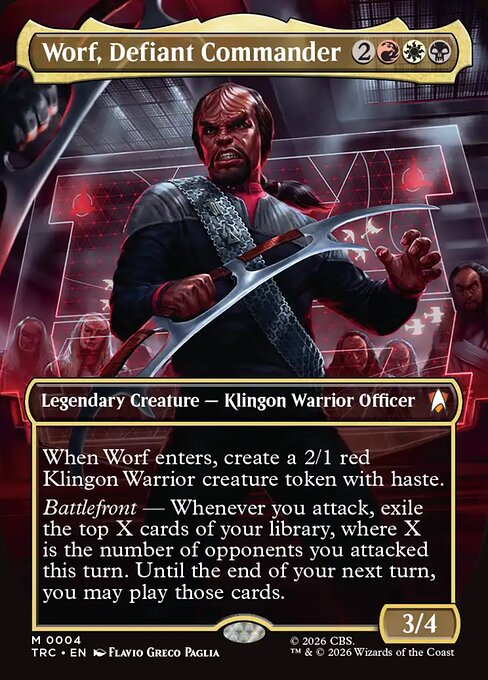
Picture a four-player pod where you point three attackers at three different opponents. Worf, Defiant Commander exiles three cards, and you may play them until the end of your next turn. That is battlefront: it counts distinct opponents you declared attackers against. Myriad copies do not count, because creatures entering attacking never attacked anyone. Extra combats remember, and an opponent hit twice counts once. Count distinct things, not total things, so spread your attacks.
Hitting one of three opponents is a much smaller edge than hitting all three. Worf rewards the wide plan: a hasty token, a few cheap bodies, and a swing at everyone.
Seek out is Commander-only, like battlefront. It triggers when you draw your second card each turn, including on an opponent's turn, so a lone draw on someone else's turn does nothing.
Strange new worlds counts differently named lands. A singleton mana base shines here, and basic-heavy builds cap out quickly. Three Forests and an Island is only two names. If you are not already running a pile of nonbasics, this word is not for you.
What I'd Do With It
Spend your learning effort on beam me up, station and assimilate. Those are the three that start table arguments. Face a dilemma is only a rules term, so there is nothing to learn beyond "you chose a mode." Spend your deck slots on whichever counting word your deck can actually feed. Battlefront and seek out are Commander-only, and battlefront is the one that rewards a full table.
The card I'd cut from the most lists is Join the Collective. Seven mana is a lot, it stays home in anything built around federation or artifact creatures, and it only really shines in token and Borg decks. The card people overreact to is Enterprise-D. A colorless three-mana ship that gives you an impulse draw the first time you station onto it each turn is fine, and it is not the Spacecraft problem. The problem is the archetype around it. Here is the stance you might disagree with: Spacecraft are the weakest new archetype in the set. They stay mediocre without anthem or counter support. The ships lag behind a counting word your deck can actually feed. Pick one counting mechanic and build the whole deck around it. One mechanic, built properly, beats five half-built ones.


